Tuesday, November 18, 2014

Top Ten Reasons Why I Hate Death Note (And You Should, Too)

I have... problems with anime.

I can safely say that I've never seen an anime series that I can 100% recommend to anyone and everyone. Granted, I haven't seen Cowboy Bebop yet, but that's for another time. It's not for lack of good animation; goodness gracious, even the very worst anime puts most American cartoons to shame as far as animation is concerned. But, if the shows I've seen are representative of most anime, Japan seems to ascribe a certain ethos to anime that ends up complicating matters, to say the least. With most American animation, intention rarely goes beyond cheap humor or action. Anime is insistent upon delivering some kind of message, a characteristic that I wholeheartedly endorse. Yet not every message works...

Especially when said "message" is morally repugnant, insulting to human dignity, and hateful. Such is the message of Tetsugumi Obha's Death Note.

If my readers have not at least heard of Death Note, then I'll provide a brief history. Death Note is a manga series, written by Tetsugumi Obha, serialized in the shonen anime magazine, Weekly Shonen Jump. (For the record, shonen just means that said material is targeted for male viewers.) The series got popular enough that Madhouse Inc, one of the powerhouses of the shonen anime scene, decided to turn it into an anime. The series ran in America from 2007-2008, rapidly developing a cult following and becoming one of the most famous anime series in the Western world. The show revolves around a "Death Note," a book that has the ability to kill anyone and everyone whose name is written within its pages. A child prodigy named Light Yagami finds this Death Note and uses it to kill off the world's criminals. A battle of wits ensues between Light and L, an investigator who is trying to put an end to Light's murders.

I watched Death Note all the way through for three reasons. One: it has very good dialogue. I will grant it that. Two: it has a strong sense of suspense. Three: it is of sufficient esteem that it has become a central part of Japanese animation culture. Not watching Death Note, at the time of my viewing, felt like not watching The X-Files; it's not a series one can skip over if one wants to be well-versed in popular media. Now, I realize that Death Note is a terrible series that no one should watch; it has many, MANY deplorable elements preventing any critical viewer from possibly enjoying it. Critical acclaim or no, Death Note is a poorly conceived and created excuse for entertainment, an experience I wholeheartedly regret, an experience I hope to dissuade any other potential viewers from undergoing. I will be spoiling the ENTIRE anime in this top ten, so to further dissuade people from watching. If you decide to stop reading now and go watch the show, I cannot stop you. All I can say is that you are wasting precious hours you could be spending on something more valuable.

These are the top ten reasons I hate Death Note.

Number Ten
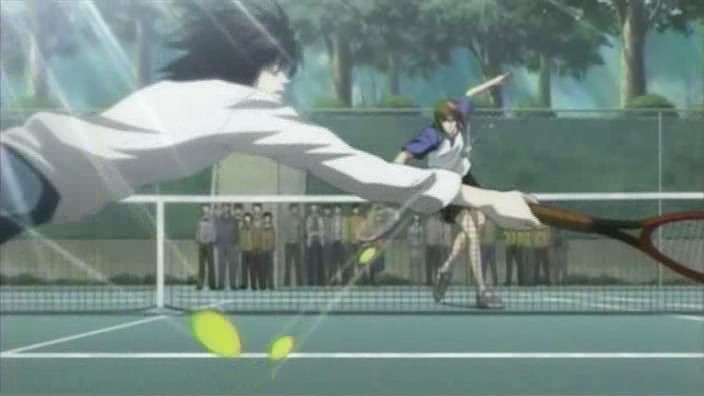
The BORING Animation

The above image is Death Note's animation at its very best. Keep in mind that Death Note has little, if anything, to do with tennis.

As far as pure artistry is concerned, Death Note has adequate background art and decent character designs. L, the only character in the show with any degree of good characterization, has a very interesting design, using massive eye size (relative to everyone else) in order to offer the illusion of inhumanity and social distance. The rest of the character models, though, leave a lot to be desired. Light Yagami is just a standard "good-looking" anime male, with none of his animation elements expanding upon the subtleties of his character. Of course, that would suggest that he has subtleties to his character, but, again, I digress.
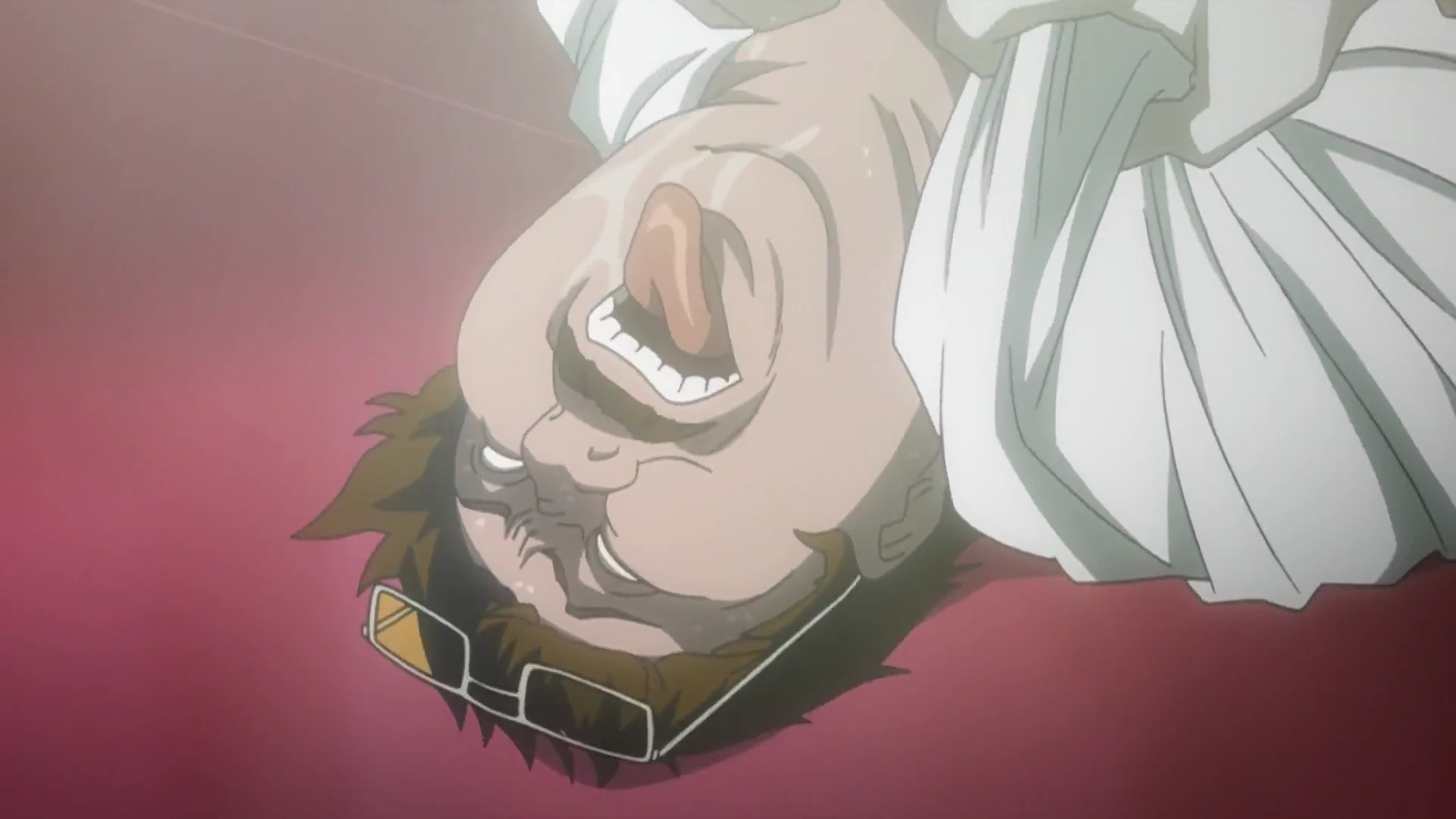
The last time I checked,
people don't stick their tongues out
when they're having a heart attack.
The biggest problem with Death Note's animation is its lack of dynamism. There are only two times throughout the series where animation actually takes a real focus. First is the tennis match between Light Yagami and L, seen above. And then there are the death scenes, in which the animators kill various people with ludicrously pronounced heart attacks. It's a shame that all the good animation was wasted on such morbid material instead of creating interesting character dynamics. The rest of the time, it's just a bunch of talking heads doing talking head things. And, of course, Death Note falls victim to the classic anime trick of showing a still frame and then moving the camera up the frame in order to offer the illusion of animation when none is actually occurring. It's the cheapest move any animation company can do. Granted, Death Note is not as bad as some other anime when it comes to this, but it's still a disappointment.

To be fair, Death Note has some nice backgrounds and uses lighting competently. It's a shame that most of these elements are ruined by...

Number Nine
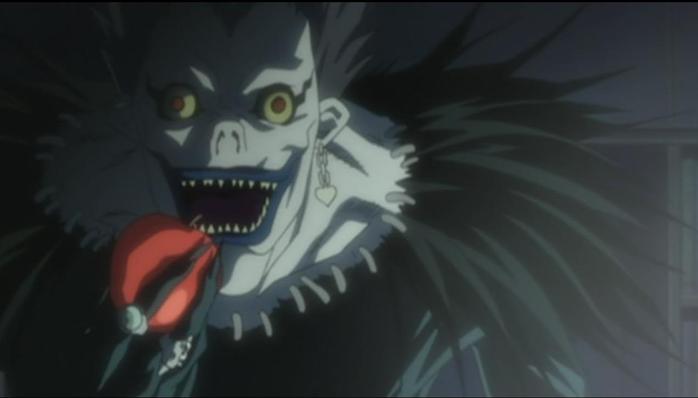
The OBVIOUS and/or MEANINGLESS Symbolism

OK, look at the above image. That monster that looks like the lovechild of The Joker and Kefka from Final Fantasy VI is a Shinigami, the Grim Reapers of the Death Note universe. This one is eating an apple, a clear allusion to the importance of apples in both Greco-Roman and Judeo-Christian religions. In both cases, it's a suggestion of sin and evil, be it the fruit from Eden's Tree of Life and/or Tree of Knowledge of Good and Evil (there's still a debate as to whether or not there's two trees, but that's a subject for another blog) or the infamous Apple of Discord that kicked off the Trojan War. This is the most subtle symbol used in the entire show... and it has no bearing on the greater themes. Since the Shinigami is the one that eats the apple, there's no reflection on either Light or L. The apples have nothing to do with the humans, who, at the end of the day, are the only characters we are supposed to care about. Apples are never used to convey a greater point about a character's moral stature (in the animators' eyes at least). Thus, their symbolic value ends up tarnished.

The other symbols in the show, however, are much worse.
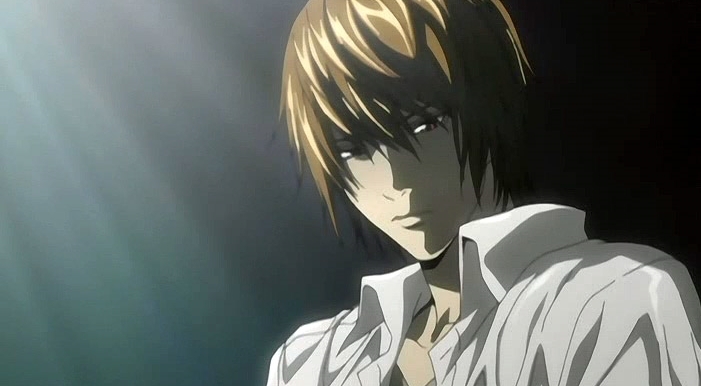
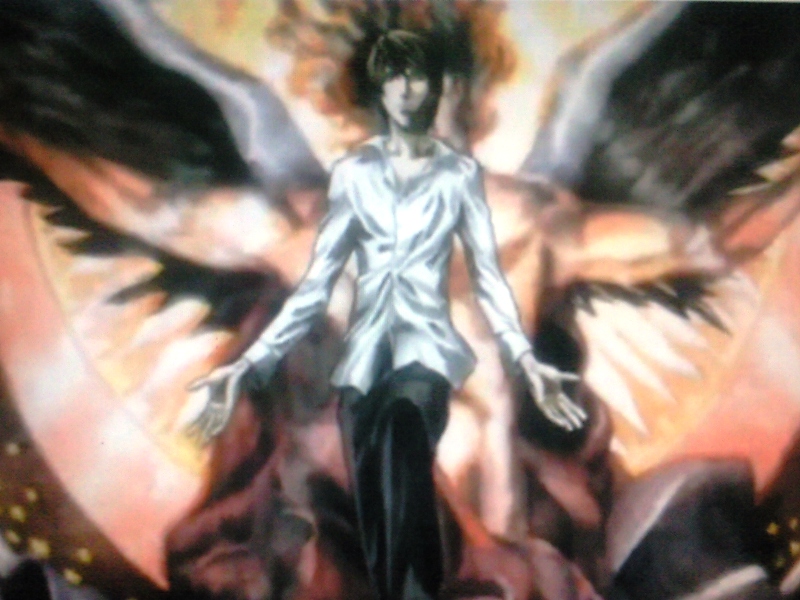
As one can clearly see, a heavenly light is shining upon Light. This means that he is being looked down upon from the heavens, equating him with a divine being. The only way one could get more overt with the symbolism would be to take Light and put him in front of a stained glass window.
I may have spoken too soon...

Last but not least, here's my "favorite" example of bad symbolism in the show.
See? Light has red hair, but L has blue hair. This means that they are opposites and have differing opinions on big issues like "justice." The two are bound to be enemies. The only way one couldn't understand this symbol is if one was comatose.

If a symbol is obvious or meaningless, it isn't worth inclusion. In fact, not including a symbol often forces the viewer to question whether there are symbols or not. Sometimes those symbols we discover that weren't even meant to be symbols are more meaningful than the most excruciatingly planned symbols in the creative process. Symbols should be used as subtle devices, not overt ones. In short, if Death Note wanted to be pure entertainment, it created half-assed symbols that only served to waste the viewer's time. If Death Note wanted to be "high art," then it failed to, formalistically, compare to the greater works that have come before it. Taking the first two issues into account, one can see why I dislike this show as a visual medium.

As for its status as an auditory medium...

Number Eight
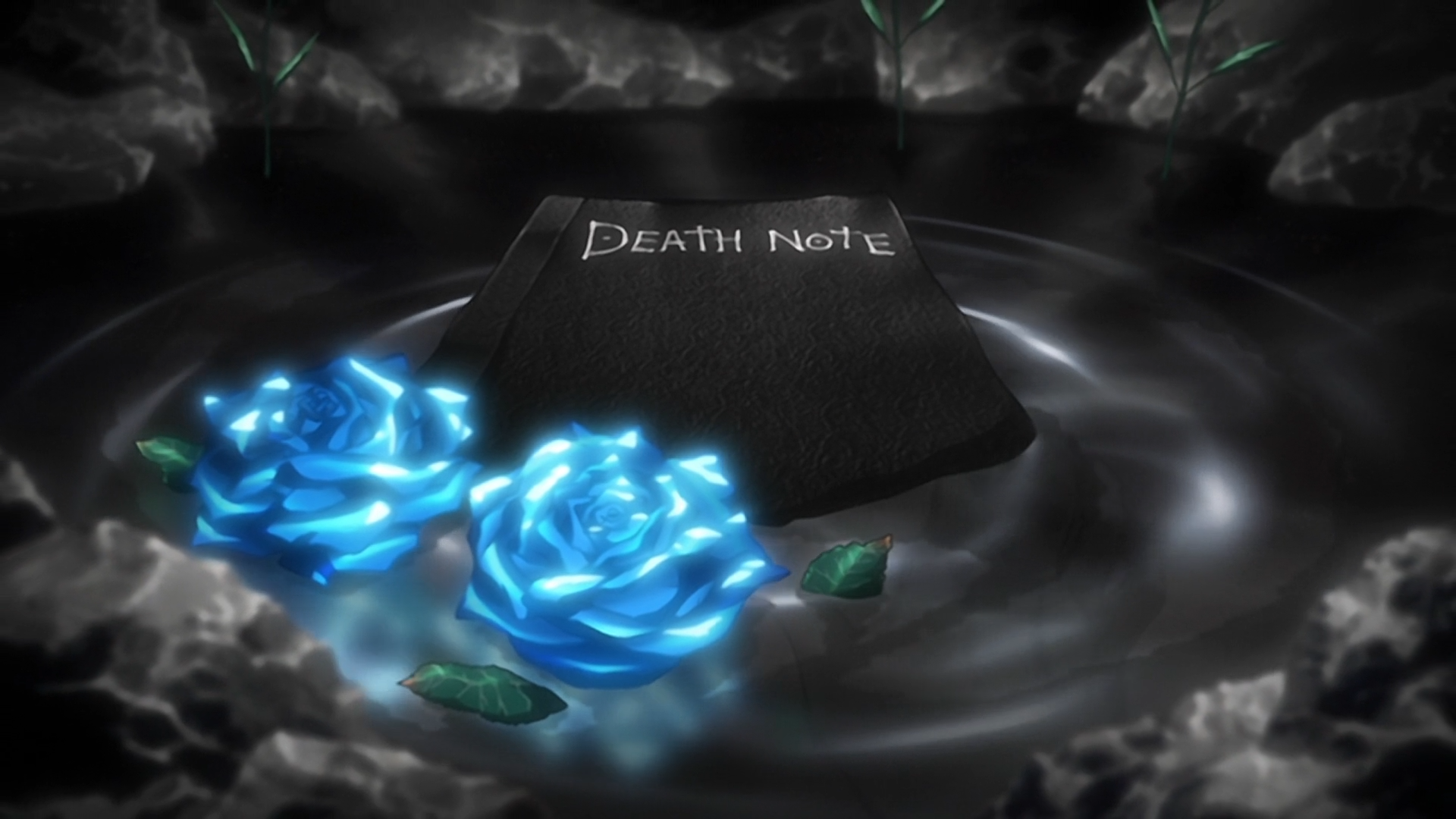
The GODAWFUL Music

First, let's address the background music for most of Death Note, the "murder" theme. You can find said music here. While this might sound impressive to many people, it really doesn't hold up to scrutiny. For one, the lyrics are just the "Dies Irae," once again offering the suggestion that Light is God. As noted before, this theme is obvious and meaningless. The choir is as standard as they come, but it suffers from having terrible enunciation. The entire piece is bloated and overblown, not using rhythm or harmony to accent any particular lyrical or thematic ideas. A final, though somewhat skeptical claim: this music's harmonic rhythm is frighteningly similar to the opening of Carl Orff's Carmina Burana, the go-to piece for making any subject matter sound more "epic." I wouldn't call the "murder" theme plagiarized, but I would call it unoriginal.

I cannot say the same for "L's Theme," which is so clearly based around Mike Oldfield's "Tubular Bells" that the song definitely feels plagiarized. The proof can be found in this cheaply made YouTube video, though I'd personally suggest playing the two songs side by side, using the original Mike Oldfield recording as opposed to The Exorcist remix that this YouTuber uses. "Light's Theme," on the other hand, is the best theme in the show, using the right mixture of King Crimson-inspired flange and piano to create a truly ominous ambience. This is the one song from Death Note that I would actually recommend people to seek out.

But the real reason this category exists is the opening theme music. Like most anime series, Death Note has a new opening theme for each season of the show. To give the first theme a bit of credit, the translation of the lyrics actually does relate to the show. Unfortunately, this is undermined by the needlessly bright and happy vocals. The song is too hyper to really evoke the main ambience of Death Note, a show that tries to be a grim neo-noir, aesthetically. The writers should have taken their cues from The X-Files or Law and Order before using this as the opening theme.

And then there's the second theme song.
I'd like to formulate a cogent criticism of this song, but just hearing it makes me want to stab myself in the face with a soddering iron. All I will say is that this is not an appropriate theme, musically or lyrically, to go with Death Note. It's loud, noisy, and unmusical; it's everything that's been wrong with heavy metal for the past fifteen years.

Granted, there's ending theme music as well. I didn't really listen to it, because I skipped to the next episode after one ended. I won't say these ending themes were bad, but I will say that terrible opening theme music incentivizes a viewer to not sit through the end credits. If you are so inclined, you can track these themes down, but I am not going to waste your or my time any further.

Number Seven
The Failure to Capitalize on the GOOD Elements of the Show

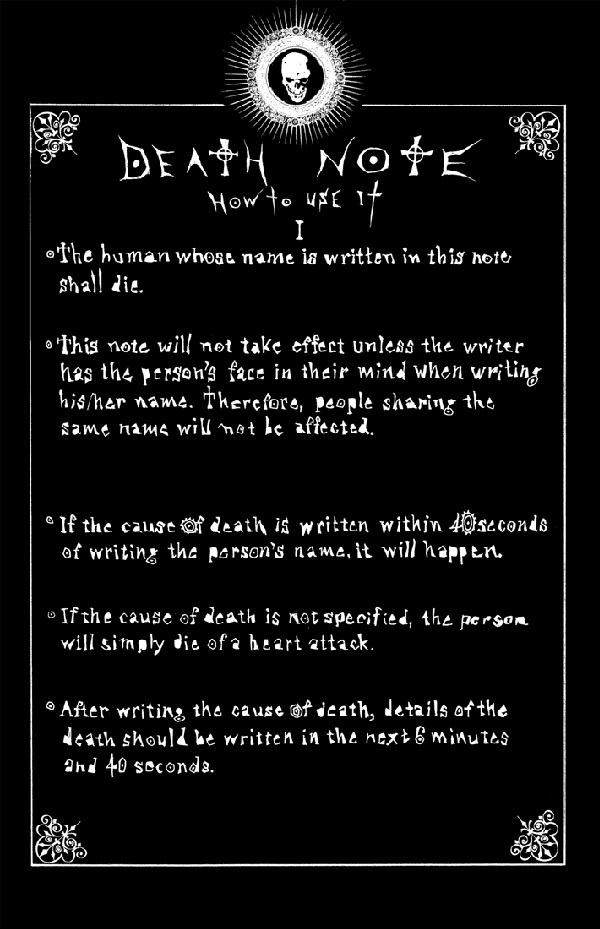
So, the above image details exactly how Death Note's main plot device works. The Death Note ensures the death of the victim so long as the user has the face and the name of a potential victim in mind. It has to be the victim's real name, so having an alias is the primary defense against death. To its credit, Death Note uses this rule to its fullest. They even expand upon this with the "Shinigami Eyes," which enable the user to learn someone else's name automatically but at the cost of half of one's remaining lifespan. This produces a lot of genuinely creative situations, allowing the show to use its ever flexible writing to its fullest.

But, if one looks at some of the other rules of the "Death Note," one realizes that there are so many other uses that this "Death Note" could have. For instance, "if the cause of death is written withen 40 seconds of writing the person's name, it will happen." Throughout the show's span, Death Note capitalizes upon this rule very few times, only two of which are creative whatsoever. As long as a death is within the laws of physics, the death can and will happen. Hit on the head with an anvil? OK. Impaled by a sword. Good to go. As long as the situation is feasible, the death can happen. The non-heart attack deaths that Death Note actually uses are relatively banal and dull. In my opinion, the show needed to take advantage of the opportunities its premise presented. The use of "more creative deaths" wouldn't only allow for some variety in the animation; it would allow the audience to see just how twisted and psychotic Light is becoming (more on that later). The show could even attempt some black comedy by killing off universally disliked characters in highly over-the-top and ludicrous ways.

To me, the failure to use the "Death Note" properly is a small but significant flaw in the grand scheme of the show. It might not be as glaring a problem as the weak music and animation, but it's ultimately a flaw that more drastically affects the plot, wherein we find most of Death Note's flaws. Including...

Number Six
The INCONSISTENT Tone and Pacing

In this section of the review, I will be formally spoiling the entire plot of Death Note. If, for some God forsaken reason, you still want to watch this show despite making it this far into my rant, I suggest that you skip to the more critical points after this part of the countdown. As for those sticking around for this point, let's break down the plot of the entire show.

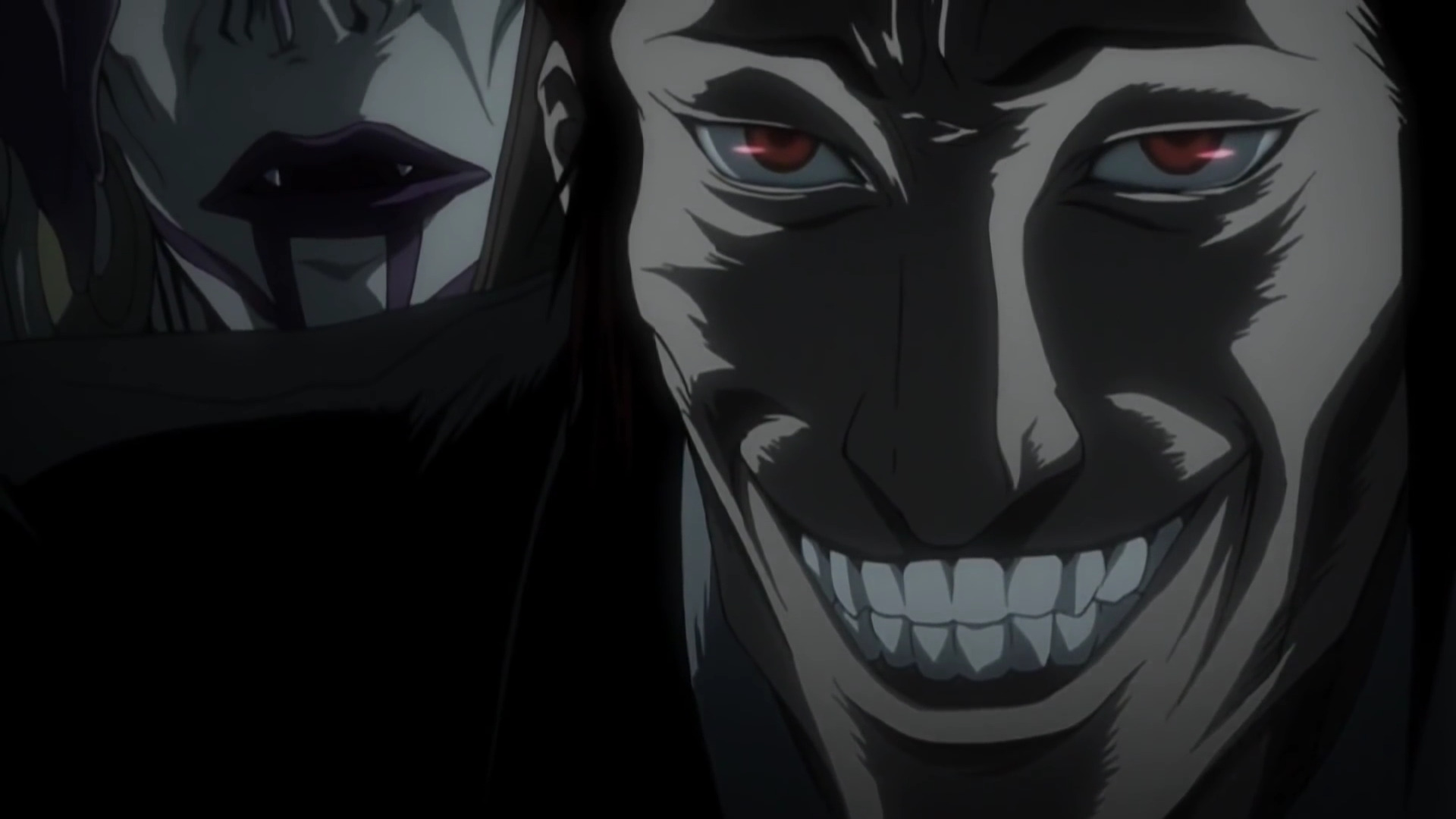
Light Yagami, under the guise of an enigmatic figure named "Kira" ends up possessing the first "Death Note," going on a crusade to kill the world's criminals. L, the world's best detective, learns of these murders and sets up a task force to bring in "Kira." Light kills off many agents but lays low when L starts to figure him out. A wrench is thrown into the mix when a fan of Light, Misa Amane, gets a "Death Note" of her own and starts killing people as well. Light eventually brings Misa under his control, only for L to deduce both of their identities. In order to hide the truth, Light induces amnesia using one of the minor rules of the "Death Note," entrusting the note to a greedy businessman named Higuchi, the gentleman with the troll face pictured above. For several episodes after this point, L and the memory-wiped Light join forces to bring Higuchi down.

I will compliment the pacing of the first part of the show, particularly the events prior to Higuchi's gaining the Death Note. The escalation of L's investigation coupled with the increase in Kira's murders does produce the appropriate amount of tension. Nothing feels rushed or forced. It's only when Misa is introduced that things start to get wonky, with L capturing the two in relatively short order after the two ally. The pacing gets more erratic after Light loses his memory, as the show takes an extremely long time to reveal Higuchi as the new "Kira" yet relatively little time to take Higuchi down. The build-up is fine, but the pay-off is deeply unsatisfying. These pacing issues are also a huge detriment to Higuchi's character, as he comes across as more of a stereotypical evil businessman/generic anime psychopath than anything else. He's a character we've seen before, from Patrick Bateman in American Psycho to Solf J. Kimblee in Fullmetal Alchemist/Fullmetal Alchemist: Brotherhood.

Also, though the pacing is relatively focused, the tone is not. In the early parts of the show, it appears as if Death Note is going to be a neo-noir of sorts, and the detective elements of the show certainly add to this mystique. But, once more mystical elements are added to the show, like the highly plot convenient amnesia, the tone gets muddled. By the time we enter the "Higuchi cycle," Death Note ceases to be a noir and turns into a buddy cop show. The contrast is glaring, and the aesthetic of the show gets muddled. Also, the addition of Misa to the main cast leads to some particularly awful comedy, as if the show couldn't get further from its origins.
But that's only half the story. Soon, Light gets his memory back and starts killing people again. His chief target: L. Spoilers: he succeeds. To compensate for the tremendous loss to the cast, the creators throw in two new characters to fight against Light: Near, a note-for-note copy of L, and Mello, an intellectually gifted terrorist who is willing to go to any lengths to stop Light. At the same time, Light gathers his own allies: news anchor Kiyomi Takada and fellow psychopath Teru Mikami. In a drawn-out and tedious three-way feud, Near ends up on top, capturing Light. Light, realizing the jig is up, finally gives into his inner psychopath and ends up being killed. The end.

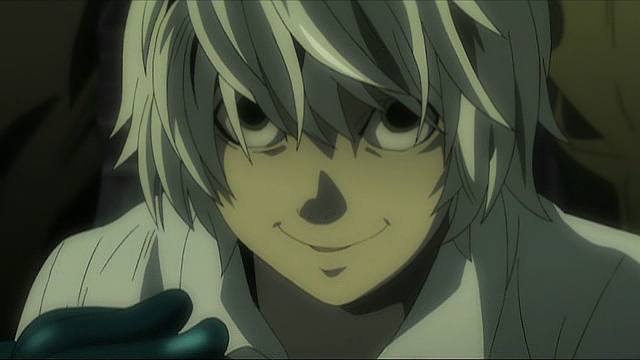
Stop smiling. Nobody likes you.
The final arc of Death Note is widely disliked on the Internet and for good reason. After L is killed, the entire dynamic of the show is drastically changed. One can't simply replace L with another genius and expect the show to work the same way. Sadly, the introduction of Near implies that the producers thought they could continue the same shtick without any narrative consequences. Putting it shortly, the technique doesn't work. Near is not L. To his credit, L has a lot of very strong characterization in the beginning of the show. Near does not. Near is boring. Since the conflict of the show has no real driving force, the pacing of the show goes slack and plot points take ages to develop. As the audience no longer cares about the characters involved in the story, each episode feels like another exercise in tedium. Tonally, the show feels as if a cheapened, lackluster version of its former self. The ending in particular,  to many, is a massive disappointment, as Light and other characters break identity completely in order to satisfy the demands of the plot/series finale.

Most Death Note fans tend to ignore issues like this, as they are so engrossed in the show that pacing no longer matters. But this is mostly a warning to new viewers. All I will say is this: if inconsistency in pacing and tone are enough for many viewers to discount watching Lost, Dexter, and Angel, why does Death Note get a free pass?

Number Five

The TRITE Message

As I described above, most anime contain some kind of moral message or philosophy that they want to impart to the viewer. Often times, these messages are extremely complex and warrant multiple viewings. Fullmetal Alchemist's discussion of equality and humanity leads to some pretty poignant moments, as in the traumatic "Night of the Chimera's Cry." By the same token, Code: Geass offers some salient points on the nature of power and control, exploring the destructive tendencies of those who use these things to exploit others. What does Death Note have to offer?

"If you somehow get the capacity to kill large numbers of  people, don't use it. It's wrong."

Thank you for pointing out the obvious, Death Note. Seriously, is this supposed to be the grand message of Death Note? For all its talk of "justice," the morality of Death Note is very black and white.  Light is evil, the blood of his victims literally drawn onto his face. L and his allies are good; they might show sociopathic tendencies, but they are fighting for the good of mankind. There's nothing more to this moral; the decision is obvious to anyone who has a functioning mind. Where is the debate? Where is the complexity? Where is the non-obvious message? I can honestly learn more about the world through using my common sense than the message found in Death Note.

If one is to construe the theme to its most complex state, one could call Death Note a criticism of US actions against Japan during WWII, namely, the use of the atomic bomb. The argument: no one, no nation should ever have the capacity to wipe out so many people at once. While said message is strong in its conviction, it is ultimately shallow in its execution. We never see the complex motivations that go into the decision to use a weapon of mass destruction, nor do we see the real impact that it has on those who use it. Light gets the note, starts killing people, and that's that. He's never haunted by his decisions, nor does he ever experience any doubts. Likewise, L never loses faith in his convictions that what Light is doing is wrong (as he should). There's no mechanism by which the audience can really question the ethics of either side. One is obviously good. One is obviously evil. There is no grey. Thus, Death Note's message is tantamount to a basic lesson one could learn from an Aesop's fable. Hell, even one of Aesop's fables is more subtle with its theming than Death Note.

The key thing Death Note lacks is thematic sophistication. There's nothing really complex about it at all, despite what fans seem to say about it. And there's one other element of Death Note that is radically overhyped, one which I have even more problems with...

Number Four

Light Yagami Is a TERRIBLE Villain

Ever since Death Note's conclusion, Light Yagami has been cited as one of the best villains in the anime canon. Many laud his descent into madness and his transformation into one of anime's most accomplished serial killers. Some even consider Light an anti-hero, what with his quest to kill the world's criminals being full of good intentions. People seem to like every single element of his character: his intellect, his dialogue, his motivations, his nefariousness, his complexity. He's a villain so beloved that many people actually want him to win.

I find it very difficult to take any of these laudatory claims seriously.

My main issue with Light is his absolute lack of passion. Since he possesses a James Moriarty-like intellect, every single one of his actions is painstakingly thought out. He never makes mistakes (at least, until the tonally dissonant ending). He never shows emotion. He single-mindedly pursues his goal without taking any time to enjoy it. Needless to say, such behavior does not make for a particularly entertaining or likeable villain. Unlike similar villains from the same mold, Light is never "fun" to watch. I won't act as if Envy from Fullmetal Alchemist or The Major from Hellsing: Ultimate are particularly deep or complex villains on par with Norman Bates or Michael Corleone, but they are at least entertaining. Light just goes about his day, writing names into a notebook and ranting about how he will be a god. He's not likeable; he's just an arrogant, elitist prick.

Perhaps I'm missing the point. Maybe Light is supposed to be more interesting in his fall rather than in the psychopath he is to become. I'd be willing to accept this criticism if Light weren't clearly a psychopath prior to the start of the main plot. People say that Light falls from grace, but it is very apparent that he is a seriously disturbed youth from the show's first episode. He is unable to form genuine friendships; he has a nihilistic worldview; he is emotionally detached from everything. He's the kind of student one would expect to be a serial killer later in life. Also, one recognizes his insanity when he so much as picks up the "Death Note" in the first place. Why on earth would a top student leave in the middle of class to pick up some random notebook that fell to the ground outside the classroom? It makes no sense. Also, once Light starts killing criminals, there is no change to his personality. Since Light was already disturbed, we are not fazed by his murders. He never actually changes. His motivations are as boring as they come, as his desire to kill the world's criminals is pretty infantile when one gets down to it. Light is just a child trying to play God; he's not a moral crusader. Plus, he monologues about his mission with such lack of passion as to further hammer home the point that he is just a psychopath.
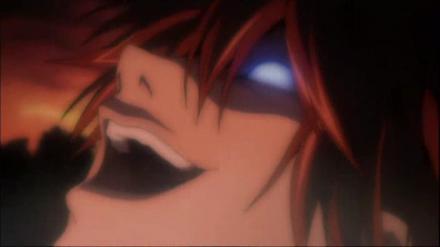
"Make 'em laugh, make 'em laugh, make 'em laugh!"

Many people dislike the ending of Death Note, saying it is wholly out of line with Light's character. Personally, the last episode of Death Note is actually one of the better ones. It's the only episode in which Light actually changes. He's been discovered. The "Death Note" is no longer in his possession. He does not know the real names of the people around him. He is well and truly trapped. It comes, then, as no surprise that he'd launch into a maniacal monologue about how he is the morally correct figure in all of this. It's the one time in Death Note that Light becomes the cheesy anime villain that we are hoping for. He laughs maniacally; he rants about moral absolutes to a crowd that does not accept his bull****. Moments like this are fun, and it feels honestly cathartic when Light is shot by the police for his many, many crimes against humanity.

There's the term "so bad, they're good" that we often ascribe to villains. While the very best villains are praised for their complex characterization, others are considered good purely on how much fun they have as villains. Light's greatest sin as a villain is his failure to enjoy himself. Unlike a Joker, a Kefka Palazzo, a Raul Silva, or a Lelouch vi Britannia, he does not take any pleasure in his evil. It's this stoicism that ultimately destroys his credibility as an antagonist we are supposed to like. He tries far too hard to be a god among men, ultimately becoming less interesting because of it.

Number Three
The HATRED of the Common Man

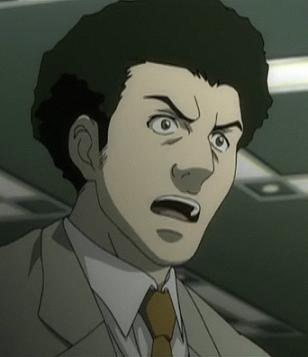
The image you see above is my favorite character in Death Note, Mr. Aizawa. He's a slightly above average cop who manages to survive the events of the show, contributing to the investigation in small but meaningful ways. Most of his victories are either minor or Phyrric, but they are victories nonetheless. He fears for his family, but he's devoted to his work and actual justice. He has his moments of doubt, but he ultimately never loses his moral convictions. He's easily the most likeable character on the show, as he is arguably the most human figure in the entire anime.

It is unfortunate, then, that men like Aizawa end up constantly thrown to the side in this show. For Death Note seems to believe in the average man's inability to do anything against an übermensch. Aizawa and the other police officers stand no chance against Light; every time they try to outsmart him, they end up thwarted and humiliated. They need to have their own übermensch: L. Then, when L dies, he must be replaced by a different übermensch: Near. It's as if the forces of good and evil are wholly at the fingertips of the supermen and no one else. All the while, the "ordinary" characters in this show are regularly used as pawns; they have no free will, being used as mere pieces on a wei qui board.

Perhaps this is supposed to be a warning from Obha and the other creators of Death Note: the various übermensches in control of society's upper echelons are controlling us like puppets. It's a noble thought, but one that doesn't hold up to scrutiny. If Obha were trying to make that point, then he would have had Aizawa be the person that ultimately takes Light down, not Near. As it stands, Aizawa is the only Japanese investigator who ends up being half-competent. Even worse, when he seeks to do more, Near tells him no, as he's not smart enough to deal with Light. It's a complete smack to the face, as Aizawa has a competent intellect and a bravery that Near completely lacks. Near faces no consequences for carelessly discarding his most valuable asset, as he already has the ability to defeat Light with the help of his fellow übermensch, Mello. Such attitudes indicate that Aizawa and the other "normal" characters on the show are essentially useless and have no relevance to our story. They are background that, for all intents and purposes, should be ignored. By extension, in the real world, the average man should be ignored in favor of focusing on the conflict between supermen. They are the only ones that matter to Obha and the other creators of Death Note.

What I hate most about this theme is the insinuation that the average man has no role or significance in the broader universe. All the victories of Aizawa and the other investigators are inconsequential to Death Note's plot. However, in reality, the actions of the "average man" can end up reshaping the world. What can we say about the messenger who dropped General Robert E. Lee's battle plans at The Battle of Gettysburg? What of the man who stood in front of a line of tanks at Tiananmen Square? The man who fired the "shot heard round the world?" The various "average" civilians providing Twitter coverage of the Arab Spring? These "normal" people reshaped the world as we know it. As Tolstoy described, the universe is a network of infinite causes, and each major event that happens is the universe is the product of thousands of thousands of decisions. While chaos and complexity theory does offer mathematical insight as to the relative importance of some phenomena over others, one cannot deny that the smaller causes have, at the very least, some impact. For Obha and the creators of Death Note, the minor characters are completely insignificant to the narrative of the show. Ultimately, the attitude the show expresses towards the "average man" is disdainful and even somewhat hateful.

But, as much as Death Note hates men, that doesn't even come close to...

Number Two

The DISGUSTING Misogyny

Some people who have read my other reviews and have watched Death Note with a critical eye knew this one was coming. Death Note is the most misogynistic, mainstream television series I have ever seen. Now, I am aware that this show targets a male audience, but that does not excuse its patronizing attitudes towards women. In addition, trust me when I say Death Note is misogynist and not sexist: a sexist show would just show women being inferior to men in some activity for another. No, Death Note actively hates women. The show only has two female characters with any relevance, but the two rank as some of my least favorite characters ever.
Meet Misa Amane, a character who...

I'm sorry. Did I call her a character?  Let me start over.

Meet Misa AmaneTM, a sex object whom the animators and male characters throughout the series use to push the plot forward. Over the course of her object arc, Misa grows infatuated with Light after he murders the criminal who killed her parents. She acquires a Death Note of her own and starts killing other people who get in Light's way. Once she meets Light, though, she loses any and all agency. She is his eager slave, willing to do whatever he says without question. No matter what terrible thing she has to undergo, she emerges with the same wide-eyed adoration for Light. She might face death, rape, or both at the same time, but she doesn't care. So long as she has Light, nothing else matters. Not helping her objectification is the fact that Misa Amane is an utter airhead, unable to come up with any thought of her own. She is only able to manipulate others when Light guides her to do so. Her sex is used solely as a weapon, and her physical desire for Light has no value in the "relationship" whatsoever, as he dictates whenever she is to be "used."
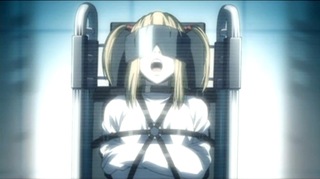
One of the most appalling frames in pop culture history
Even worse is the treatment that the animators put her through. Misa is fan service incarnate, for the animators put her through almost every fetish one could possibly imagine. She dresses in a schoolgirl uniform, gothic leggings, pop star attire, a sexualized version of a nun's habit. Hell, there's even a scene in which Misa is in bondage. The animators were so desperate to win over viewers that they had Misa tied up and blindfolded in order to appeal to fans' perverted desires. Certainly, there's a plot related excuse for this animation, but one can create a plot contrivance for anything.

Also, to add a personal gripe to the mix, Misa has the most annoying voice I've ever heard, barring Chris Tucker. The Japanese voice acting sounds like a baby whining as much as humanly possible.

I've learned that Mr. Obha created Misa Amane in order to break up the monotony of an all-male cast. That should never be one's attitude when creating a character. Characters, men or women, need to feel like people. People have complex identities and motives. What is Misa's identity? A perfect servant for Light. What is Misa's motivation? Serving Light in whatever way possible. The creators do not treat Misa like a person. Her fanaticism combined with her stupidity make her practically inhuman in her devotion; for all intents and purposes, she is a robot, a tool used to satisfy the demands of Light and the plot.
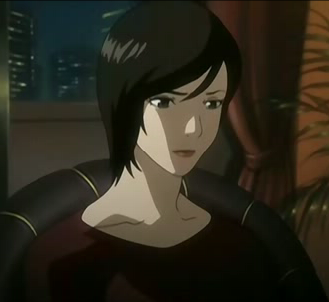
It's easy to call Misa is the worst female character in the show, if not the worst character on the show period. But, being honest, there are times when I think the worst character on the show is actually the other female character: Kiyomi Takada. At the outset, Takada seems like the smarter counterpoint to Misa, an accomplice to Light that isn't a complete bimbo. She's smart, professional; she even holds a position of some authority as Light's chief supporter in the media. Yet, for all her exterior power, Takada is an even greater tool. She is even more emotionally dependent on Light than Misa, if that is even possible. Making matters worse, Light doesn't show any sign of affection for her whatsoever. At least he occasionally went on dates with Misa in order to make her happy; Takada has to be consoled with the false promise that Light will make her "the goddess of the new world." In the very worst part of her character arc, Takada is murdered in order to make sure Light's plan to take over the world is airtight.

In fact, killing and/or brutalizing women in order to enhance male character arcs is very much a constant throughout Death Note. Misa is forced to trade over half her life for the magical "Shinigami Eyes" ability twice during the show. Therefore, at most, she could live 25 years. But, not to worry, Misa need not fear that, as she commits suicide in the show's aftermath. All the women who try to capture Light end up dead, through one reason or another. Mello kidnaps Light's sister in order to coax him out of hiding. Even Light's mother doesn't come away from this show unscarred, as half her family ends up dying because of her son's actions. In the world of Death Note, women are just collateral damage, just bits of debris instead of human beings.

It's quite astonishing that a show of such acclaim as Death Note manages to uphold its reputation despite the hundreds of misogynist moments and concepts contained within it. The women of Death Note are weak, shallow, stupid, annoying, useless, male-dependent, rag dolls who only gain value once they are murdered, very often by their own hands. If that's not indicative of a deep hatred of women, I don't know what is.

And, the worst part? That's not even number one.

NUMBER ONE
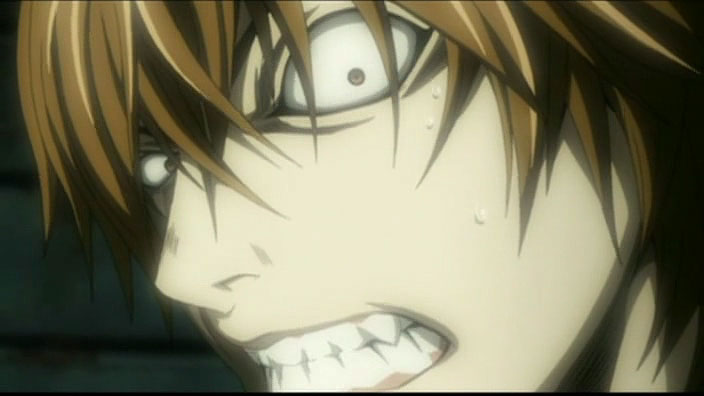
DEATH NOTE CELEBRATES MASS MURDER

There are a lot of things to be said about "good intentions." I can certainly understand that most people have them. Indeed, some philosophers argue that no one does anything wrong without having good intentions. And it's clear that Death Note has some good intentions. What was Death Note supposed to be about? It was supposed to be a show about a serial killer, a serial killer whom we are supposed to understand yet despise, and the noble efforts of investigators to take him down in spite of his genius intellect and reign of terror. What is Death Note about, as it is? Death Note is about a genius whose plan to commit global genocide was foiled by dastardly ethical people.

Death Note's biggest crime is not the number of murders within it. There are plenty of great works of art that feature disgusting amounts of gore and violence (The Triumph of Death, most of the works of Haruki Murakami, Pulp Fiction). Death Note's biggest crime is claiming that these murders are permissible or "part of a greater good." Death Note believes that Light is the good guy and that we should side with him.

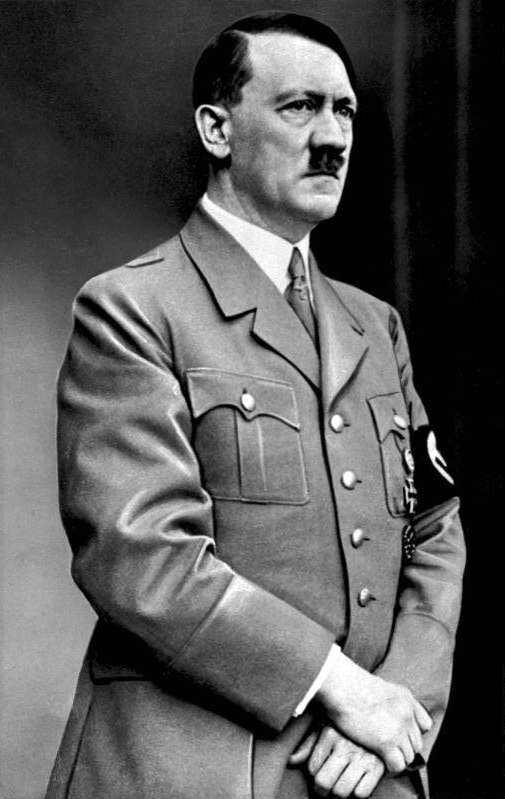
Many readers might be skeptical of this assertion. Is not Light considered one of the best villains in anime (if falsely)? Therefore, how can he possibly be considered a good person on the show? Well, herein comes the matter of Death Note's framing. For the vast majority of the show, Light never indulges in the attitudes that one would expect of a villain. As I said before, this significantly impedes his development as an antagonist. It makes him a formulaic, static character. But such a depiction also indicates that Light is becoming numb to his murders. As he kills more and more people, it becomes more of a day job than an expunging the world of his enemies. There have been plenty of other people who were numb to mass murders. Such people include this one:
This one:
And, let's not forget, this one:
Yes, Light Yagami is as evil as Adolf Hitler. In fact, Light/Kira kills almost as many people (offscreen) as did the Nazis. When depicting the stories of genocidal maniacs and serial killers, any effort to humanize the evil must clearly be used to illustrate why said evil exists. Also, such a depiction should never cast the villainous person in a positive light. To make the point clear, Der Untergang (Downfall), a film that I consider to be one of the best movies of the 21st century, received tremendous criticism for so much as remotely humanizing Hitler. I've discussed why Bruno Ganz's depiction isn't unethical in my review of the film, but the criticism has, at the least, some merit. We shouldn't, as ethical agents, portray genocidal maniacs as "good" people.

Death Note doesn't just frame Light as a good person; Death Note frames Light as a God among men. Take a look at his death, for instance.
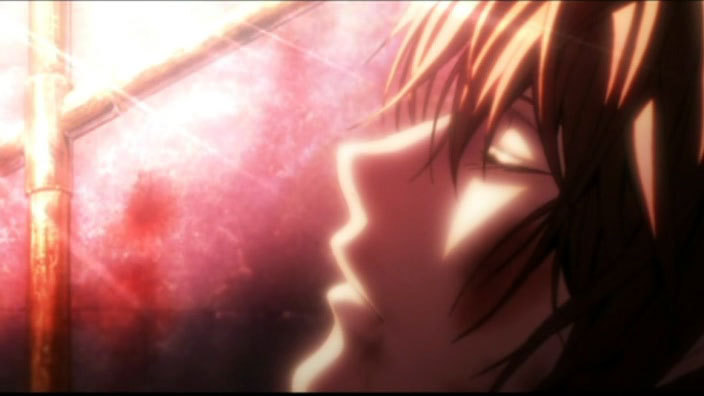
This is not the death of someone who is being damned. This is the death of someone who is being lifted up to a godlike status. Light's face is utterly at peace, despite his murdering hundreds of thousands of people. Throughout Death Note's last episode, Light stumbles around with heavenly light constantly shining upon him, as if he is a Christ-like figure in his pursuit to free the world of crime. Everyone else has simply failed to understand him and his "good intentions." As he dies surrounded in the heavenly glow, we are meant to look at him with an attitude of lament, as if the world's hope for salvation from sin has died. Light's death isn't the only moment in which this happens. At various points throughout the show, Light is equated with God and/or heaven. Light surrounds Light. Light is never wholly shown as the bad guy, as the show always offers the suggestion that his concept of "justice" is the right one. The show offers us a choice in whom we can side with. It may be my personal morality clouding my critical judgment, but I feel so much as offering the choice to follow a genocidal maniac is an action that is morally questionable at the very least.

It's not the murders that sickens me; it's not Light's boring character; it's the fact that the animators send the viewers an implicit message that is morally wrong under any grounded moral theory in human existence. Kant wouldn't stand for this. Bentham wouldn't stand for this. Nietzsche wouldn't stand for this. Moses wouldn't stand for this. Yeshua of Nazareth wouldn't stand for this. Muhammad wouldn't stand for this. Siddhartha Gautama wouldn't stand for this. No moral person would condone the adoration of a serial killer. Yet Death Note does.

Perhaps some of my readers think I am looking too deeply into this matter. After all, my claim that Death Note supports Light is based on a background cue and a Longinan concept of formalism (props to you if you know what this last term means). Indeed, even if one accepts my terms, there could be a counter-argument. Maybe Death Note is trying to say that anyone with power over life and death is evil, including God himself. I do not subscribe to this theory for two reasons. One: there is a difference between letting someone die within a world that is predetermined by human free will and action and actively killing someone. Two: if this was the grand plan of Death Note, and if this was the real message Death Note was trying to send, then Obha and the other creators would have made it more explicit. Even if I were to agree with this theory, I could then only recommend Death Note to atheists. As it stands, I cannot recommend Death Note to anyone.

If one needed any proof to show that my theory about Death Note's celebration of murder is correct, one only needs to look at Death Note's fanbase. Just a quick check on YouTube gives us plenty of fan theories of "how Light should have won" or "Death Note's ending sucks because Light lost." There were people who tuned into Death Note wanting Light to win. There are fan sites praising Light as the "God of the New World" that he wants to be. There are people who have adopted his same concept of "kill every criminal who has ever committed any crime ever" mentality. "Light Yagamists," as I like to call them, are some of the most frightening fans I have ever witnessed. In a fanatic fashion, they are praising a serial killer as the paragon of human morality.

The very fact that "Light Yagmists" exist indicates that Death Note fails to do its job. Whenever a villain, whenever a truly terrible person is the focus of a show and/or movie, they must be framed as if their actions are wrong. Consider Michael Corleone of The Godfather. He might have elements we can sympathize with, but at no point do we ever think that his actions are moral. The same goes for Tyler Durden, Norman Bates, or the Joker. We are not supposed to admire these people. Yet people do, and the heavy-handedness of Death Note's imagery and morality leads them to whole-heartedly follow their fandom. People who cosplay as the Joker and Harley Quinn say that they wouldn't ever kill someone with lethal laughing gas; people who are fans of Light Yagami say they would use the "Death Note" if one existed in real life. This is in spite of the fact that Death Note should clearly show that no human being should ever want to use the "Death Note." In fact, the "Death Note" ranked as the second-most desired fictional ability in anime in this, popularity-determined WatchMojo countdown; if that isn't a massive moral failing on the creators' part, I don't know what is. The "Death Note" has one function: murder. The fact that people want this power is indelible proof that the show, inadvertently or otherwise, endorses it.
_________________________________________________________________________________
If my ramblings and rankings haven't made the point clear enough. I think Death Note isn't just a bad show. It's an evil show. In spite of good dialogue and appropriate suspense, it promotes a morality that I find wholly repugnant. When watching it, I didn't fully see its flaws. But, after just one day of thinking it over, I realized that this show was quite possibly the worst I had ever seen. Death Note is a waste of time, of paper, of oxygen. It is a show that is lazily produced and paced. It is a show with a clear lack of  focus. It is a show that espouses disgusting morals through insidious devices. I do not give traditional ratings and/or recommendations to television series on this blog. This feels appropriate for a show like Death Note, a show that is practically a vacuum in its spiritual emptiness.

I hate this show. So should you.

Friday, October 3, 2014

Movie Review #19 - Cujo : October Terrors

Cujo (1983)
Director: Lewis Teague
Writer(s): Stephen King, Don Carlos Dunaway, Lauren Currier
Starring: Dee Wallace, Danny Pintauro, Daniel Hugh-Kelly

First "Carrie," then "The Shining." Now, author Stephen King unleashes the most terrifying fear of all... Cujo: false advertising at its finest.

Let me make one thing clear: Stephen King is not a good author. He's pretty much the James Cameron of the literary world, creating semi-interesting ideas while executing them with more care to the human attention span as opposed to artistic merit. His writing is shallow at best and downright awful at worst. At the same time, I do respect King's abilities as a storyteller. There are plenty of creative ideas at work in his books - a high school student whose puberty incorporates elements of the supernatural, a hotel that fuses an atmosphere of paranoia with ghosts, a deranged fan who traps her favorite author in a bed - all good stories. I thus have a rationale for not respecting his "novels" but respecting his movies. These are the kinds of stories that make for good drama; if given to a capable director and cinematographer, say Stanley Kubrick, these stories can produce really good movies. Thus, I must ask, of all the Stephen King books out there, why on earth would someone choose to make a movie out of Cujo?

I can't be the only one out there who thinks this was a bone-headed move on the studio's part. How did we go from Carrie and The Shining, two of Stephen King's most interesting ideas, to a story about a rabid dog attacking people? I guess it's an homage to the classic "creature-features" of the 1950s and 1970s like Them! and Jaws. But those movies had revolutionary budgets and effects for their time. Not to mention that both of those films had competent direction and a greater rationale behind their stories, the former admonishing nuclear proliferation, the latter criticizing city corruption and lackadaisical attitudes. Cujo is just about a killer dog. That's it.

Being wholly honest about the plot, a whole lot more happens. We just don't care about it. The Trenton family lives a semi-normal life, but their car is in need of repairs. They head to the home of the Camber family to get the job done, where they meet the family's friendly St. Bernard, Cujo. Cujo, however, contracts rabies from a bat and goes on a rampage, killing the Camber family patriarch and his a** of a neighbor. Meanwhile, Vic Trenton (Daniel Hugh-Kelly) learns that his wife, Donna, (Dee Wallace) has been cheating on him, so he gets angry. While Vic blows off some steam at a business meeting, Donna takes her son, Tad (Danny Pintauro), and goes to finalize the repair deal. Unfortunately, Cujo attacks her right when the car has reached the last of its lifespan. Thus, she and her son are trapped in the car on a hot summer day with a giant killer dog outside.

The acting of this movie is mediocre at best and migraine-inducing at worst. The characters have no personality at all. Donna's not a particularly strong woman; her motivations aren't interesting or anything new. Vic doesn't strike the audience as a perfect husband, but, at the same time, he doesn't really do anything so immoral as to induce Donna to cheat. Then again, I could see why a woman might leave this guy in the dirt: he has the romantic charisma of a dead rat. The other adulterer, a guy named Steve, has nothing interesting to him at all. He's just kind of lecherous. The Cambers are mere caricatures of rural life. There's the suggestion that the Camber dad is a wife beater and a neglectful parent, but it's not developed at all. It's very sad when the only interesting character of the rural community is the red shirt neighbor. He strikes me as a racist, arrogant *** who deserves what he gets. His death is by far the most satisfying in the movie; if only for that reason, he ends up being the best (human) character.

The distinction of "worst character in the movie" goes to Tad, the most annoying child character I have seen in a movie in a long time. We're supposed to sympathize with children in danger, but I seriously wanted this kid to die, for the simple fact that he never shuts up. His acting is absolutely horrendous, what with his "pwecious" speech pattern and his incessant questions. Worst of all: the screaming. The middle of this movie's climax can be replaced with a ten-minute tape of Danny Pintauro screaming his little lungs out. If I had to make a choice between listening to his screams or the collected works of Creed, I'd take the post-grunge in a heartbeat. At least I can make fun of that. I didn't care for this kid at all. Let him die from heatstroke: at least my eardrums will be free from his ungodly screaming.

The best character in the movie isn't even human: Cujo himself. The great irony of Cujo is just how badly the audience feels for the dog. Before he gets bitten by the bat, Cujo seems like a really friendly dog. Sure, he chases bunny rabbits, but don't all dogs of that size? He's not to blame for all the violent things that he does; he's just a sick animal. What makes the audience feel even worse is the make-up on this dog. Throughout the film's climax, Cujo is caked in dried blood and little bits of gore. It's imagery like this that generates the viewer's sympathy. Disease has completely warped the mind and body of an innocent animal, and it's genuinely sad seeing him rampage himself to death. I'm no fan of dogs, and I still felt more for the pooch than for the human characters. I have to wonder what a dog lover thinks about this movie.

The pacing sucks. Cujo is 93 minutes long, but it feels like 193. The opening domestic drama is so dull and drawn out that the audience grows bored very quickly. The only urgency comes from Cujo's development from an innocent dog into a rabid, foaming monster of death. Otherwise, the rest of the film is just Donna being adulterous, Tad whining, Vic being boring, Tad whining, the Cambers acting like characterless hicks, Tad whining, the car stalling, and Tad whining. When Cujo finally traps Donna and Tad in the car, the film actually starts to become interesting. But it only stays that way for about five minutes, for Donna manages to lock the door and keep Cujo outside. The rest of the time, Donna and Tad slowly get sunstroke and nearly die of heat exhaustion. This is supposed to create an intense atmosphere, but it only gets halfway there. Sure, there's an uncomfortable sense of claustrophobia, but the characters are so hateable that we want them to die. Adding to all of this is the rather lackluster cinematography, editing, and sound quality. Then again, the problems with the last of these probably more has to do with Tad than anything else.

So, is there anything to redeem Cujo? Well, Cujo has one of the single best scares in any horror movie... ever. There's a scene wherein Donna is trying to keep Tad emotionally stable after Cujo's first attack. The camera creeps through the open door, as if we are getting Cujo's perspective as he readies himself to pounce upon the two. Then, at the perfect time, Cujo appears from the other side of the screen, attacking Donna and Tad through a window. I knew this trick was coming, but it still managed to make my heart skip a beat. The timing is just fantastic. If the rest of the film's scares were like that, then I'd give this movie some approval.

As it stands... Cujo doesn't fare very well on my scale. It's far from the worst movie I've seen this year, but it's really grating. It just feels unsatisfying. I give it a few points for Cujo being a genuinely fun movie monster and for the few scares that do work. But with so many other horror films in the world, I'm not sure this is the best use of someone's time. At the end of the day, Cujo is one of those Stephen King movies that is roughly of the same quality as one of his books.

Recommendation: If you're a die hard horror fan or a Stephen King completionist, I don't think I'm going to stop you from watching Cujo. For everyone else, I recommend trying to find the last 20 minutes or so on Youtube, Hulu, or somewhere else. That way, one can appreciate the scares without slogging through the beginning.

I give Cujo 3.3 out of 10 stars.

Tuesday, September 30, 2014

Movie Review #18: Magic in the Moonlight

Magic in the Moonlight (2014)
Director: Woody Allen
Writer(s): Woody Allen
Starring: Colin Firth, Emma Stone, Hamish Linklater

If one looks at my reviews of this year's films, one will quickly find that I have not been particularly kind to them, even if they have received critical acclaim. Despite Boyhood being heralded as the year's best movie upon release, I gave it a rating barely over a 5/10. Chef faired even worse. Edge of Tomorrow, despite being called one of the best action pictures of the year, is one of my least favorite movies of the year. It gives me pride to say that I have not given my money to Michael Bay, the moron responsible for what will undoubtedly be the two worst movies of the year (if only for the fact that they will kill the most brain cells): Transformers: Age of Extinction and Teenage Mutant Ninja Turtles. Worst of all, I can't watch most of the good blockbusters due to my own personal tic. I refuse to watch a sequel unless I have seen the original, for any sequel viewed without seeing the original lacks essential context and character development. As one can guess, I have not seen The Avengers due to my having to see The Incredible Hulk, Thor, the first two Iron Man movies, and Captain America (granted, I have seen that one). By the same token, I refuse to watch X-Men: Days of Future Past or How to Train Your Dragon 2. As a result, 2014 has been a very disappointing year for me.

Fortunately, Woody Allen has given me a motion picture to break up most of the CGI-fest/emotionally manipulative tear-jerker/feel-good fluff monotony. Magic in the Moonlight is one of the best motion pictures of the year, and it deserves commemoration as a picture worthy of Woody Allen's auteur status. Alarmingly, I find a plurality of critics seem to dislike this film for rather weak reasons. Over the course of this review, I will try to elucidate why I think Magic in the Moonlight is a great movie while simultaneously countering the various arguments made against it. While some consider Magic in the Moonlight to be a tired movie repeating themes Allen has discussed before, if examined in the right way, it's one of the most psychologically complex and challenging movies released this year.

Stanley Crawford (Colin Firth) is an accomplished illusionist and ESP/spiritual medium debunker, a 1920s James Randi. While on tour, he encounters one of his old friends, Howard Burkan (Simon McBurney); Burkan has been studying a particularly accomplished medium who has been entangling herself in the life of the Catledge family, a well-to-do clan of aristocrats who are easily won over by spiritual connections. Stanley, determined to prove that there is no such thing as beyond-the-grave contact, heads off to debunk the medium. Little does he realize that the medium, Sophie Baker (Emma Stone), is not only beautiful but is quite possibly the real deal. Romantic tension ensues as Sophie begins wearing down Stanley's skeptical exterior. At the same time, Brice Catledge (Hamish Linklater) has fallen in love with Sophie and is determined to marry her. The conflicts all begin to unravel in a truly magical movie experience.

My description makes it seem as if Magic in the Moonlight is just another rom-com. Sadly, any attempt to summerize the plot does the film's plot a great injustice. It's difficult to capture the essence and spirit of Magic in the Moonlight. In any case, it is no mere rom-com. For one thing, the characters of Magic in the Moonlight are far more complex than those one would find in a rom-com. Stanley Crawford isn't the quirky, lovable skeptic one would immediately think of; he's a jerk. His behavior towards others is understated at best and callous at worst. His rationality has shattered any and all emotional and spiritual illusions he might place before himself. It is clear that he wants to enjoy life, enjoy love, but his realistic tendencies forbid him to gain even a modicum of happiness. His bitterness throughout the picture gives him a reality few rom-com characters have. Colin Firth, as always, is fantastic. As of this moment, he is my leading candidate for best male performer, with only Ralph Fiennes of The Grand Budapest Hotel even coming close.

The rest of the cast isn't quite up to par with Firth, but they all turn in satisfying performances. Emma Stone, who has become one of cinema's most dominant young actresses, is quite good as Sophie, even if some of her inflections are a bit over-the-top. She's clearly trying to evoke the theatrics of mediums, and she's gets about 60% of the way there. It's the occasional awkward intonation that slightly weakens the audience's suspension of disbelief. Ever since Hamish Linklater's role as Jerry Dantana on Aaron Sorkin's The Newsroom, I've been looking forward to see him in other roles. He certainly fits the bill here; while Dantana is inherently dissatisfied with the lot of the oppressed, Brice Catledge is totally unaware of others in his lovestruck bliss. His profound naïveté makes him incredibly endearing, despite him being the clear romantic rival. Noted British actress Eileen Atkins gives a great turn as Stanley's aunt, Vanessa; her "noble" nature belies a carnal mind that provides comedic moment after comedic moment. McBurney's Howard Burkan satisfies his role to a T. Two of the best performances come from Jeremy Shamos and Erica Leerhsen, the two Catledges who do not buy into Sophie's mystique; their psychological inclinations are an excellent foil against Stanley's rationalist perspective.

So, what are the complaints? Well, most of them seem to revolve around the romance between Stanley and Sophie: namely, Stanley is far too old. All too many find this subject matter unsettling, especially considering Allen's own marriage to former step-daughter Soon-Yi Previn. While I do question, at the very least, Allen's marital decisions, I'm not so sure one can criticize Magic in the Moonlight for the same problems. While Colin Firth is much older than Emma Stone, the make-up department in this film does wonders in both decreasing Firth's age and increasing Stone's age. While there is still a marked age difference, it doesn't end up feeling unsettling. Furthermore, our opinions of the artist's character shouldn't play a major role in our assessing a piece of art. Phil Spector may be a convicted murderer, but "Be My Baby" isn't any less of a song for it.

The other major complaint is the notion of Allen retreading some of his own themes. Magic in the Moonlight has a clearly atheistic worldview, one reminiscent of earlier films such as Crimes and Misdemeanors. This criticism has much more weight: redundancy is never appreciated. Yet I think Magic in the Moonlight is a more complex film than such criticisms suggest. Despite what the Oscar-nominated acting scene would have you suggest, this film isn't merely about being skeptical of God. Magic in the Moonlight delivers what it advertises: it's a film about magic. Not the Merlin/Gandalf/Harry Potter kind of magic, but the Harry Houdini/Paul Daniels type of magic. This movie has a huge emphasis on theatrics and misdirection. The script, though criticized for being somewhat roundabout, is designed to have the audience looking in the wrong directions. The somewhat contrived locations and happenstances of the film create the atmosphere of a stage show. Magic in the Moonlight doesn't unfold in the manner of a traditional movie; it's more like a stage play put to screen. There's a truly clever wit hiding beneath the bright cinematography.

The movie also has a very even-handed grasp of comedy and tragedy. The film often shifts from tremendous tragedy to tremendous comedy with a very strong sense of pace. The tone feels very comfortable, and the audience is rarely thrown into emotional flux. Such a tendency offers a tremendous insight into the life of the magician. The magician is the person in control, reveling in the world of spectacle. But that spectacle is based around deception; the entire livelihood of the magician is staked upon a set of lies. Also, for all his/her claims of superiority, the magician is still vulnerable to the same losses as those of any other individual. Thus, the magician might retreat into his/her own art in order to escape the harshness of reality. This complex theory of mind is constantly at play in Magic in the Moonlight. One never knows if a character is bearing him/herself to the audience or if it is all part of one grand trick. Instead of feeling manipulated, though, the audience is enthralled.

There is one element of the film, though, that the critics have justly torn into: the romance. It's not that the romance is morally disgusting or sexist or anything of that ilk; it is just too rushed. I have always disliked the notion of romance through montage; it doesn't set up any real romantic tension or true development. It offers the illusion of growth as opposed to actual growth. Magic in the Moonlight is definitely guilty of using romantic montage in the wrong way. Furthermore, the third act of the romance is full of several romantic turns that make little sense when analyzed thoroughly. Had the scenes been given a bit more space to breathe, they might have worked, but the romance does feel somewhat shallow. Seeing as the romance does take up a sizable portion of the film, this is a major problem.

In spite of that, I still recommend Magic in the Moonlight for anyone with the patience and inquisitiveness to appreciate it. I've met plenty of people who didn't like this movie for perfectly rational reasons, but nearly anyone who saw it did find things to admire. It's a movie that engenders conversation, and that's a key factor in nearly all art. Is it the best movie I've seen this year? No. Is it the best film of 2014? Probably not. But it's certainly a breath of fresh air from the CGI and food dominated blockbuster scene. I thoroughly enjoyed this movie, and I can't wait to explore more of Allen's work.

Recommendation: Magic in the Moonlight is a Woody Allen movie. If one doesn't like Woody Allen movies, one probably won't like Magic in the Moonlight. If one does like Woody Allen movies, or wants to like Woody Allen movies, then Magic in the Moonlight is as good an introduction as anything else.

I give Magic in the Moonlight 7.9 stars out of 10.

Friday, August 15, 2014

An Evaluation Zone Countdown: Buffy the Vampire Slayer - Ranking the Seasons

I'm the first to admit that I'm far from an expert on the history of television. I do have a general sense of the small screen's story, what with the rise of sitcoms after I Love Lucy's revolutionary three-point-camera and the rise of dramas with Hill Street Blues's major advancements in writing, but I'm not able to tell someone the name of the most influential episode of thirtysomething or Frasier. I'm not sure I fully understand the politics of television either. What I do sense, though, is a massive disconnect between what I call "TV culture" and "TV counterculture." Namely, TV culture has predominantly championed the sitcom and the drama as the models of premier television; after all, these are the shows championed by network television as the most appealing to the most people. Counterculture has largely been the realm of sci-fi and fantasy; shows like Star Trek and Doctor Who, while adored by their fans, often get a skeptical and polarizing reception from the rest of the viewing public. The two cultures, as one would expect, do not get along. The politics certainly grew heated, especially when the original Star Trek was consigned to the infamous "Friday night death slot" during its third season. It's very rare that a show manages to be recognized within both television's culture and counterculture as a masterpiece.

Leave it to a show about a girl in her late teens killing vampires to bond the two cultures together. Buffy the Vampire Slayer remains an anomaly in the history of the small screen. Aside from being one of few non-literary narratives to follow strong female characters with, well, characters, Buffy the Vampire Slayer transformed itself from a standard monster-of-the-week kids' show into a beloved drama with surprisingly adult subject matter. Certainly, its themes are not as subtle as those of The Wire. Certainly, its atmosphere never equals that of The X-Files. Certainly, its characters are not as multi-faceted as those of The Sopranos. But, rather than excelling in one particular area, Buffy the Vampire Slayer tries to be really good in pretty much all of them. It is a fantasy series that refuses to be a one-trick pony. It very well could have ridden out two seasons purely on its premise, but Joss Whedon turned the show into a dramatic, high octane, and even moving experience. It's one of the first shows, in my mind, to have turned TV counterculture into its mainstream culture. If not for Buffy, I'm certain shows such as Lost and Game of Thrones would not have gained the traction they did.

Thus, in homage to this incredible show, I'm going to count down each of its seven seasons from worst to best. I will try to refrain from revealing major spoilers, but some spoilers are inevitable in a list that covers a series's entire history. I will get very critical at times, so fanpersons beware. But a show of this caliber deserves a full examination. Furthermore, when I discuss the show's failings, I discuss them with the greatest affection possible. I really like this show, but it is not beyond criticism. Besides, by the time we get to the top of the list, I will be finding it difficult to make criticisms at all. Also, I will not be reviewing Seasons 8 and 9, as they are comic-based as opposed to screen-based.

Well, let's waste no time and get to the slaying!

Number 7

Season 1

I'll be open and honest; Season One of Buffy is bad television. Really bad television. There are seasons of Power Rangers that are better developed and more cohesive than Season One of Buffy the Vampire Slayer. Granted, it's an entertaining kind of bad, but there's no really getting around it. The first season of Buffy is nearly as bad as the original Buffy the Vampire Slayer movie. Let's see why.

Sweet Jesus, was this episode bad...
Well, to start, most of the episodes are of poor quality. The only two episodes of Season One that I thoroughly enjoyed were "Witch" and "The Puppet Show" - two episodes that subvert horror clichés to their fullest. The others... oof. "Welcome to the Hellmouth" may introduce us to the main characters, but most, if not all of them, come across as caricatures. "Prophecy Girl" is perhaps the most underwhelming season finale of any season of Buffy the Vampire Slayer, with the climax taking the form of an evil Muppet. While "Angel" is a good episode, compared to the rest of its season, it is still ungodly boring compared to episodes to come. The less we say about "Teacher's Pet" and "I Robot... You Jane," the better. Season One feels like a monster-of-the-week series and nothing more, and unlike Doctor Who and Star Trek, the monster-of-the-week is practically the same each time: it's either a vampire or a demon. And not one of these monsters is particularly interesting.
Hey, if Elton John can pull them off, so can I!
The first season of Buffy is also the most dated. Perhaps it is to be expected, what with the show not really finding its legs yet, but the dialogue of the first six episodes is often groan inducing. There's a writing stye called "Buffyspeak," in which characters fail to use eloquent words to express complex ideas, instead using fake nouns and verbs to try to get across their point. Let's just say the "Buffyspeak" of Season One is just trying to find its legs. Even worse is the music. Much of Season One takes place in a bar/club called the Bronze, in which Joss Whedon seems to hire every bad 90s post-grunge act imaginable. The sheer number of Mazzy Star wannabes this show includes is utterly baffling; while this is a problem that plagues the first three seasons, nowhere is it more prominent than Season One. The action is subpar when compared to the rest of the show, usually consisting of two to three punches, one of which is caught, leading into a throw and then a staking. It barely changes.

Powers of darkness, make my monster grow! Or, is that the wrong show...
Even the villains are disappointing. The Master may have better make-up than pretty much every other vampire in the series, but he's underwhelming otherwise. He just keeps sending his minions, one at a time, to kill Buffy while doing nothing otherwise. He has one truly powerful minion, the Anointed One, but said minion is a plot device so flimsy as to make me wonder why he was included. (He leads the Slayer to the Master and... does nothing?) The only malevolent character I liked in this season was the Master's minion, Darla, for the sole fact that she seemed to enjoy being evil. She gets better in the second season of Buffy's spin-off, Angel, but that's another story. Giving credit where it is due, Darla does well enough in Buffy, but she's not enough to save the entire villainous roster.

Also, she doesn't feel the need to glare all the time.
So, where does Season One work? Buffy the Vampire Slayer, for one. Buffy Summers is one of maybe three or four strong female characters put to screen that have characters beyond "I-need-to-have-an-assertive-personality-because-the-producers-don't-want-the-show-to-be-accused-of-sexism." She has her vulnerabilities, her fears, her strong moments, her shallow moments - just like a real person. She's fundamentally independent, but she falls into states of dependency, usually emotional in nature, in the same way any three-dimensional character does. I've seen a variety of lists claiming Buffy is not the best character in Buffy the Vampire Slayer: I cannot see any basis for such a judgment. Most people call Buffy out for acting in a patronizing manner, occasionally. I ask: would anyone not act patronizing if put in the same situation? Buffy has to prevent the entire world from literally going to Hell; if that's not enough stress to lead one to act in a patronizing manner, I don't know what is. Furthermore, Buffy is the best character in the show if only for the fact the show develops her the most. Buffy the Vampire Slayer never deviates from making Buffy the focus of the audience's attention, always giving her something interesting to do or undergo. I think most people confuse the notion of the "best" character" with that of the "favorite" character. Certainly, Buffy might not be the quirkiest or most likeable character on the show, but she's the one with the most focus, best writing, strongest development, and, dare I say it, best acting. Sarah Michelle Gellar is no Judi Dench, but she does a great job. She gives Buffy a strong, feminist presence rivaled only by Sigourney Weaver in the Aliens franchise; being perfectly honest, I think she's even better than Sigourney Weaver. Buffy herself is the best element of her show, and nowhere is that more clear than Season One.

Did I mention the costumes suck too?
The supporting cast is pretty strong, too. Buffy's Watcher (AKA mentor), Rupert Giles, doesn't merely satisfy the monomyth standards of the mentor figure; he is learning much more from Buffy, from the first outing, than Buffy ever learns from her. He ends up as more of a balance board than anything else, putting a unique spin on the traditional character structure. Buffy's best friends, Willow Rosenberg and Xander Harris, also get some nice development. Throughout most of the season, they serve little purpose other than "the nerd" and "the guy who thinks he's cool but is not," but they do grow endearing as their dialogue gets better. Even Buffy's first love interest, an ensouled vampire named Angel, fares well; personally, I find him a bit too broody, but I can see how others like him. The only real character who is a caricature through and through is the bully, Cordelia Chase. Fortunately for viewers, she does get better in successive seasons, but she's merely annoying in this one.

One final good thing about Season One is its atmosphere. The darkness of the series is palpable from its very first episode. The shadows, the grim settings, the often claustrophobic combat - it all works really well. Even the notion of the show's town, Sunnydale, being set upon a portal to Hell provides a great sense of tension. I often call Season One "Power Rangers with higher production values" purely because of the strength of its atmosphere. Indeed, few seasons of Buffy managed to capture the same dark spirit as Season One, with Seasons Four and Six all but abandoning the eeriness of the first. It's the one thing I always turned to when struggling to get through some of Season One's worst episodes.

At least things got better from here on out...

Number 6


Season 4

With a huge stumble in Season Four. While Season One was bad in an entertaining way, Season Four was bad in a mostly groan-inducing way. There were episodes in Season Four I struggled to sit through. When I say struggled, I mean intentionally distracted myself with an Iphone game.

There's a wall that gives people orgasms. Think about that.
Season One may have had its duds, but the worst episodes of Season Four are by far the worst episodes of the entire series. "Living Conditions" (guys, imagine if everyone who listened to Celine Dion was evil), "Beer Bad" (wherein beer literally turns people into Neanderthals), and <shudder> "Where the Wild Things Are" (seriously, Buffy and her boyfriend have sex throughout the entire episode) - all of these are terrible episodes. Granted, the episodes aren't as consistently bad as those of Season One, but they delve far further into terrible territory. Instead of feeling phoned in and unoriginal, like those bad episodes of Season One, they seem as if they were Buffy the Vampire Slayer episodes written by the all-star team of Michael Bay, Edward Wood Jr., and Tommy Wiseau!

Are there any college dramas that don't suck?
The main arc of episodes is also weak. Season Four is the season in which Buffy and her friends go to college; as a result, the show tries to split itself into the "teen-getting-used-to-college" story and the standard "vampires-trying-to-take-over-the-world" story. The tone feels very inconsistent and the show rarely seems focused. During the first three seasons of Buffy, Whedon and co. do a fairly good job of translating the struggles of high school into vampire action. Not so in Season Four; most of the college struggles are either sidelined for sake of the action, or vice versa, in a manner that feels tonally dissonant. Worse, when the writers actually do combine the two struggles, we get episodes like "Beer Bad." Let's be honest, going to college was the worst narrative decision Buffy the Vampire Slayer ever made. Seasons 5 and 6 got much better if only for the fact Buffy no longer went to classes, as the show regained its narrative focus.

Adam, SMASH!!!
The writers also try to pull everything together with the introduction of a government agency called "the Initiative." The Initiative is basically a gesture from the writers that the outside world is not unaware of all the monstrous activity happening in Sunnydale. Yet the actions of the Initiative are ridiculous. Why would a government agency devoted to slaying monsters have a special ops team manned by college students? Why would the agency design its headquarters through secret passageways in the college as opposed to the remains of the high school, especially when the high school located directly above the portal to Hell? Why would an agency devoted to capturing vampires refuse to develop an arsenal of pop-guns firing wooden bullets? Worst of all, why would this agency design a monster made out of various demon parts? Did they honestly expect this monster to be a good person? Have they ever read and/or watched Frankenstein? Also, said Frankenstein's monster, Adam, is the worst Big Bad in Buffy the Vampire Slayer history.

Character or oil painting? I can't tell.
Last, but certainly not least, on the s***-list is Buffy's love interest for the season: Riley Finn. One could not possibly design a more boring character for Buffy to date. The show keeps trying to give us reasons to like Riley (i.e. he's initially supportive, he is a highly trained soldier, he's loyal to a fault), but none of them can surmount the fact Marc Blucas is a terrible actor. The only faces Riley is able to express are "derpy smile," "deep gaze," and the "mildly shouty scowl." His performance leaves the audience asking for so much more. Making matters worse, Riley is the focal point of several ridiculous plot threads tying him to Adam. He's the biggest turn-off in an entire season of turn-offs.

The one time where screaming does solve your problems.
So, with all my complaints about Season Four, why is it higher than Season One? Well, Season Four added three major improvements to Buffy's dynamic. The first comes in the season's strongest episode: "Hush." Often called the second-scariest television episode in history (only behind The X-Files disturbing look at inbreds, "Home"), "Hush" tells the story of a group of demons called the Gentlemen that steal everyone's voices and hearts. The characters must struggle to communicate and battle their foes without the aid of sound. Buffy's quips, a key part of her multi-faceted offensive, are all but useless. "Hush" is easily Buffy at its most atmospheric, featuring an almost Gothic musical score and some truly horrifying monsters. The eerie fashion with which the Gentlemen float above the ground is unsettling, to say the least. "Hush" is the only episode of Buffy to be nominated for an Emmy for Outstanding Writing, and it established a precedent for great episodes to come. "Hush" was the episode that pushed Whedon to create other tonally distinct Buffy stand-alones. Other stand-out episodes like "Conversations with Dead People," "The Body," and, of course, "Once More, With Feeling" owe everything to "Hush."

Did I forget her vendetta against bunnies?
Another welcome addition to the Buffy crew is Anya. A former vengeance demon turned Xander's girlfriend, Anya is upfront and literal about nearly everything. Her absolute lack of social tact adds to an extreme sexual confidence that is both empowering and hilarious. For the next three seasons, Anya would be a regular cast member, and a welcome one at that. Though she debuted in Season Three, Anya really gave it her all in Season Four, and I've got to give her credit. If we had to rank my personal favorite Buffy characters, Anya would be in my top five. She's that good, especially in this season.


The definition of "so bad, it's good."
And then there's Spike. Good God, Spike is the single greatest source of entertainment in Season Four. Spike, one of the main villains of Season Two, comes back in glorious fashion. Originally intent upon burying Buffy and her friends, Spike gets a chip implanted into his brain that prevents him from harming humans. The only way he can satisfy his lust for violence is by turning on his own kind and fighting demons. He turns from a deadly, threatening enemy to a snarky, unwilling, and untrustworthy ally. As in Season Two, Spike is always funny, always compelling, and always entertaining. He's the one character in all of Buffy that never falls short of brilliant. Even Buffy, as fantastic a character as she is, has her moments of pretension and banality. Spike is the perfect package, my favorite character in the show (though not the best). Season Four is the season in which he went from good to great.

Season Four is an inconsistent and unstable season. Its peaks are tremendous, its valleys are perilous. The bad tends to outweigh the good, but it is a net improvement over Season One. Together, the two form Buffy the Vampire Slayer's darkest period (at least in terms of quality). The next entry is a lot better.

Number 5

Season 7

Many fans consider Season Seven to be the weakest season of Buffy. I tend to disagree - its low moments are lightyears ahead of the low points of Seasons One and Four - but many of the criticisms do not go unfounded. After the emotionally-centered Season Six, Buffy the Vampire Slayer tried to end its run with a bang, a climax so massive no other could top it. Though the last few episodes come close to satisfying Whedon and co.'s goal, the rest of the season does feel as if Buffy the Vampire Slayer was on life support. At its best, it ranks up with some of Buffy's top moments. At its worst, it falls into a state of tedium.

Also, bad CGI.
More than any other season, Season Seven is defined by its Big Bad: the First Evil. Briefly introduced in Season Three, the First Evil is pretty much Buffy the Vampire Slayer's version of Satan itself. Now, the concept of Buffy v. Satan sounds pretty cool. But Whedon and co. take the more religious route (saying a lot considering Whedon's clear distaste for fundamentalist religion) and makes the First Evil into a relatively weak being. It can only manifest itself as visions of those who are already deceased, and it is only able to work through disciples and trickery. The problem: it seems that whoever plays the First Evil (pending on the episode) is forced to "act" in an almost complete monotone. Furthermore, while the whole "tricky" evil idea isn't bad in and of itself, it's very difficult for the season finale to build up a sufficient climax. Ultimately, when considering the sheer scale of what happens in the series finale, "Chosen," the First Evil seems like small fry.

"Ms. I'll make a woman out of you...": somehow not as catchy.
The First Evil is more important, however, in that it destroys the entire framework of the Buffy universe. The being practically annihilates the Watchers' Council, the network of mentors that dictates how the "vampire slaying business" ought to be run, forcing every person that might potentially become a vampire slayer to come to Buffy's house. Thus, Buffy's cast of guest stars leaps from about three or four to ten or eleven. Most of these new characters have very little time to develop; indeed, some of them do not develop in the slightest. I wish I could tell you some things about characters like Rona or Amanda, but they are given so little time that I cannot give the slightest amount of information about them.

Because emotional abuse is funny! Right?
The only potential who is given any airtime is  the worst of the lot. Kennedy, a self-proclaimed brat who more than lives up to her description, is quite possibly Buffy's worst character. Her only reason for existing is providing a love interest for Willow (who has come out by this point in the series). As far as that is concerned, Kennedy displays no qualities indicative of a supportive girlfriend. She has no real characteristics to speak of other than her self-entitled nature. Worst of all, Kennedy bullies a girl to death and does not receive any negative repercussions because of it. I know bullying wasn't seen as a tremendous issue back in 2003, but I have no issues with applying a modern standard of morality on a previous era. As it stands, Kennedy leads someone to commit suicide and receives zero punishment for it. Buffy's worst character: bar none.

High school acquaintances make good plot devices.
The presence of the First Evil and the potentials turns almost every episode of the final season into a plot thread episode. Thus, the plot tends to get a bit tedious and the episodes a bit less interesting. If one doesn't mind the First Evil, as I do, then most of the episodes fall in the OK category. If, like some others, one hates the First Evil, then Season Seven is pretty weak across the board. Only two episode of the season stand out as truly fantastic: "Conversations with Dead People" and "Selfless." Told in real time, "Conversations with Dead People" breaks down three story lines in which the First threatens Willow, Buffy's house collapses around itself, and Buffy faces down an old acquaintance from school. In "Selfless," Anya, having returned to her job as a vengeance demon, must fight Buffy to the death as a result of one particularly brutal act of revenge. The two episodes manage to stand on their own merits rather than being bogged down by the admittedly convoluted plot elements of the season.

Also, Principal Wood has quite the voice.
The character work of Season Seven is pretty middle-of-the-road as far as Buffy is concerned. One of the main antagonists of Season Six, Andrew, returns as a supporting cast member in the seventh season; he's fairly entertaining, and he is the star of one of the season's better episodes. One of my personal favorite characters is Principal Robin Wood, the son of a former Slayer turned principal of Sunnydale High. His showdown with the vampire who killed his mother is easily one of the season's high points. The dynamic between other characters, such as Xander and Anya, as well as the culmination of the friendship between Xander, Willow, Giles, and Buffy, also works rather well. The character highlight, though, is the culmination of the Buffy-Spike dynamic. Needless to say, the conclusion is the most satisfying portion of the series' finale, "Chosen." I refuse to spoil anything; watch the season to find out.

Buffy the Vampire Slayer ends on a tragic but hopeful note (fortunately devoid of bad pop songs), and one can see why "Chosen" is a fan favorite episode. It's far from the best season finale the show has ever had, but it does satisfy. And, though the season was inconsistent, Season Seven is a fairly noble attempt to tie up every loose end. It tries to end with a bang, and it does so fairly well. Is it perfect? Absolutely not. But it is certainly competent.

NUMBER 4


Season 6

Easily the most polarizing season of Buffy, Season Six draws both praise and contempt pending on which viewer one talks to. It's either a daring emotional drama that alters the Buffy formula for the better, or it's a plotless, disorganized mess that tries to create drama where there's none to be had. Personally, I consider the season a plotless, disorganized, yet daring emotional drama that alters the Buffy formula for an ultimately effective season.

Fortunately, Evanescence hadn't released "Bring Me to Life" yet.
Buffy the Vampire Slayer was supposed to end after the climactic finale of Season Five. In order to keep the series going, Whedon and Willow had to, literally, bring Buffy back from the dead (to be fair, Whedon had done so before). This single action has its repercussions, as the entire Buffy universe starts to implode in on itself. Buffy begins to default on her mortgage payments; without a college degree, she is forced to work at a fast food joint (leading to some of the series's very worst episodes). Making matters worse, it turns out that Buffy was untimely torn from Heaven itself; she thus resorts to having sex with Spike in order to make herself feel dirty and perverse, AKA masochism. Spike's own feelings for Buffy, combined with his villainy, lead to the most terrifying scene in Buffy history during the episode, "Seeing Red."

Get used to a lot of this...
Indeed, the sexual cruelty of Season Six is potent. Xander and Anya, easily the most stable source of romance in Buffy's reasonable run, break down into utter chaos. Unlike the other quasi-romances of the season, though, their arc is the least-well handed. The resolution feels rushed and wrong in every sense of the world. Though some might argue this adds to the realism of the situation, I have my hesitations. Let's just say the relationship between Xander and Anya was too strong prior to Season Six for things to turn out the way they do. The relationship between Willow and her girlfriend, Tara, is far better handled. Tara, introduced in Season Four, finally develops some individuality once her relationship with Willow is put through the ringer. The levels of emotional abuse she goes through and ultimately overcomes are astounding. The multi-faceted tragedies of Tara and Willow's relationship rival those of Buffy and Spike, perhaps even surpassing them. It is a harsh world, and no one escapes pain.

For God sakes, man, you could have saved everything!
Yet Season Six does not unfold like a Shakesperean tragedy; it's a season that structurally tears itself apart. The various arcs - be they sexual, domestic, violent, etc. - are not arranged in a way to make them meaningful. They just seem to pop up and vanish into the ether. The season clearly tries to build up to a dramatic emotional conclusion, but the drama is suffocated under the weight of its own pacing. What makes this major failing of Season Six even worse is the very simple solution. Giles, a mainstay of the series for the first five seasons, departs in Season Six, due to Anthony Stuart Head wanting to spend time with his family. Had Giles remained in the series, the audience would have had an anchoring point with which to pull together all the various plot threads. As a result, Season Six could have been much more meaningful.

Dude, do you have some hex?
Most of Season Six's elements are left wanting for more. Each of the plot threads could have received more time, as Season Six does have its fair share of filler. The writing is arguably at its weakest, with the dialogue turning more into dramatic speech after dramatic speech rather than human discourse. The humor of the season is generally lacking, except for one episode (we'll get to it). Most importantly, the character development the season aims for tends to fall flat. Character development in Season Six seems wholly determinate on the events Whedon puts his characters into rather than any personal growth. Sometimes, this works: Anya and Xander do grow throughout the season, as does Buffy. Spike, Willow, and Tara tend to stagnate, despite the various new scenarios into which they are put. It doesn't help that some of the scenarios they enter are particularly moronic (apparently, dark magic is as addictive as crystal meth).

The true faces of evil.
As if to make Season Six even more difficult for me to evaluate, the villains of Season Six are inherently polarizing. The Trio, a group of nerds taken from various points in Buffy's history, is a faction both entertaining in its moment and disturbing in its implication. The three nerds - Warren, Jonathan, and Andrew - are incredibly funny and enjoyable whenever they are on screen. Each of them is a character in his own right. Warren is a sexist jerk, through and through, murdering anyone who gets in his way. Jonathan is experienced yet simultaneously naive; his charm from previous seasons has not diminished. Andrew, a newer addition, is quite possibly the funniest of all three, with the homosexual overtones of his character not going unappreciated. But Whedon's depiction of the Trio presents himself as somewhat hateful of his male audience. How is that? Well, we're going to have to dabble in some feminist criticism.

Nearly every Buffy antagonist can be reconstructed as a patriarchal force trying to suppress the show's female leads. Each represents some element of the patriarchal mystique: The Master - its power via tradition, Adam - its power via testosterone, The First Evil - its power via precedence. The Trio is clearly indicative of the patriarchy's use of intellect to force women to submit to it, as in the middle-aged lawyer marrying a trophy wife in order to satisfy his physical urges while she benefits from the fruits of his knowledge. Yet Whedon's portrayal of the Trio seems to cast most of his male fans as sexist assholes merely for being male and smart. With every other Big Bad, there is some male force of good that uses the same weapon used for destruction to help women (Giles - power via tradition, Riley - power via testosterone, Spike - power via precedence). Unlike every other Big Bad, the Trio lacks a positive male counterpart (Giles isn't in this season). Furthermore, the portrayal ignores the other half of the feminist construction: unlike in prior scenarios, the woman must willingly submit to the intellect of the patriarchy rather than simply being overpowered by it. Certainly, the man is far more in the wrong, but we cannot ignore that some of the blame does fall on the woman for favoring money rather than emotional commitment, equal treatment, or not being treated as a means to an end. The actions of the Trio are such that all women are blameless in the scenario, when the real-life analogue is infinitely more complex than what Whedon presents. The Trio is thematically unsatisfying, and, speaking as a male geek, even somewhat insulting.

Though they do look good when standing in a line...
I don't mean to insult Whedon and his noble intentions; he's clearly trying, and he at least gets 60% of the way there. I hold Whedon in the same esteem when I say "Once More, With Feeling" is an overrated episode. The only series of the episode to be a musical, "Once More, With Feeling" is widely considered to be Buffy's best episode and one of the seminal episodes in television history. I will be fair: "Once More, With Feeling" is ahead of its time and has clearly influenced several shows to come. It is also an interesting plot device to illustrate the various character revelations that have been mounting throughout the first half of the season. Most importantly, it is one of the funniest episodes of Buffy the Vampire Slayer, with the tonal dissonance alone being enough to ensue hours of laughter. But all of these things cannot surmount the fact that most of Whedon's songs are poorly composed. Sure, some songs, namely Spike's and Tara's, are quite nice and even somewhat clever. Others fall flat on their backs due to overly simple structures, while others find themselves bogged down by clichés (if I have to hear another song with the word "fire" in the chorus, I swear to God...). Most of the articulative elements are ripped directly from Rent, and the song structures themselves are Disney-lite. Once again, I really like this episode, but it's got some problems.

My views of Season Six match those of the fans. It's the single season on which I am the most conflicted, as it has so much to offer, yet it manages to botch most of it. It's far more exciting than Season Seven, giving it an edge, but it is still a far cry from the top three. Trust me when I say the quality difference between Season Six and the three best seasons is massive. While my prior assessments have been mixed to negative, the following three entries will receive little but complete praise. As is stands, Season Six is a flawed but important run for Buffy. Its cruelty may be somewhat sporadic, but, when it's at its best, it's damn good.

Also, it's the season in which...

NUMBER 3

Season 5

I was somewhat conflicted when thinking about Season Five. It's not that I hold mixed feelings about it; far from it. I just wasn't sure if Season 5 deserved to be number one or number three. In some regards, it's the most complete and compelling season of the entire series. It's Buffy at its darkest and most immediate, providing both atmosphere and drama at all the right moments. It has, hands down, the best single-episode finale of any Buffy season. The character development of the season is remarkably subtle. The fight choreography is arguably at its most impressive. In the end, only two elements prevented Season Five from topping this list, but we'll get to those after I fawn over all the great things found in Season Five.

Also, kudos on making a clever female villain.
Much like in Season Seven, the Big Bad is one of the huge determining factors behind the season's development. However, instead of us getting the underwhelming First Evil, we get Glory. Glory is the god of a hell dimension that has gotten trapped in the human world and had her power limited. Limited, but not depleted: Glory is the only Big Bad to consistently beat Buffy up singlehandedly. She's self-confident in practically everything she does, and she does not make mistakes. She singlemindedly pursues the object of her desire - a Key that can open a portal back to her hell dimension - with the focus of a heat seeking missile. While not the funniest Big Bad or the most intimidating, she's arguably the most dangerous foe Buffy and co. ever battle. The only real downside to Glory is her alter ego, Ben, a whiny human who is willing to kill the infirm in order to maintain his own sense of self. Much like the Silence of the new Doctor Who, Glory has the ability to make people forget that she and Ben are the same. Unlike in Doctor Who, the idea's not handled all that well. But it's a small flaw in the grand scheme of things. Glory is still the most difficult opponent Buffy has ever had to face head on, and her overall mettle rises on that basis alone.

Glory's presence activates the Murphy's Law of the Buffy universe: everything that can go wrong does. Buffy's relationship with Riley disintegrates in a wash of vampire prostitutes and government mayhem. Spike, despite trying to kill Buffy for three years, suddenly develops feelings for her. He still lacks a soul. Giles ends up taking over a magic shop when he begins to run low on revenue. Glory begins draining various people of their sanity and turning them into her mentally deficient minions. An army of knights devoted to stopping Glory try to kill Buffy due to her sheltering the Key. Worst of all, Buffy's mother develops a brain tumor. The latent tragedy in all these events is palpable throughout the season, and there is always something at stake. Thus, Season Five has the most urgency of practically any season of Buffy the Vampire Slayer.
Honestly one of Buffy the Vampire Slayer's funniest moments.

Despite all these plot threads, Season Five, unlike Season Six, manages to tie them all together quite nicely. This comes primarily from the use of setting and atmosphere to combine narrative threads. Buffy's mom's going to the hospital provides the perfect setting to explore the effect of Glory upon Sunnydale's mentally infirm. The magic shop provides a stable meeting place for Buffy's allies, something lacking in the previous season. The graveyard becomes more than just the primary location of action sequences and exposition dumps; it's an opportunity to expand upon Spike's story. Buffy's home becomes fraught with domestic tension as Buffy's mom copes with her illness. Context is crucial. Since Season Six lacked the appropriate context for most of its events, the story felt disorganized and unfocused. Season Five outclasses it in terms of pacing, coherency, and immediacy.

So... many... feelings.
Season Five is even a triumph in the character department. Season Five showcases Buffy at her most vulnerable. One wouldn't think a Slayer could cry, but enough chaos ensues in Season Five to break Buffy completely. No number of forced exiles, attitude changes, or witty comebacks can stop the misery: Buffy has to face a near-crippling emotional and physical threat in nearly every episode. She only breaks down in one episode, but when she does, it is devastating. Spike's embodiment of "familiarity breeds fondness" throughout the season is both hilarious and compelling. It makes sense that a vampire with Spike's personality could develop beyond being a snarky villain-antihero into a genuine companion. Buffy's rebuffing him throughout the season only makes him more likeable, as he continues to prove to the audience (with one brief but disgusting digression) that he is someone capable of loving without being loved in return. Sure, Buffy may not love him and justly refuses him, but Spike's desperation makes him all the more compelling. The Xander-Anya romance is at its most beautiful in Season Five, with the two engaging in the best romantic banter in the show's history. Indeed, the sheer quality of the Season Five romance makes the conclusion of it in Season Six all the more unsatisfying. Giles provides a strong series anchor. The only character who does little in Season Five is Willow, but I can forgive this considering her considerable presence in Season Six.

Now that's what I call bringing the hammer down...
The episodes of Season Five range from the underwhelming, to the good, to the amazing. At the low end of the spectrum is "Forever," an episode that tries to undermine almost everything that made the preceding episode great. Pretty much every other episode, however, is very good. "I Was Made to Love You" introduces Warren Mears (one of the members of the Trio) in fine form. "Fool for Love" features the best character development for Spike in the whole season. "Crush" brings Drusilla, one of the antagonists of Season Two, back for one of the best confrontations in the series. The two episodes that everyone deservedly remembers are "The Gift" and "The Body." The former is the season finale; being honest, it's an episode so complete it should have been the series' finale, as was intended. The latter... let's just say it's the most emotionally draining experience in all of Buffy.

Only two elements of Season Five are less than optimal. The first is Riley, Buffy's boring as hell (actually, that's a bad comparison; hell is much more interesting than Riley) boyfriend from Season Four. He is no more interesting in this season than he was in the previous one. In fact, he gets even worse, as he transitions from being a kind, accepting boyfriend to being a control freak with a narcissistic complex. "Into the Woods" is one of the cheapest emotional moves in the show's history if only for its revolving around Riley. His departure midway through the season is tremendously appreciated.

And then there's Dawn...
I'm acting...
Dawn is Buffy's sister, a character ret-conned into the show via her presence as the mystical Key which Glory is after. A group of magical monks manages to write her into the show's history; suddenly, all of the characters in the show have artificial memories of Dawn, even if some of these memories clash with the series's established continuity. As a result, Dawn becomes both a living plot device and a plot hole. Her presence de-stablilizes the season and the entire Buffy continuity. Despite the interesting material thrown at Dawn later in the season, she remains exceedingly annoying and distracting in the first few episodes. This is not helped by Michele Trachtenberg, easily the worst actor to portray one of BtVS's main characters (beating out Alyson Hannigan by a country mile). Trachtenberg is a special kind of annoying, carrying herself with an air of petulance that goes beyond mere pre-teenage arrogance and into Crazy Frog levels of annoyance. In some episodes, she even makes Riley seem tolerable by comparison. Though Dawn improves as the season progresses, her weak initial presence ensures Season Five's placement at the bottom of the top three. She is a risk that both fails and succeeds, as her existence, while not gratifying in itself, does end up enhancing the other characters. While I do hate the use of characters as plot devices, Dawn is one of the few instances of this technique being used correctly.

Some consider Season Five to be Buffy's self-contained masterpiece; they might very well be right.

NUMBER TWO

Season 2

I knew from the instant I watched "Chosen" that the battle for my number one spot would come down between Season Two and the top ranked season (which you should be able to deduce if you can count to seven). The prevailing sentiment, as far as the Internet is concerned, is that Season Two is the best season of Buffy the Vampire Slayer, and it's an assessment with which Joss Whedon himself would probably agree. After all, Season Two is the season that transformed Buffy the Vampire Slayer from a feminist Power Rangers knock-off into one of the most dynamic fantasy dramas of its, or any, era. It's the most emotionally charged season of Buffy the Vampire Slayer, it is home to, in my opinion, the single best episode of Buffy the Vampire Slayer, it introduced the most new elements to Buffy the Vampire Slayer: it's the season that defines Buffy the Vampire Slayer's identity. In other words, keeping Season Two from the number one spot was pretty damn difficult.

The beginning of a new era... and some great villains to boot.
Season Two of Buffy the Vampire Slayer may open on a weaker note, due to its taking off directly from "Prophecy Girl." Once one gets to "School Hard," though, the viewer is treated to arguably Buffy's most emotionally satisfying arc. With the formal introduction of Spike (as a full-blown villain) and his consort, the utterly insane Drusilla, Buffy the Vampire Slayer finally receives the antagonists it deserves. Spike and Dru offer a relentlessness that Buffy and her comrades are unused to facing, and the group is often put on the ropes. The Buffyverse expands when another Slayer, Kendra, arrives (replete with bad Jamaican accent) to try and defeat the two malevolent vampires. Practically every element of the show improves from the first season, what with slicker fight choreography, more varied settings, wittier dialogue, stronger character development, and timelier pacing.

Also, is it a bad thing that I prefer Angelus?
Even more impressive is the show's subsequent alteration after the episode, "Innocence." In Joss Whedon's personal favorite episode, Angel, Buffy's vampire boyfriend, loses his soul once he has sex with Buffy. This reverts him into an evil vampire called Angelus, a creature so foul as to give Spike and Drusilla a run for their money. An episode taut with betrayal, emotional story-telling, and rich atmosphere, "Innocence" adds an entirely new dynamic to Season Two, making it a story equally about personal betrayal and frayed emotions.

So... many... feelings... again!
The character development of Season Two is quite possibly the best of any Buffy season. Buffy's emotional anguish during Season Two is excruciating; while she's not as vulnerable as she is in Season Five, she certainly feels as if she is out of her league. Not only are her emotions thrown out of sync, but she's also facing three of the most dangerous vampires in the world at the same time. Her managing to endure all the mayhem is a testament to her resilience. Indeed, Season Two showcases why Buffy Summers is an actually strong female character as opposed to the generic Hollywood definition of a strong female character. At points, she does break. She does make mistakes. She does depend on others too much. It is, instead, her capacity to endure that makes her strong. It's not to say that she always makes the right choices - sometimes she buries her pain, making it even worse - but she recognizes something beyond the need of the moment. Thus, Season Two defines Buffy the Vampire Slayer by defining Buffy, the vampire slayer.

This romance is so wrong, but it leads to so many good episodes.
But it's not just Buffy. Everyone receives a great treatment in Season Two. Giles gets his best character development, as his normal British stoicism is put through the wringer. Buffy's mother, Joyce, thankfully learns about her daughter's vampire slaying, finally removing all the moronic alter ego mania of Season One. Willow gets her first romantic interest in Oz, a rock band geek played by Robot Chicken co-creator Seth Green. Xander even manages to date Cordelia, who ends up having more character traits other than cheerleader b****iness. Though many of these relationships are considered comically rather than dramatically, they remain engaging nonetheless. There's an enjoyability in simply watching these characters mature, as they grow into distinct personalities beyond the caricatures of Season One.

"Passion" = perfection.
Everything brilliant about Season Two can be summed up in "Passion," my choice for the best episode of the entire series. Easily the darkest episode of Buffy the Vampire Slayer, "Passion" is an episode of shock, elegance, brutality, turmoil, and eeriness. The framing of each shot in "Passion" is completely meaningful, adding extra gravitas to the tremendous plot events that happen within it. It is the first episode of Buffy the Vampire Slayer to truly deal with loss, and it's a loss made all the more palpable by its subtlety and understatedness. Every character, from the heroes to the villains, is pushed to an emotional limit. It's an episode that forces characters and actors to draw lines and break them all at the same time. No other episode contains as much finality and foreboding as "Passion," and the season finale "Becoming" seems tame by comparison. As much as I love the number one season, nothing within it matches "Passion" in terms of episodic and atmospheric perfection.

Looks intimidating? Think again.
But the rest of the season's heights are really quite phenomenal. Though I think Whedon is wrong when he calls "Innocence" the best episode of Buffy, it is certainly within the top ten. The same applies for Season Two's often overrated season finale, "Becoming" (it's really not as deep as the fans say). One of my favorite episodes is "Bewitched, Bothered, and Bewildered," as it both manages to subvert the thousands of zombie horror films while also being the funniest single episode of Buffy the Vampire Slayer (seriously, this episode had me laughing for hours). Other great episodes include "Phases," "School Hard," and "I Only Have Eyes for You": the season is just fantastic.

Come to think of it, I think this is where The Amazing Spiderman
chose the design for The Lizard.
Thus, if there are so many good things about Season Two, why is it not number one? First off, there's enough brilliance in the number one entry itself to warrant its placement. But Season Two suffers most in its bad episodes. Despite Season Two's rather consistent and engaging arc, every so often Season One-style episodes rear their ugly head. While some work ("Bewitched, Bothered and Bewildered"), most don't ("Bad Eggs," "Reptile Boy"). Indeed, the bad episodes are made that much worse just by being juxtaposed against the good ones. Did we really need to follow up "Passion" with "Killed by Death"?

Yet this complaint is so minor as to be utterly trivial. I'd love to simply tell viewers to watch Buffy the Vampire Slayer from Season Two onward, but Season Two really does gain much more meaning if one already has some connection to the characters. My longing to skip Season One is a testament to the sheer quality of Season Two. It's the season that truly created the Buffy the Vampire Slayer we all know and love. But, if Season Two invented it, then the top entry perfected it.

NUMBER ONE

Season 3

The third season of Buffy is a masterpiece in pretty much every sense of the word. In fact, there's only a single episode of Season Three ("Anne") that is anything less than great. Pretty much everything about the season works to its absolute maximum. The atmosphere is great. The pacing is great. The arc is great. The standalones are great. The character development is great. The villains are great. The fight choreography is great. The emotional heights are great. There was hardly a moment in Season Three that is not outwardly entertaining while simultaneously containing a brilliant subtext. As with Season Five, one could stop watching Buffy the Vampire Slayer after Season Three and be fully satisfied.

There are tons of great shots like this.
More than any other season, Season Three knows how to properly split time between the season's main arc and the stand-alone episodes. And when the season arc is as massive as that of Season Three, one is in for a massive season. Buffy, now a senior in high school, has an uncertain future ahead of her. She's not the most brilliant student, even without Slayer duties on board. Making matters worse, the Watcher Council, the international body dictating Slayer activity, loses faith in Giles and puts a new Watcher at her head, the ever pompous (and hilarious) Wesley Wyndam-Price. At the same time, a new Slayer arrives in town: Faith. Faith is simultaneously everything Buffy is and is not: witty, independent, and headstrong, but selfish, unsympathetic... and totally psychotic. Halfway through the season, Faith kills a human being, snaps completely, and joins forces with the new Big Bad, Sunnydale's corrupt mayor intent upon becoming a demon. AND, Buffy must deal with Angel's return, him having been restored after the events of Season Two. It's an order as tall as that of Season Five, but Season Three manages to surpass Season Five in pretty much every category.

The eyebrows say it all.
For one thing, there are no annoying characters such as Riley and Dawn to get in the way. Indeed, the vast majority of Season Three's new characters are great. Wesley Wyndam-Price is perhaps the most consistently funny character in Buffy the Vampire Slayer, as his combination of naïveté and stuffiness is absolutely chuckle-inducing. Furthermore, he's a constant reminder of the Slayer's role in a world of vampire slaying. Season Three is actually the first season to introduce Anya, in one of the best Buffy one-offs ever, "The Wish." Willow's boyfriend, Oz, is developed in fine form throughout Season Three; while he was good throughout Season Two, he finally takes an active role in Season Three. Somehow, despite nearly every story possibility involving him (well, within the context of Buffy the Vampire Slayer) being exhausted in Season Two, Angel manages to remain interesting. Indeed, David Boreanaz's strong presence in Season Three probably cemented the development of Angel parallel to Season Four.

Also, the germaphobe has shrunken heads in his office...
But the villains steal the show completely. Mayor Richard P. Wilkins III is the kind of delightfully evil baddie that only comes around once in a while, a villain who so loves being bad that we can't help but love him for it. What astonishes me most is his nonchalant attitude: he values becoming an evil demon just about as much as he values getting his suit dry-cleaned. Honestly, the Mayor seems like a nice guy who just so happens to be evil rather than vice versa. Faith complements the mayor in all the right ways. Her accidental murder of a human being warps her into a monster: though she acts heartless and uncaring, it's clear that this is merely a mental escape from her own loneliness and guilt. Her refusal to face the consequences of her actions (a big part of one of my personal favorite episodes, "Consequences") creates perhaps the most interesting dichotomy of villainy in the entire show. Yet the Mayor and Faith aren't just entertaining enemies for Buffy to face: they form a cohesive unit in and of themselves. The Mayor is a genuinely supportive father figure to Faith, providing for Faith as well as defending her when worst comes to worst. Certainly, the two are evil, but they demonstrate that evil beings are not incapable of familial love. The villains of Season Three make the entire show that much more fun to watch, as the series gets antagonists deserving of its titanic protagonists.

Also, the fight between Buffy and Faith in the Season Three
finale is pretty much perfect.
Indeed, if there's any reason why Season Three takes the top spot, it's the dynamic interplay between good and evil that is lacking in previous seasons. In Season Five, Buffy has to face a deeply threatening physical wall in Glory. In Season Two, Buffy has to face a deeply threatening emotional wall in Angelus. In Season Three, Buffy has to face down both Faith and the Mayor, two antagonists adept at being both physically and emotionally insurmountable. Faith isn't just a Slayer with fighting skills equal to Buffy's; she's a dark reflection of what Buffy could become, and, in later seasons, what she does become. The two are nearly identical: both are lacking a biological father figure, both are impetuous, both are adept at masking their emotions under snark and dry humor. One, however, is a homicidal maniac, whereas the other is Sunnydale's defender. Faith is a living symbol of what anyone, especially Buffy, could become without the proper support system. What makes this theme of Season Three better than the themes of Season Two is the subtlety; since there is so much action and humor to fill up the run time, it is left to the viewer to do most of the thinking. This is the stuff of art, providing enough material for the viewer to draw his/her own conclusions.

There's so much in this shot that shouldn't work, but does.
Season Three is full of subtle touches. The Mayor, while entertainingly evil in himself, is an almost awe-inspiring symbol for corruptive power. Absolute power can be used not only for extreme evil, such as turning into a giant snake and eating everyone, but also for extreme good, such as lifting a homeless girl out of poverty. Sometimes the greatest evil is hiding behind a smile, but a shred of good can yet be found within the darkest recesses of our minds. The relationship between Buffy and Angel truly does question the value of "forever,"as Angel can never truly support a relationship with a mortal without it collapsing in resentment due to others' aging. And, oddly enough, it takes the perspective of the villainous, yet equally immortal, Mayor to finally reveal the tragic truth. It's in the unified grief of good and evil that the third season of Buffy the Vampire Slayer finds its greatest (well, second-greatest after "Passion") romantic tragedy.

Sadly, suffering is the greatest source of good drama.
There's hardly a bad episode in Season Three. While the opener, "Anne" is somewhat underwhelming, the chaos of the previous season finale warrants the understated beginning. After "Anne," every other episode is a 7/10 or higher. The one-offs - "Band Candy," "The Wish," "Doppelgangland," "The Zeppo," "Earshot," "Amends" - are all fantastic. Most of these one-offs also have small but significant bearings on the seasonal arc; "Revelations," an entertaining standalone featuring an evil Watcher, could be seen as a foreshadowing of what is to happen to Faith. The emotional payoffs are rewarding: as much as I generally dislike sappy episodes like "The Prom," the final speech at the episode's end is genuinely touching. Most important of all, the pacing of Season Three is perfect. The interpolation of the arc between the standalones is absolutely flawless, as one is never left wanting for more plot or more relaxation time. The last few episodes before the finale are nail-biting. Throw in the two-part "Graduation Day," the most exciting and satisfying of all the season finales, and one's got an impeccably designed story.

The only way I could really do Season Three justice is to review every episode shot by shot, joke by joke, character by character, until my material ran dry. It's a season so satisfying that every subsequent season of Buffy the Vampire Slayer simply feels underwhelming. It's the most rewarding experience to be found in Whedon's television catalogue, and perhaps all of fantasy television in general. It's the one season of Buffy the Vampire Slayer that I couldn't possibly try to improve. It's a combination of quality scripting, atmosphere, structure, action, and pathos that TV has rarely seen before and since. Rolling Stone ranked the third season of Buffy as Whedon's magnum opus; as far as I've seen, they're right. Buffy the Vampire Slayer is one of the most important television series in recent history; Season Three is its greatest run.