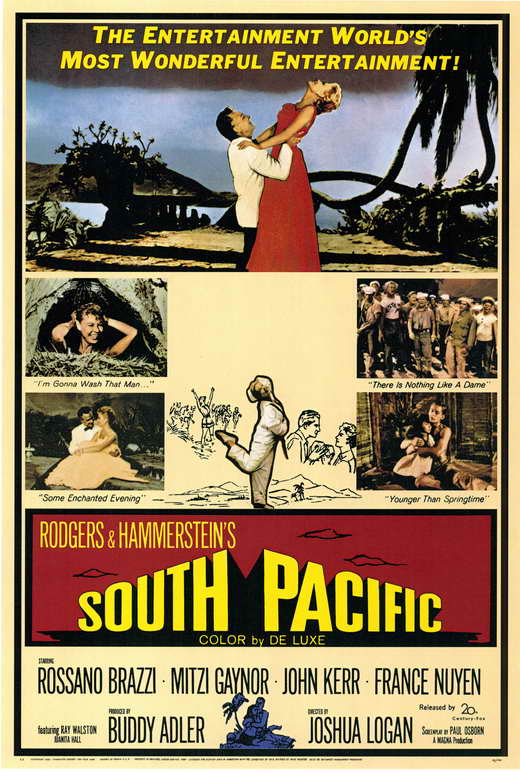
South Pacific (1958) Director: Joshua Logan Writer(s): Paul Osborn Starring: Rossano Brazzi, Mitzi Gaynor, John Kerr
History lesson: after the successes of Carousel and State Fair, Rodgers and Hammerstein decided to make their most ambitious musical yet. Allegro opened on Broadway in 1947, a minimalist production intended to reveal the plight of the average man in the ever-changing world. To date, Allegro is perhaps the most divisive musical ever. Some critics think it is one of the best the medium has ever produced; others consider it a pretentious, slipshod mess. I'd love to offer my own thoughts, but there is no Allegro movie for me to review. Also, since Allegro bombed at the ticket office, few productions and revivals have been seen since. Thus, I have not seen it. The financial failure of Allegro was such that Rodgers and Hammerstein went back to the drawing board and decided to create a more conventional musical. The result was 1949's South Pacific, made into a movie in 1958.
Critical appraisal: South Pacific isn't very good.
My opinion on this matter doesn't so much extend to the actual 1949 musical as it does to the 1958 movie. But, being honest with myself, I would have been unsatisfied with South Pacific barring even the flawed film-making. The songs just aren't as powerful or memorable as those of Carousel or even Oklahoma!. The characters are not engaging. The story and themes are neither groundbreaking nor timeless. Throw into this several moronic filming decisions and South Pacific feels as if a manipulative, monotonous, and malodorous movie.
South Pacific takes place on an island in the South Pacific (duh) during WWII. United States Marines and navy men have a base on site, on which they have a lack of women. A new officer arrives in Lieutenant Cable (John Kerr), sent as part of a spy mission against the Japanese forces. He seeks aid from a local, refugee Emile de Becque (Rossano Brazzi), who refuses the offer due to his trying to make a new life with an American nurse, Nellie Forbush (Mitzi Gaynor). But problems emerge, as Emile has two half-Polynesian children from a previous marriage, and Cable falls in love with a Polynesian girl. Nellie, raised in the then-racist Little Rock, Arkansas, has severe difficulties with Emile having those children. Various hijinks and adventures commence in the islands of the South Pacific.
Now, South Pacific is usually cited as one of the musicals that dared tackle the issue of racism. It was a pioneer of its time, being one of the first, if not the first, to say racism is wrong. The musical number, "You Have to Be Carefully Taught," is about the systemic development of racism in America. This would be a tremendous accomplishment in South Pacific's favor, if not for its poor development. By the end of South Pacific, the only real message is "racism is wrong." We already know this. Now, more tasteful movies like Do the Right Thing, 12 Years a Slave, and The Defiant Ones challenge us with the racism plaguing America; they draw out the problem and explore the causes and consequences. When characters ultimately reject racism, they have grown significantly. The characters in South Pacific turn from racist to non-racist within the span of a single jump cut. Furthermore, I'm skeptical of whether or not South Pacific was really the best context to examine issues of race. Perhaps anti-Polynesian tendencies were far worse than I realize, but it seems as if discrimination against the Japanese would probably be a more daring starting point.
Not to mention, any attempt to salvage this message is ruined by the film's... disturbing undertones. Lieutenant Cable falls in love with the daughter of one of the natives. The girl looks as if she is under 16 years old, while Cable is clearly over 25. The music number they share is called "Younger than Springtime." They make love in their very first scene, without even having a conversation prior to this! By the second act, these two want to marry! I know the point of this story is to break down the race barrier, but the AGE barrier between the two is a big problem. I didn't want these two to get together. I wanted Cable to be put under a restraining order. Oh, and the girl has no purpose other than being a telos for Cable. Brilliant.
Granted, it is not as if Cable is much better. Cable is Curly without the singing voice; he has no purpose other than being a knight in shining armor. Rossano Brazzi does a fair enough job as de Becque, easily the best character in the show, but I'd be lying if I said an Italian playing a Frenchman wasn't distracting as heck. His French accent is terrible, and there's no mistaking the Italian origins of his baritone. Mitzi Gaynor plays Nellie with some spunk, but her character comes across as remarkably superficial. The woman turns on a dime. Her racist tendencies turn her away from Emile briefly, but the mere act of giving her flowers is enough to bring her back. Nellie basically contains every negative female stereotype rolled up into one package: total domestication, inability to function outside of her relationships with men, ditziness, and emotional hysteria. The only other character I had a soft spot for was Ray Walston as Luther Billis, a snide soldier who manipulates his officers in order to get what he wants. He did bring up quite a few laughs, so I'll give credit where it is due.
But the music must be able to save the movie. After all, Oklahoma! suffered from bad character work, but the music was able to redeem it. Sadly, that's not the case. "Some Enchanted Evening" is unimpeachable, but nearly every other song in the movie feels shallow and rushed. "There Is Nothing Like a Dame" and "I'm Gonna Wash That Man Right Out of My Hair" are annoying and even somewhat sexist. Some of the numbers ("A Cockeyed Optimist; "You've Got to Be Carefully Taught) are barely two minutes long: not enough to leave an actual impact. Either tons of music was cut out for time, or Hammerstein didn't write enough lyrics to leave a sufficient impact. The result is "drive-by musical theatre": the movie comes along and sprays us with songs that have no real purpose. South Pacific favors quantity of songs over quality of songs. Plus, they happen in such quick succession that the music almost becomes background noise.
And don't get me started on the backgrounds. During some of these musical numbers, the studio decided to drastically change the color saturation on the film. There are points where the screen turns almost completely yellow. I'd love "Some Enchanted Evening" so much more if I could actually see Emile singing it. It would be one thing if this only happened during the songs, but entire scenes are shot in the same yellow filter. At other points, the studio went the cheap way out, adding in a blue filter instead of shooting a scene at night. That is not symbolic; that is lazy. Directors can get away with those techniques on a stage, but movies demand effort.
That is what South Pacific lacks: effort. The characters, with only a few exceptions, are lazily written. The songs are thrown in and are of little consequence. The cinematography is horrible. The sound mixing is amateur. The themes are tepid. The pacing is inconsistent. South Pacific is a bad movie. I'm sorry, R&H, but this film gets a complete thumbs-down.
Recommendation: Watching South Pacific is a movie experience I wholly regret. It's something I wouldn't want to subject anyone else to. If you are a die-hard Rodgers and Hammerstein fan, I guess there's no stopping you, but for anyone else, this is a definite skip. I will say, though, I would not be opposed to go seeing a stage production of this. Maybe the actual, physical show is better. Fingers crossed.
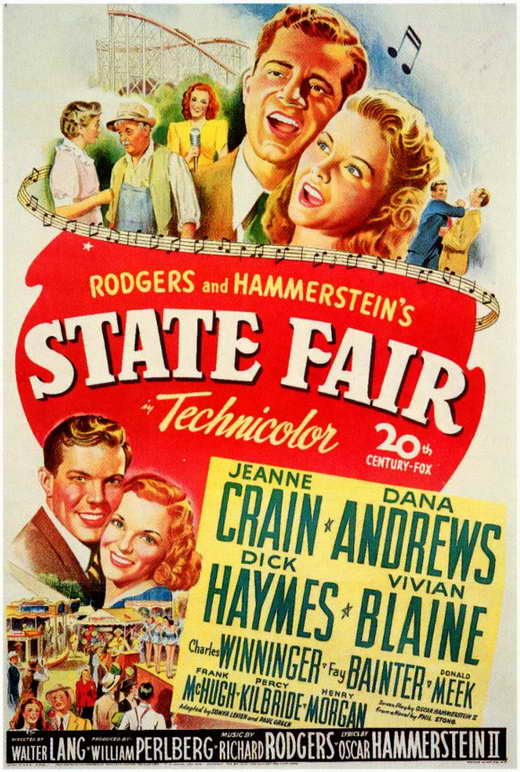
State Fair (1945) Director: Walter Lang Writer(s): Paul Green, Oscar Hammerstein II, et al. Starring: Jeanne Crain, Dana Andrews, Dick Haymes, Vivian Blaine
State Fair and Carousel came out pretty much at the same time; presumably, the two were written at the same time. But there's a huge difference between the two productions. While Carousel is an adaptation of a play, State Fair is a remake of a movie. Rodgers and Hammerstein's involvement in State Fair really only extends to the music and lyrics; they were already stuck with the plot. Thus, most of my criticisms will only extend to the movie itself and not R&H's work. That being said, State Fair dumbs down much of the material from the original movie. While the first State Fair is a more "scandalous" story, State Fair plays it very, very safe. As a result, it's just kind of OK.
Abel (Charles Winninger) and Melissa Frake (Fay Bainter) are two Iowa farmers preparing for the annual state fair, preparing their prize-winning boar and mince meat respectively. Things aren't so happy for their children, Margy (Jeanne Crain) and Wayne (Dick Haymes). Margy seems to have Disney princess syndrome (i.e. constantly wanting more) and Wayne's date cannot go to the fair because her mother is sick. Conveniently, both of them find new love interests at the fair: a news reporter (Dana Andrews) and a nightclub singer (Vivian Blaine). Hijinks ensue at the fun state fair.
State Fair is a romantic comedy that forgets the comedy. There's really only one joke that gets a laugh, but it is a good one; Melissa's mince meat is supposed to be made without brandy in it, but, over the course of the movie, brandy keeps finding its way into the dish. The effect on the judges is priceless. Otherwise, the humor of State Fair comes from a pair of pigs that fall in love with each other, badly placed puns, and forced awkwardness.
As a result, one really just watches State Fair for its plot. I do have to hand it to State Fair: I genuinely did not know what was going to happen. While one could say that the film uses several clichés and tropes to keep its plot moving, I was not certain how they were going to be used. At points, the film genuinely surprised me, especially the reveal of the Vivian Blaine character. Sure, there are contrived misunderstandings, last minute choices to be made, but they do factor into the fun factor of State Fair. Despite the story being as simple as Green Eggs and Ham, it is kind of fun.
This is where the music is the saving grace of the movie. If not for the songs, State Fair would be next to unbearable (well, unless one derives pleasure from watching Oprah-endorsed sap-fests). Fortunately, State Fair has two very good songs. One is "It Might as Well Be Spring," Margy's lament of her situation. Though Jeanne Crain seems to be giving her best Judy Garland impression, it's pleasant enough. The big number, though, is "It's a Grand Night for Singing," one of the catchiest songs ever written. This ear worm of a melody will not go away once heard; fortunately, Richard Rodgers is a competent songsmith, so it's not annoying. The light bounce of the melody does replicate the feeling of the fair. It's a lot of fun, and it does not get tired with age.
In terms of production, State Fair looks and sounds crisp. It may be because I watched a remastered version of the movie, but everything is mixed very well. I bring this up because sound mixing is incredibly important in a movie musical; we'll talk more about this when I someday review Les Miserables. The camera work isn't daring in any way, but the set is very nice. Having gone to a few state fairs, this is what one of them looks like.
The main problem with State Fair, though, is the character work. As in, there's none of it. The characters are pretty much substitutable with any other rom-com characters of the era. The most one can say is that these characters sing as opposed to make jokes. The actors clearly do their best, but they have next to no material to work with. As a result, the movie doesn't make us care about what's going on. A viewer could feasibly space out and come back in without missing anything important.
But I'm not sure if State Fair is really about character. If one views the movie as a series of vignettes, it's actually pretty enjoyable. Much like Oklahoma!, there's no real moral value to it. But, I admit, I had fun watching this movie. Is it great? No. Is it even good? Probably not. But I did not regret watching it.
Recommendation: State Fair is much like cheap Chinese take-out: it satisfies for an hour but soon leaves one hungry again. If you like Rodgers and Hammerstein, I'd say a watch is deserved. If you like musicals, then I wouldn't turn you away from this film. But if you're looking for a great classic movie, State Fair is not what you are looking for.
I give State Fair 5.2 stars out of 10.
Oh, I will not be reviewing the 1962 remake of this movie. Why? Two words: Pat Boone.
Carousel (1956) Director: Henry King Writer(s): Phoebe Ephron, Henry Ephron... as adapted from Richard Rodgers and Oscar Hammerstein II. Starring: George MacCrae, Shirley Jones, Susan Luckey
"If" is the most important word in Carousel. It is a word loaded with connotations of condition, of hope, of time spent and to come, of uncertainty, and of responsibility. It is the word that cemented Rodgers and Hammerstein's status as the premier musical writing team of their era, the word that brought the musical play into the status of high art. While I personally do not consider Carousel to be the greatest musical ever written (a review for another day), it is easily within the top ten, if not the top five. I may have had problems with Oklahoma!, but Carousel is a nuanced exploration of poverty, dysfunctional families, responsibility, and sexual expression. How are all of these themes jammed into two and a half hours? Let's find out.
Adopted from the play, Liliom, Carousel begins in medias res with a man named Billy Bigelow in a state of Limbo. Granted, the effects during this portion of the film are terrible, but good musicals have never been about technical spectacle (cough, cough, curse you, Spiderman: Turn Off the Dark, cough, cough). Bigelow is given the chance to look back on his life, beginning with his career as a carousel barker. Bigelow becomes infatuated with a millworker, Julie Jordan, who returns his affections; sadly, this infatuation costs Bigelow his job. Though Bigelow marries Julie, the relationship turns sour quickly once Bigelow's limited skill set and overwhelming arrogance prevents him from getting a job. But, when Julie is revealed to be pregnant, Billy decides to earn enough money to support his child by whatever means possible. This decision proves to be Billy's literally fatal mistake. Now, Billy Bigelow must journey from Limbo to deliver a last message of forgiveness and hope to his wife and sexually frustrated and humiliated daughter.
Billy Bigelow is not a "good" person, at least in the sense that Curly from Oklahoma! is a good person. At his core, Billy is selfish; he values things and others only insofar as they are useful to him. In many ways, he is a man incapable of love, making the "if" of "If I Loved You" all the more important. Most of his career choices are dependent on his inability to accept anyone other than himself as his master. Nowhere is this selfishness more vivid than in "Soliloquy," the seven-and-a-half minute opus that is Billy's main song and the standard by which all musical theatre baritones are judged. Billy begins the piece determined that his new child will be a boy, a boy named after him no less. The child will participate in all the activities Bill enjoyed as a child; as for career aspirations, none of them matter so long as the young Bill has the same autonomy as the elder Bigelow has. Bigelow is essentially pouring all his love into himself.
The great tragedy of Carousel is Billy's inability to overcome or channel his selfishness. Several times throughout the film, Billy lashes out and strikes Julie and, later, his daughter. Each time, he claims that he merely "hit" them, whereas the rest of the world says he "beat" them. Bigelow is unwilling to accept that his actions are indicative of a far greater emotional problem: an almost sociopathic need for power and control. Even when he realizes that being father to a girl is meant to be a selfless, rather than selfish, act, he is unwilling to be her father on anyone's terms other than his own. He schemes to gain money through illegal means rather than taking a job of lower status, as he feels anything else is below him. The dramatic, tragic irony: by bringing himself into a life of crime and poverty, Billy is already putting himself below careers he disdains. His desire for freedom makes him even more a slave.
Yet I hesitate to think Bigelow's motivations are essentially wrong. The hope to achieve greatness or success for oneself, on one's own terms, is the essence of social mobility and the "American dream." The reason for Billy's failure, I think, is his obstinacy in going through his trials alone. Though Julie and her friends do their best to push Billy onto the right path, he outright rejects their offers and suggestions. He walks alone. The same does not apply for his daughter, a girl finally mature enough to control her own life. There is a reason "You'll Never Walk Alone" is a staple of high school graduations nation-wide. The song essentially outlines the virtues of Billy Bigelow's life philosophy while adding one essential addendum: you are not alone. Support systems, friends, and family are there to aid us in the paths we take, to be the cushion when not all goes as planned. Billy Bigelow shuts all this out, but it is not too late for his daughter.
Eut can his daughter excel? In the sexist world of Carousel, achieving one's aspirations is extremely difficult, especially as a girl. One of the most powerful scenes in Carousel is the ballet sequence in which the Bigelow daughter, Louise, is lured into a brief but fruitless relationship with the carnival, the same carnival that entranced Billy as a child. There are three distinct movements to the ballet: an initial sequence in which Louise dances with several boys in a tomboy-ish fashion, a second wherein she interrupts the prim and proper dance structure of the Snow family, and finally a third in which she dances with a boy from the carnival and is shamed for doing so. Dance sequences of this time nearly always are meant to represent something greater: in my opinion, the Carousel ballet is almost entirely about sex. Louise begins her teenage years willing to express her sexuality but unwilling to actually take part in sex, a lifestyle "unsuitable" for the cloistered Snow family. The carnival, however, is representative of a first sexual encounter, one for which Louise is repeatedly shamed. The ballet ends ambiguously, leaving the audience to determine if Louise's fate is of her own making or the prejudices and sexism of a malevolent world.
And then there's Julie. Some might accuse Julie of being submissive, actively defending her physically abusive husband. Yet there are real world analogues to this; thus, the tragedy of Julie's situation is even more palpable. In an important turn in musical theatre, Julie is our moral role model. She actively finds the good in every human being and tries to weed out the bad. She is persistent. Most importantly, she is the first person in the show to pass beyond the "if" of "If I Loved You." She has a true capacity to love, something most, if not all, the other characters in the show lack. Her joining the final "You'll Never Walk Alone" is one of the most powerful moments in the film.
The songs are nearly all fantastic. The only dud is the first actually sung piece, "(When I Marry) Mr. Snow," and it is only the weakest by virtue of its lack of memorability. The rest of the songs are unilaterally fantastic. "What's the Use of Wond'rin" and "You'll Never Walk Alone" are beautiful. "If I Loved You" is the best hypothetical love song ever written and is the thematic center of the show. "Soliloquy" is the most daring musical composition the Rodgers and Hammerstein team has ever written. It's a toss-up between "If I Loved You" and "Soliloquy" in terms of choosing the best song, but I feel making a choice is to discredit one of these musical treasures.
The only real flaws in Carousel are mostly those of film-making and cinematic limitations. Carousel does feel as if an expansive work, with an entire world to explore; I think the themes of the musical are enhanced when the actors are working in a more claustrophobic environment. This is especially apparent in the large choral numbers; while they work to establish setting and context, they do feel somewhat contrived when the physical setting makes it abundantly clear that it is early summer. Also, while the script given to Gordon MacCrae and Shirley Jones is so strong as to convey its themes without actual performances, Jones and MacCrae aren't fantastic actors. They get the job done, no doubt, and their singing is more important than their dialogue, but some of the inflections do fall flat. Otherwise, any criticisms I would make would be nitpicks.
Carousel is a vibrant, intellectually stimulating, enjoyable, thrill ride of a musical. Indeed, Carousel is so good that Richard Rodgers called it his best musical. But could he top it? While that question remains to be answered, the pair's next show was of neither the same caliber or the same scale. After all, it was written at the same time as Carousel, so one can't really blame the two from experiencing some professional burn-out. Nonetheless, the two created the soundtrack to one of the most... frustrating movies I've ever seen: State Fair. But that's a review for another day. As it is, Carousel is a musical so good one will never want it to stop.
Recommendation: The only people who shouldn't watch Carousel are those who hate musicals in general; even if Carousel is as fantastic as it is, I doubt it will change their minds. For anyone who has the slightest inkling of musical tolerance, Carousel is a must-watch. And, if you are dead-set on not watching this movie, I implore you, see the actual musical if it comes by your area or is revived on Broadway.
Oklahoma! (1955) - A Rodgers and Hammersmonth Review Director: Fred Zinneman Writer(s): Sonya Levien and William Ludwig... adapting the work of Richard Rodgers and Oscar Hammerstein III Starring: Gordon MacRae, Shirley Jones, Rod Steiger
Welcome to a project I like to call "Rodgers and Hammersmonth." Throughout the month of July, I'll be reviewing the films of Rodgers and Hammerstein, arguably the two most important figures in musical theatre history. Though these reviews are reviews of the film adaptations, first and foremost, I will offer my thoughts on the significance of many of the shows described. But these are movies; if the production values are inadequate, I will make note. I will be writing other movie reviews during July, of course; the Rodgers and Hammerstein reviews aren't intended to be contiguous. These are just some notable films that I wanted to review.
Oklahoma! is the first musical produced by the Rodgers and Hammerstein team, a musical first put on the stage in 1943. It marked a revolution in musical theatre not for its story or even its musical composition: the great advance of Oklahoma! is its pacing. Prior to Oklahoma!, musicals, both movie-based and otherwise, didn't really know how to handle the entire "music" element. Musicals did not want to adopt to the operatic style, featuring only singing, nor did they want to be ordinary plays/movies with no singing. Songs, then, were sporadically placed. The problem: often times said songs had nothing to do with the plot. This doesn't mean said numbers couldn't be meaningful and culturally important (see "Remember My Forgotten Man" from Gold Diggers of 1933), but it did mean that the musicals lacked fluidity. If you want a good example of how this style is inherently flawed, watch The Incredibly Strange Creatures Who Stopped Living and Became Mixed-Up Zombies, one of the worst, if not the worst, movie musical ever made.
Oklahoma! makes the smart decision to integrate the songs into the musical as essential elements for the plot and characterization. The music is an extension of the story. This revolution has led most musical theatre critics to characterize shows as either "pre-Oklahoma!" or "post-Oklahoma!" The 1955 film adaptation of Oklahoma! brought the show to new audiences who missed its incredible initial Broadway run. The question is: does this landmark of a musical still hold up?
Curly (Gordon MacCrae) is a dashing cowhand with great affection for farm girl Laurey Williams (Shirley Jones). It's clear that Laurey's Aunt Eller (Charlotte Greenwood) approves of the relationship, though there is a massive wrench in the form of Jud Fry (Rod Steiger), an aggressive farmhand who desires Laurey for himself. At the same time, Laurey's friend Ado Annie (Gloria Grahame) finds herself caught in a love triangle between a pandering salesman (Eddie Albert) and a down-to-earth rancher (Gene Nelson). All these elements combine together to produce a rousing musical experience.
Or not.
I knowOklahoma! is a musical landmark. I know nearly everyone else likes this movie wholeheartedly. And, indeed, I do like a lot of things in it. Gordon MacCrae and Shirley Jones sound fantastic on most of these tunes. Most of the tunes are very well-written. The colors are quite vibrant. But all of these things must fade into the background when one considers the emotional and moral shallowness of the actual story. Both of Oklahoma!'s plot lines could be featured in an episode of Dudley Do-Right; they are cliché in every sense of the word. The story of Oklahoma! is essentially that of The Great Train Robbery. A dark, villainous force threatens the virginal female, only to be defeated by a dashing knight in shining armor. This is the Curly-Laurey-Judd plot note for note. Curly is meant to be the handsome, sweet-voiced knight who must come to Laurey's rescue from the hulking Jud. The Annie plot is rather similar, only this time the dark figure, the salesman, actually wants to get rid of Annie. It is thus of even less consequence, and we care even less about it.
Complaining about a movie musical's being intellectually sophomoric is preaching to the choir: pretty much every movie musical nowadays is laughed off for the same reason. (God help you if you are a musical adaptation of a previously acclaimed work i.e. Man of La Mancha, Les Miserables, Rent.) But, as a lover of all things musical theater, I want to cut Oklahoma! some slack. After all, Rodgers and Hammerstein were first starting out. They must have been focused primarily on the music and the lyrics. And, in the context of the original musical, most of the musical motions make sense. But the movie makes cuts to the musical that are nigh irreconcilable.
Let's discuss the most glaring cut from the movie: the villain song, "Lonely Room." For those who haven't heard it, "Lonely Room" is the "Hellfire" sequence from The Hunchback of Notre Dame on steroids. "Lonely Room" is Jud's final plead for recognition and sexual satisfaction, as he vents his frustrations with his poverty and his social ineptness to the audience. When put in the hands of the right actor, this song can be downright chilling. Granted, hearing Rod Steiger sing an entire song is a frightening enough thought, but the actual quality of the song could have carried across the point. The reason this cut is so horrific is Jud's resulting lack of character. Without "Lonely Room," we have little grasp of Jud's motivations. His desperation at the end of the film comes across as sporadic rather than part of a carefully designed musical arc.
The Ado Annie arc, while having a decent amount of character, ultimately amounts to a pretty shallow experience. We learn Annie can't help herself in the most overused audition song in the history of mezzo-sopranos, "I Cain't Say No," an almost insufferable musical experience due to Gloria Grahame's horrible voice. Her knight in shining bootspurs gets a fun dance number in "Kansas City," but the song actually reveals nothing about him. The salesman's song was cut, another problem with the film's characterization, leaving us only with "All 'Er Nuthin'" to wrap up the storyline once it is over. The only truly developed arc is that of Curly and Laurey. Not only does the duo get the show's best songs - "Oh, What a Beautiful Mornin,'" "The Surrey with the Fringe On Top," "People Will Say We're In Love" - but they also sound the best on them. Granted, I would have preferred if "People Will Say We're In Love" was a bit less overblown and a bit more hushed, but the music works. Not to mention Shirley Jones and Gordon MacCrae have voices that meld perfectly.
I know the preceding few paragraphs were pretty harsh, but I think the great team of R&H can take it. The two are legends, and they kept growing as they went on. If one looks at the rest of Oklahoma!, the material is quite strong. The dancing is all top notch, even if the "Farmer and the Cowhand Should Be Friends" number overstays its welcome. The centerpiece of the show, Laurey's dream ballet, is absolutely beautiful; it even gives us a taste of the "Lonely Room" musical motif the movie lacks. But the golden star has to go to "Pore Jud is Daid," quite possibly the funniest song in all of musical theater. One wouldn't think a song about convincing someone to commit suicide could be funny, but once Jud starts to imitate Curly's obsequiousness, the effect is priceless.
Oklahoma! is a landmark show but a primitive show. Its film, however, lacks the landmark status. So, when I give a final rating, it's going to take the musical's many flaws into account. But, as it stands, Oklahoma! is an important piece of theatre, if not the best piece of theatre. Fortunately for viewers, the next outing from Rodgers and Hammerstein wouldn't just be a better musical. It would be a fantastic musical, a musical so good many critics still call it the best musical ever written.
Recommendation: Oklahoma! may have the emotional and intellectual value of Fruit Loops, but it is a fun watch. It is wholly accessible for children and adults alike; there is a reason this film was the blockbuster of its era. While I'd recommend introducing someone to the actual musical first, Oklahoma! is a satisfying movie if you feel the urge to sing along.
I give Oklahoma! an even 5 stars out of 10.
...did I somehow write this entire review without talking about the title song? Great, now it's stuck in my head again. "Oooooooooklahoma, where the wind comes sweeping down the plain..."
The thorn in one's side. The inkling of error. The flaw so glaring that one is forced to tell one's peers "just ignore that." These are the characters we hate in films we like. Just as every movie critic, I have certain characters I like/hate, and these are the ten that make me feel the most pain, irritating me to no end while I watch movies I enjoy.
Honorable Mentions:
John Connor - Terminator 2: Judgment Day
I know John Connor is an easy target, what with him being one of the most hated characters in action movie history. To his credit, Edward Furlong is clearly trying throughout this film. The problem isn't his acting, but the writing. The dialogue poor Edward has to deliver has just not aged well. "Hasta la vista, baby" has only endured because of Arnold Schwarzenegger's awkward pronunciation, not its enduring social value. John Connor could have worked had only the writers worked a little bit harder.
Violet Beauregarde - Willy Wonka and the Chocolate Factory Willy Wonka and the Chocolate Factory is one of the great family films, capturing all the magic of the cinema in one two hour package. It is a film with great characters, wonderful music, and a strong moral center. The only flaw in it is Violet Beauregarde: was Roald Dahl really concerned about gum-chewing? Is this as bad a quality for children to express as gluttony, television addiction, and brattiness? I have my trepidations. Otherwise, Beauregarde is just a snotty child who is wholly unlikable. And, unlike Veruca Salt, Violet Beauregarde is not punished for her true sin. Her being a snot is just thrown in for no clear reason.
Elle Driver - Kill Bill Vol. 2
I talked about Elle quite a bit in my Kill Bill comparison, but I just find her wholly unlikable. Villains like Budd, Gogo, and Vernita Green are all enjoyably villainous, but Elle is, pardon my French, just a b*** with a samurai sword. Her relationship with the Bride is rushed and almost forced, and we learn that she killed Pai Mei with a method as simple as poison. She's a back stabber with no grace or likability, resulting in an instantly hateable character.
Let the actual list commence.
NUMBER 10
Ariel from The Little Mermaid.
Ariel gets a lower spot on this list due to every other critic tearing her a new one. Ariel is a feminist's nightmare, garnering praise for being the first active Disney princess while garnering scorn for being the first Disney princess to act in a wholly morally reprehensible manner. In the original fairy tale, the Little Mermaid pays in full for selling her soul for sex; in the Disney version, Ariel is rewarded, getting exactly what she wants. She never has to face the consequences for her action, relying on others to save her at every opportunity. While she does save Prince Eric once, she saves him through the most stereotypical "girlish" means possible: pulling on Ursula's hair.
So, what about Ariel aggravates me? Putting it bluntly, Ariel is little more than a whining brat. Every moment she's with her father, she adopts a tone of entitlement and ignorance. She cares for no one other than herself, hardly showing self-sacrifice. "Part of Your World" may be pretty, but it is little more than Ariel whining about wanting "more." Why would one want more when one is a princess surrounded by anything a girl could ever want? Certainly, there must be plenty of mermen eager to court King Triton's favorite daughter. What is it about Eric that makes him so special? He has no personality. Why should Ariel even care about him? For her emotional shallowness and sexist elements, Ariel wholly deserves her spot.
NUMBER 9
The Lizard from The Amazing Spiderman
I, along with many others, consider The Amazing Spiderman to be a superior film to the original Sam Raimi Spiderman. While Andrew Garfield lacks the nerdiness of the Tobey Maguire Spiderman (though he retains the geekiness), he does have a charm and full control of his superhero persona. The supporting cast is a vast improvement, what with Martin Sheen and Sally Field stepping in as Uncle Ben and Aunt May. Discussing Emma Stone as Gwen Stacy is almost redundant: everyone else has explained how brilliant she is. There's only one element of The Amazing Spiderman that is not better than that of the original movie: the villain.
Curt Connors is meant to be an interesting Jekyll and Hyde type villain with total control over reptilian life. He is a ferocious monster, with teeth and claws powerful enough to rip through steel. His desire to exterminate all mammalian life makes him one of the most dangerous Spiderman villains, even if he's not the most popular. However, the Lizard of The Amazing Spiderman is kind of dull. His motivations for evil are incredibly vague, as the Jekyll and Hyde persona never takes full shape. Connors actively tries to help the Lizard, as opposed to being terrified of his other half. Adding to the faults of the Lizard is his horrendous design. While he did look like a humanoid lizard, he lacked the ferocity required of the character. Is it that difficult for CGI animators to add teeth? Whenever the Lizard was on screen, all I could feel was disappointment as one of my favorite comic book villains got the shaft.
NUMBER 8
Cosette from Les Miserables
Few things irritate me more than useless female characters, female characters that serve no purpose other than being the telos of a male character. As a society, we have progressed beyond The Great Train Robbery; we deserve to have female characters that have characters. Thus, Cosette from Tom Hooper's production of Les Miserables comes across as one of the most useless female characters in recent memory. I ask one simple question: does Cosette do anything?
Really, Cosette does nothing of consequence throughout the entire musical (one of the many faults of the musical as well as the movie). She is a being acted upon rather than acting. The entire "In My Life" song is the only piece in which she is given an inkling of character development. And, even then, her main function is that of an exposition fairy: announcing the helter skelter nature of the Valjean family life to the audience. While she laments being treated like a child, she does nothing to prove that she has moved beyond this. Otherwise, she is just wall-candy. Her high notes may be pretty (well, as pretty as Amanda Seyfried can make them), but her character is non-existent.
NUMBER 7
Lois Lane from Superman: The Movie
I hope my readers are sensing a pattern here. Useless female characters are arguably the single greatest plague upon movies I like. Maybe the writers focus too much time on the male character development. Maybe there are professors deliberately trying to tell students not to pass the Bechdel test. I don't know the full details. All I know is this: characters like the Lois Lane of the original Superman movie are disgusting.
Lois Lane is the typical plucky, career-empowered woman who suddenly turns into a ball of jelly as soon as a man comes along. We see the same kinds of problem with Megara of Hercules, Padmé Amidala of the Star Wars prequels, and Princess Katey of A Kid in King Arthur's Court, to name a few. These characters are usually found in fantasy/sci-fi films, presented as an initial mentor to a character who then becomes next to useless once the main villain emerges. Lois Lane doesn't fall into all of the traps, but she does fall into an even worse category: a character who really only cares about sex. No sooner does she learn that Superman has X-ray vision than does she ask "what color is my underwear." Is this supposed to be our model of a strong career-driven woman? One who women are supposed to aspire to be? A person we are supposed to care about? To be frank, I wish this character died in the end: not only did the terrible ending of the original Superman make no sense, but it also resurrected an absolute waste of time.
NUMBER 6
Hugo from The Hunchback of Notre Dame
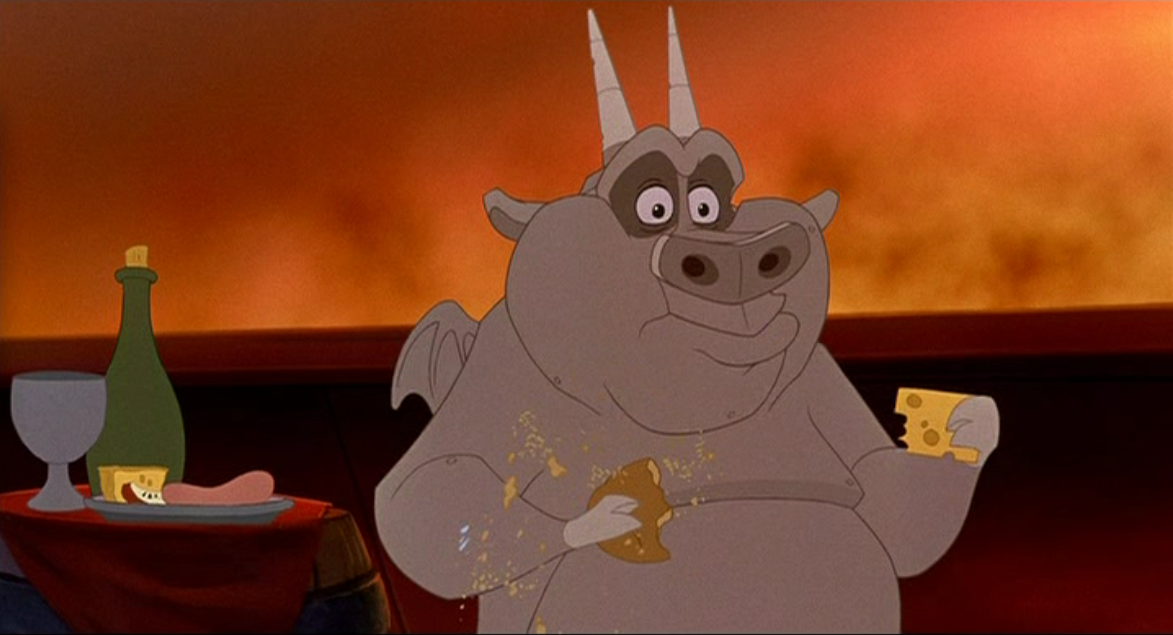
The absolute worst of the Disney comic relief characters, Hugo manages to be a massive distraction to the otherwise powerful gothic atmosphere of The Hunchback of Notre Dame. All of the gargoyles are tonally dissonant from the rest of the movie in the worst way possible. They make no meaningful contribution to the plot, as Quasimodo is perfectly able to express his feelings through song as opposed to half-baked dialogue with a trio of animated statues. Granted, they do have distinct personalities, but they lack character arcs, they don't function properly as figments of Quasimoto's imagination, and, worst of all, they just aren't funny.
Hugo is the worst of the three. How dare a movie make Jason Alexander not funny? We know that Jason Alexander can be one of the most humorous men on the small screen, but he's also demonstrated great vocal chops in the Aladdin television series and sequel. In this film, he serves no purpose other than to be a gluttonous jerk. He's insensitive to Quasimoto's needs, as the "A Guy Like You" sequence really doesn't help Quasimoto's love life at all. He is indifferent to the suffering of others, as clearly shown by his roasting a hot dog over a burning Paris. Above all, he is just annoying and even somewhat creepy. I'm pointing directly to you, implied bestiality humor.
NUMBER 5
Voldemort from the Harry Potter film series.
Note: I only refer to the Harry Potter film franchise. The Voldemort of the books is exonerated from this discussion. This is the only entry on this list that is wholly the fault of the actor and not the writers or directors. Putting it blunt, Ralph Fiennes should know better than this. He's a Shakesperean-trained actor; he should know better than to turn Voldemort into a chicken-dancing goose who likes to stick out his tongue. Just like Hugo, Voldemort is enraging due to his tonal dissonance; his silly behavior is utterly unbefitting the Harry Potter movies. Ever since the third Harry Potter movie, the films have adopted specific color schemes and cinematographic styles to better reflect the themes and emotions of the films. Voldemort, on the other hand, is a constant distraction, what with his bizarre strutting, awkward delivery, and overall hammy performance.
I'm not going to be dishonest in the same fashion as most people in my age group: the Harry Potter series isn't fantastic in a wholly new way. It follows roughly the same plot as every monomyth tale; the comparisons to The Lord of the Rings do not go unnoticed (especially with the very concept of Horcruxes). The only reason the Harry Potter series has endured as a lasting piece of pop culture is its allegory. It is very clear that the entire Harry Potter series is an allegory for the Holocaust (swap out "pureblood" with "Aryan" and "mudblood" with "Jew," and the parallel is uncanny). As a result, it has more intrinsic value than the thousands of other "chosen one" stories. Therefore, I find it personally infuriating that the wizard equivalent of Adolf Hitler is turned into an over-the-top idiot. How can I take the villain for a serious threat when he is this silly?
Thank goodness Helena Bonham Carter is there to counteract this performance.
NUMBER 4
Mae Wynn from The Caine Mutiny
Most of the other characters on this list are pretty common targets, but Mae Wynn from The Caine Mutiny is far less known. She's also the worst acted character on the entire list; I may have ragged on Ralph Fiennes's hamminess, but I'd take hamminess over monotone any day. Every second Wynn is on screen is a second wasted. She has nothing to do with the plot of the movie. She has no character. She satisfies every bad female character trait we've seen in the preceding entries (no purpose other than eye-candy, cares only about her man, has no development) while also having the dishonor of being horribly acted.
Mae Wynn (the actress has the same name as the character) is so bland, so forgettable, and so pointless that her performance is actually kind of fascinating. Her placement in the movie is forced in a way unique to movies I've seen. It feels as if someone deliberately wrote her into the movie after the main shooting had been finished. I would not be surprised if she was a relative of one of the producers who wanted to put her into the movie. Either that or... insert your own sexist joke here.
NUMBER 3
J. W. Pepper fromLive and Let Die and The Man with the Golden Gun
Now the list is getting offensive. As someone who loves the James Bond films for their cheesiness and mindless escapism, I am fully aware of the many, many problems with the franchise (i.e. pretty much every girl in the series). Live and Let Die may be one of the more fun entries in the Bond franchise, but it is perhaps Bond at its most culturally insensitive and despicable. One wouldn't think it is possible to get worse than the following film premise: a white, British agent is called in to save a white girl from an army of African-American, voodoo-worshipping, Afro-sporting, cocaine-dealing gangsters. But Eon Productions managed to do it by hiring Clifton James as J.W. Pepper.
J. W. Pepper is the worst of the worst, the cherry on the sundae of the many offensive characters in Live and Let Die. Pepper is a racist, foul-mouthed hick of a sheriff who follows Bond around in an attempt for the movie to have some comic relief. Now, aside from such a character's utter uselessness (Bond is already comic relief enough), Pepper manages to be annoying in every sense possible. His drawl is nearly impossible to decipher unless he is swearing. He screams and hollers at any possible moment. He continually interrupts a genuinely entertaining boat chase. He has to say the name "Billy Bob" several times, as if to hammer home the fact that he is a Southern hick. Finally, Pepper is a wholly apparent racist and is never punished for that fact. (Though, coming from Live and Let Die, I'm not very surprised.) Pepper's encounter with Bond is forced and amounts to nothing story-wise. By the end of the film, every second with Pepper is a second wasted.
That would be enough to secure Pepper a nice place at the bottom of this list. But Pepper has the gall to come back for the sequel, The Man with the Golden Gun. I don't know if the writers were hoping to make Pepper a constant presence in the series, but it was a bad idea to have James reprise this role. If it were possible, Pepper has even less to do with the plot of the movie. We only manage to run into him because he, coincidentally, happens to be on vacation in the same place as Bond's mission. Bond coincidentally uses his car for a chase, leading Pepper to make loud, obnoxious commentary throughout the entire sequence. It's quite a shame, because The Man with the Golden Gun has a far greater sense of intrigue than Live and Let Die; it ends up being an even worse movie due to Pepper's uselessness and the unnecessary camp found in the film's other elements.
I enjoy the Bond films despite their many faults; the preceding two films are arguably bad movies, but I enjoy them for their silliness, not their insensitivity. Pepper, on the other hand, is reprehensible in every conceivable way. He is annoying, racist, and repugnant. I watched these movies to see James Bond, not Jerry Springer.
NUMBER 2
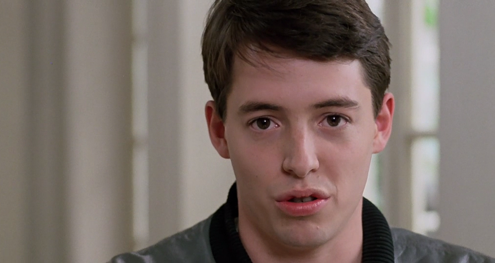
Ferris Bueller from Ferris Bueller's Day Off
I went there.
It's kind of hard to talk about Ferris Bueller's Day Off without talking about Ferris himself. For many, he's the epitome of cool, with an appropriate life philosophy for someone of his age group. Empire Online named Ferris Bueller the fifteenth greatest character in movie history. Richard Roeper, a film critic I highly respect, once called this film his absolute favorite. So, it's safe to say that Ferris Bueller is a pretty well-liked character.
So, why do I hate Ferris Bueller? Perhaps it's his utter disregard for authority of any kind. Perhaps it's his selfishness. Perhaps it's his signs of sociopathy. But, to me, none of these problems are as glaring as Ferris Bueller's hypocrisy. The clearly stated moral of Ferris Bueller's Day Off is "stop and smell the roses before they die." That is an important message for us to consider: one can busy oneself with the rat race of life, but if one never appreciates the joys of it, for what purpose has the journey been at all? The crazy antics, the care-free attitude, the potential illegality of his actions: all of this could be passed off as one creative high schooler's last hurrah.
If not for the fact Ferris has done this same act NINE TIMES!!!
Seriously, no one remembers Ferris Bueller changing his absences? It's very apparent that Ferris has been truant several times throughout the year, probably for the same silly reasons as those shown in this movie. (It's a sunny day. Seems like as good a time as any to skip school!) During that time, who knows how many parades he's sabotaged, cars he's ruined, girlfriends he's been inconsiderate to, best friends whose lives he's ruined, principals he's accidentally maimed, nervous breakdowns he's incited, classmates from whom he's extorted money? This movie shouldn't be called Ferris Bueller's Day Off; it should be called One of Ferris Bueller's Days Off.Ferris Bueller's Day Off has a positive message for high schoolers, but the film undermines the message with his lack of consideration for anyone but himself. Call me Principal Rooney, but get this child back into the classroom; after all, his grades demonstrate that the education process has not been wasted on him!
NUMBER 1
You got lucky...
Jar Jar... Just kidding.
As much as I dislike Jar Jar Binks, he's not the character I hate the most from films I like. That dishonor, though, does go to a character from the Star Wars prequels, films I enjoy despite their flaws. The dishonor goes to one of the worst villains I've ever seen in a movie, a character so offensive as to make my blood boil, a character so flat as to make my critical senses go haywire out of rage, a character so useless as to bore me out of my wits. Without further ado,
THE REAL NUMBER 1
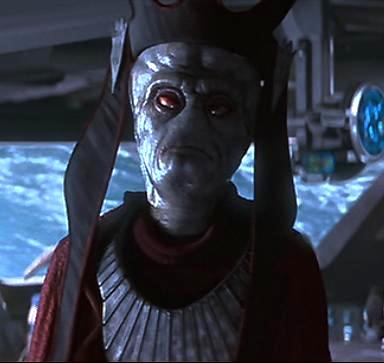
NUTE GUNRAY from the Star Wars prequels.
Dear Asian people, on behalf of George Lucas, I apologize.
Nute Gunray is... disgusting. One knows the prequel films are going to be bad when this Neimoidian slime is one of the first characters we encounter. Jar Jar may have been bad, but at least he is trying to be funny. Nute Gunray seems to be doing everything possible to be the worst villain ever created for a blockbuster film franchise. Great villains are those that we love to hate. Bad villains are either ineffective or so hateable as to have no elements to enjoy whatsoever. Gunray is the latter, a character so despicable as to offend me in every conceivable way.
Nute Gunray is a genocidal murderer. Throughout The Phantom Menace, it is heavily implied that Gunray is responsible for the murders of Lord-knows-how-many Nabooians during the main events of the film. He sets up death camps (that we never see; shame on you, Lucas) in which he and his army of boring droids can exterminate whomever they desire. All the while, Gunray is a simpering coward who has his droids do all the work for him. He hires bounty hunters to do his dirty work once the bulk of his Federation troops are put out of commission. He hides behind General Grievous and does whatever his dark masters tell him. He is a rat, first and foremost. There are plenty of genocidal murderers in fiction who are good villains (i.e.Kefka Palazzo from Final Fantasy VI, Hans Landa from Inglourious Basterds, to name a couple), but Gunray lacks any of their gleeful evil. He's just a despicable coward.
Then there's the offensive content. Actor Silas Carson approaches the role of Gunray with all the cultural tolerance of Archie Bunker; his short delivery is meant to replicate the often short phonemes of East Asian languages such as Mandarin. The make-up design highlights his eyes in a wholly racist fashion. Adding to this is the fact that Gunray leads a Trade Federation, a not-so-subtle jab at the Chinese exporting sector. George Lucas implicitly aligns all Asians or people of Asian descent with this character, presenting them, in turn, as genocidal, cowardly scumbags. Jar Jar may have made people of the Caribbean sound like retards, but at least they weren't aligned with genocide. Once again, Asian people, I apologize.
Most annoying of all is the fact that Nute Gunray sticks around for three entire movies. All the other villains in the prequels are killed off quite unceremoniously. Darth Maul, the character who first introduced a saber-staff to the Star Wars films? Cut in half. Jango Fett, the bounty hunter predecessor to Boba Fett? Decapitated. Count Dooku, a turned Jedi played by the greatest villain actor in history, Christopher Lee? Beheaded. General Grievous, an admittedly wasted villain who still enjoyed some of the best fight choreography in the series? Blown up from the inside. Nute Gunray manages to outlive all of these villains. The character with no potential to develop, no likability, no creativity, no interesting traits whatsoever lives while all these great sources of Star Wars fun die.
Nute Gunray is offensive. Nute Gunray is a genocidal maniac. Nute Gunray wastes time that should have been spent on other villains. Nute Gunray is a character so bad that even Jar Jar seems tame by comparison. I repeat: Nute Gunray makes Jar Jar Binks seem tolerable. I'll admit the sequels had flaws, but they could be seen as both fun romps and extended metaphors for the fall of the Roman Republic. They have some value to me. But Gunray is the one element I always cringe at when looking at them again. There's a reason Star Wars: Revenge of the Sith is my favorite of the prequels. It's not the better characterization, not the greater sense of atmosphere, not even the tragic deaths of the Jedi. No. It's this scene:
Here's hoping for some better characters next time around. Next upload begins something new. Something fun. Something... musical.
The Great Mouse Detective (1986) Director: Ron Clements et al. Writer(s): Peter Young et al. Starring: Barrie Ingham, Vincent Price, Val Bettin
Of all the "classic" Disney animated films, The Great Mouse Detective was the only one I did not see as a child. I'd heard a great deal about it, but I never actually saw it. I decided to watch it one night, in order to finish my collection. And even though I was likely thirteen years older than this film's target audience, I think The Great Mouse Detective still captures the essence of the Disney animated magic I loved so much as a kid. Is it a masterpiece to be compared with Beauty and the Beast and The Lion King. Certainly not. Butit's certainly as good as Mulan or The Emperor's New Groove: it's a fun animated film that almost everyone in the family can enjoy.
One night in London, a toymaker is kidnapped. His daughter, Olivia, seeks out the help of Basil of Baker Street, London's greatest rodent detective. She finds him with the help of a Dr. Dawson, voiced by Val Bettin. But, it soon turns out Basil is an egotistic eccentric who denies help to others unless it is in his personal career interest. Fortunately for Olivia, the true culprit behind her father's kidnapping is Professor Ratigan, the self-professed world's greatest criminal mind and Basil's arch-rival. As soon as he learns the truth, Basil springs into action, and the adventure is on to save Olivia's father and all of Mousedom itself.
The voice acting and character work are both pretty consistent. Barrie Ingham plays one of the great Sherlock Holmes adaptations, even though he is quite insensitive. However, said insensitivity works well within the context of the film's humor. His superiority complex manages to be both hilarious and interesting. Val Bettin's Dawson is also fun, being the "nice Watson" character we've come to expect. Granted, I've yet to see a Watson true to the spirit of the Arthur Conan Doyle' novels, but that's an issue for another review. The real highlight of the film, though, is Vincent Price as Ratigan. Disney's always had great villains, but there are few as fun as Ratigan. He's a great blend of sophistication, rage, and sadism. And, as far as pure voice acting is concerned, Vincent Price gives the best performance of any of the Disney villain voice actors. From just listening to his voice, one can envision the animation. The animators really got a treat when Vincent Price took the part. According to interviews, this was Vincent Price's favorite villain role he ever played; the enthusiasm shows.
Ordinarily, I'd discuss the music in a Disney film in great detail, but The Great Mouse Detective has alarmingly few songs as compared to, say, Oliver and Company. Of these, only "The World's Greatest Criminal Mind" is of quality. One wouldn't think Vincent Price singing would be enjoyable, but his spoken vocal drips with evil delight. The rest of the tunes are pretty weak. The other Vincent Price tune, "Goodbye So Soon" ends up rather inconsequential, as the music comes from a garbled record player. The other song, "Let Me Be Good to You," is the worst part of the movie, as it is sung from a mouse stripper. I am not kidding: The Great Mouse Detective includes a scene in a mouse strip club. It's a rather dull song serving no other purpose than padding.
The great accomplishment of The Great Mouse Detective is its ability to remain entertaining despite its relative limitations. The Great Mouse Detective emerged right before the tremendous changes of the Disney Renaissance, the now famous period in which Disney produced a new wave of children's animated classics. To me, however, the Disney Renaissance is notable more for its animation than the actual quality of the films involved. If one looks at Disney Renaissance films, one notices how cleanly and seamlessly the animation flows; the frame rate is perfect. The animated models have a far greater sense of realism, with curves and brush strokes that more clearly emulate the actual world. Looking at the very early Disney films, animation usually adopted a particular style that was either rigid and angular or somewhat blurry and water-color based. (The two great exceptions to this, in my mind, are Fantasia and Bambi, but that's for another day.) The Great Mouse Detective, however, is trapped in a period between eras, a period in which Disney didn't quite know what it was supposed to be as an animation studio. As a result, the actual animation of the film comes across as somewhat lacking. There are episodes of DuckTales and Gargoyles with better animation than what can be found in The Great Mouse Detective. Most of the characters, with Ratigan and Basil being the great exceptions, are remarkably lifeless in their motions. The designs are rather primitive across the board, sans Ratigan and Basil. The only element of the actual production I really liked was the backgrounds; one does feel the seediness of London from the look of the picture. There is a lot of good work involving shadows, too, so the atmosphere certainly isn't lacking.
Now, I suspect the reason behind the animation slights for the film emerges in the CGI portion of the film. While The Great Mouse Detective was far from the first animated film to use CGI, it is often cited as the first film to ever get it right. The film's climax is a battle between Ratigan and Basil inside Big Ben, a scene in which the cogs and gears are all CGI-animated. It's a huge shift in style; it feels somewhat jarring at first, though one does get used to it. My fear: did The Great Mouse Detective slack off in the rest of its animation because most of the money was spent on this sequence? If so, I'm not sure the choice wholly paid off. I'd rather have the climax be traditionally animated and have a few more creative textures employed than see a CGI fight; in fact, my favorite portion of the climax is the second half that is only hand-drawn animation.
Despite my complaints, the film certainly works. The dynamic between the hero and the villain is fun, the atmosphere is rich, the animation is passable if a bit primitive, the climax is exciting, and the story straightforward. Is it an animated classic? I wouldn't consider it a part of the Disney Renaissance like some others do, but I can see young kids enjoying it. As it stands, it's probably a film I'd watch once butwouldn't revisit anytime soon. It's a flawed film, but one strong enough to carry the Disney name.
Recommendation: The Great Mouse Detective is a children's film. The animation is tailor-made for young children (3-6). At the same time, the atmosphere and climax are more adult, so an older viewer might still enjoy the movie. Is it a movie that the average person should seek out and watch? I say no. But, if you are a Disney fanatic like me and you have not yet seen the film, it's an hour and a half of your life that you won't regret spending.
I give The Great Mouse Detective an even 7 stars out of 10.
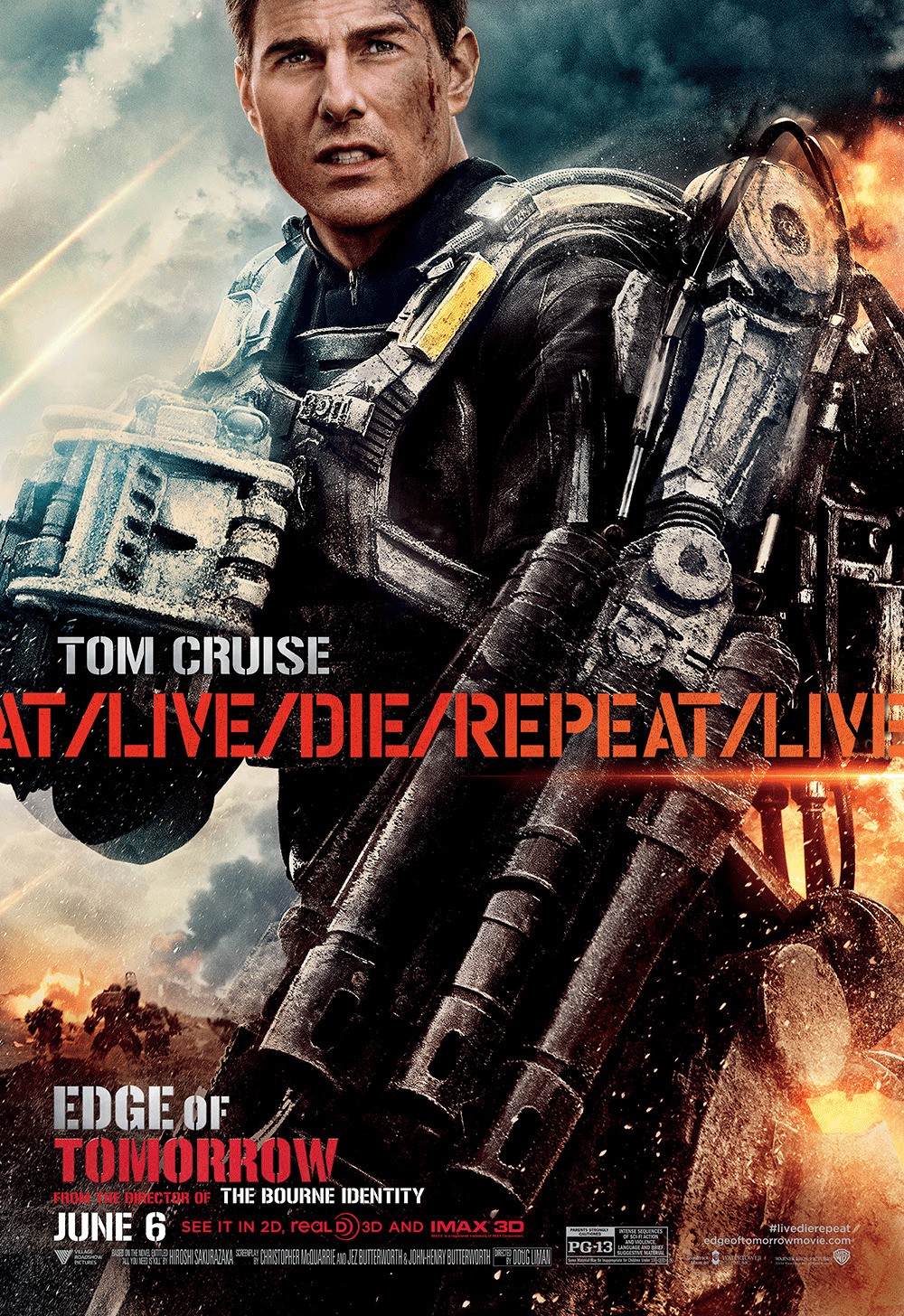
Edge of Tomorrow (2014) Director: Doug Liman Writer(s): Christopher McQuarrie, Jez Butterworth, John-Henry Butterworth Starring: Tom Cruise, Emily Blunt, Bill Paxton
It's Groundhog Day with aliens... and it's not very good.
OK, that's being a bit harsh. But, I'm going to be blunt. Edge of Tomorrow is a film that is clearly trying to subvert the big blockbuster special effects extravaganza model with some semi-clever plot elements, but I say it's a film that is trying and failing. Despite its admittedly fun story design, Edge of Tomorrow cannot surpass its limitations as an alien invasion sci-fi story. Paper-thin characters and monster design are just a few elements bogging down this clunky, cliché mess of a film. While not as bad as I expected it to be, Edge of Tomorrow is a bad film.
Major William Cage (Tom Cruise) is a PR officer for global defense forces, currently embroiled in a war against a bizarre race of aliens called the Mimics. Why are they called Mimics? I still have no idea; they clearly do not model themselves on their opponents, so they clearly don't live up to their name. The Mimics have taken over most of Europe, so Cage, despite his trepidations, is sent into combat to fight them. Cage, being a coward, tries to run from battle, but he gets caught up in the fighting anyways. He kills one Mimic that's much larger than the others, only to be killed seconds later. But, as soon as this happens, he wakes up to the previous day, as if nothing has ever happened. What follows is a Groundhog Day-esque series of deaths, in which Cage repeats the day over and over again in order to defeat the Mimic forces. He is helped along the way by Emily Blunt, who plays a soldier who has had the same phenomenon happen to her. Together, the two must battle against the Mimic hive mind, a powerful being that is able to turn back time in order to gain an advantage in intergalactic conflict.
Edge of Tomorrow's only strength is its gimmick. The time loop element does lead to various possibilities for storytelling not found in the generic sci-fi action flick. Furthermore, the gimmick also makes a meaningful contribution to the plot. The Mimics are successful in war due to their capacity to turn back time and learn from the mistakes of the previous day; Cage must then use the aliens' own power against them. That is a neat concept. Its execution, however, is less than perfect. The pacing of this sequence is taken, beat for beat, from Groundhog Day. The first rewound day is a simple repetition with Cage trying to make sense of it all. The second day is the spasmic freak-out. The third day is when he starts to take advantage of the situation. Then an arc of story begins with a series of days shown in rapid succession. And so forth.
One would think taking the plot and pacing from a great film like Groundhog Day would work to Edge of Tomorrow's advantage. But Edge of Tomorrow forgets the quintessential element that made Groundhog Day work: character. Groundhog Day only works insofar as Phil and the rest of the cast are interesting characters. By the end of the film, we got to know everyone in Punxsutawney pretty well. The cast was well-rounded. Edge of Tomorrow's cast is flat at best and forgettable at worst. While Tom Cruise tries his best to give a convincing performance, Cage really doesn't have a character at all. Though he presses the Emily Blunt character for information about her backstory, he never gives us one of his own. But, giving Cruise the benefit of the doubt, he actually does show genuine emotion. That's more than I can say for Emily Blunt, who plays generic "strong female role model #5." A clear effort on the part of the filmmakers to appeal to a feminist audience, Blunt's character is the brooding, tough female soldier we've seen in every sci-fi flick since Aliens. But, while she is given a backstory, the performance is so lifeless as to make us not care. All the characters die dozens of times throughout this movie, and we are supposed to care: of all the characters, I cared the least when Blunt died. The rest of the cast is a collection of cardboard cutouts disguising themselves as the genuine articles: the Red Team in Star Wars: A New Hope had more character than these clowns. The only character I actually liked was that of Bill Paxton: a master sergeant who scorns the notion of luck and faith. I wish we got some more time with him, because he was the only member of the cast that had some potential for characterization.
If Wikipedia is to be believed, Edge of Tomorrow has received much positive acclaim for its alien design. To which I say: what? The Mimics look as if one applied a splatter effect of black CGI goop to the background and had it writhe around. No CGI effect can impress me: I've seen it do pretty much anything imaginable. The Mimics have no capacity for expression, nor do they have a frightening presence. Their movements are so spastic that one cannot appreciate the design even if there was a good one to be had. Even worse is the notion of the caste-system within the alien forces: the entire system seemed custom designed for the studio to produce a terrible licensed FPS based on the game. (Just replace respawning with the time loop; it's the easiest $60 Treyarch and co. will ever make.) At any rate, I don't see the originality.
So, is Edge of Tomorrow really as bad as I make it out to be? Well, it's not insulting, at least in the way the Transformers films are insulting. There is nothing shameful or overtly sexist. Furthermore, the story isn't confused; it does manage to keep matters focused enough. The pacing, too, while stolen from Groundhog Day, still works to an extent. If one is able to let one's critical sense leave the theatre, one might be able to have a bit of fun with it. Otherwise, Edge of Tomorrow is just another explosion, CGI-heavy, sci-fi flick. Hollywood needs to recognize that the key to a good sci-fi blockbuster is not the special effects or even the story: it's the character that really counts. If we don't care about anyone, then there's no reason for us to care about the movie itself.
Recommendation: If you are looking to rot your brain and enjoy some mindless escapism, then Edge of Tomorrow might satisfy. If you just came back from your Bergman marathon and are seeking yet more intellectual stimulus, then stay as far away from Edge of Tomorrow as possible. If you are looking to watch aquality sci-fi blockbuster along the lines of The Empire Strikes Back, then I'd say Edge of Tomorrow isn't the film you are looking for. Head to your nearest library and check out something more meaningful instead.
I give Edge of Tomorrow an even 3 stars out of 10.