Oklahoma! (1955) - A Rodgers and Hammersmonth Review
Director: Fred Zinneman
Writer(s): Sonya Levien and William Ludwig... adapting the work of Richard Rodgers and Oscar Hammerstein III
Starring: Gordon MacRae, Shirley Jones, Rod Steiger
Welcome to a project I like to call "Rodgers and Hammersmonth." Throughout the month of July, I'll be reviewing the films of Rodgers and Hammerstein, arguably the two most important figures in musical theatre history. Though these reviews are reviews of the film adaptations, first and foremost, I will offer my thoughts on the significance of many of the shows described. But these are movies; if the production values are inadequate, I will make note. I will be writing other movie reviews during July, of course; the Rodgers and Hammerstein reviews aren't intended to be contiguous. These are just some notable films that I wanted to review.
Oklahoma! is the first musical produced by the Rodgers and Hammerstein team, a musical first put on the stage in 1943. It marked a revolution in musical theatre not for its story or even its musical composition: the great advance of Oklahoma! is its pacing. Prior to Oklahoma!, musicals, both movie-based and otherwise, didn't really know how to handle the entire "music" element. Musicals did not want to adopt to the operatic style, featuring only singing, nor did they want to be ordinary plays/movies with no singing. Songs, then, were sporadically placed. The problem: often times said songs had nothing to do with the plot. This doesn't mean said numbers couldn't be meaningful and culturally important (see "Remember My Forgotten Man" from Gold Diggers of 1933), but it did mean that the musicals lacked fluidity. If you want a good example of how this style is inherently flawed, watch The Incredibly Strange Creatures Who Stopped Living and Became Mixed-Up Zombies, one of the worst, if not the worst, movie musical ever made.
Oklahoma! makes the smart decision to integrate the songs into the musical as essential elements for the plot and characterization. The music is an extension of the story. This revolution has led most musical theatre critics to characterize shows as either "pre-Oklahoma!" or "post-Oklahoma!" The 1955 film adaptation of Oklahoma! brought the show to new audiences who missed its incredible initial Broadway run. The question is: does this landmark of a musical still hold up?
Curly (Gordon MacCrae) is a dashing cowhand with great affection for farm girl Laurey Williams (Shirley Jones). It's clear that Laurey's Aunt Eller (Charlotte Greenwood) approves of the relationship, though there is a massive wrench in the form of Jud Fry (Rod Steiger), an aggressive farmhand who desires Laurey for himself. At the same time, Laurey's friend Ado Annie (Gloria Grahame) finds herself caught in a love triangle between a pandering salesman (Eddie Albert) and a down-to-earth rancher (Gene Nelson). All these elements combine together to produce a rousing musical experience.
Or not.
I know Oklahoma! is a musical landmark. I know nearly everyone else likes this movie wholeheartedly. And, indeed, I do like a lot of things in it. Gordon MacCrae and Shirley Jones sound fantastic on most of these tunes. Most of the tunes are very well-written. The colors are quite vibrant. But all of these things must fade into the background when one considers the emotional and moral shallowness of the actual story. Both of Oklahoma!'s plot lines could be featured in an episode of Dudley Do-Right; they are cliché in every sense of the word. The story of Oklahoma! is essentially that of The Great Train Robbery. A dark, villainous force threatens the virginal female, only to be defeated by a dashing knight in shining armor. This is the Curly-Laurey-Judd plot note for note. Curly is meant to be the handsome, sweet-voiced knight who must come to Laurey's rescue from the hulking Jud. The Annie plot is rather similar, only this time the dark figure, the salesman, actually wants to get rid of Annie. It is thus of even less consequence, and we care even less about it.
Complaining about a movie musical's being intellectually sophomoric is preaching to the choir: pretty much every movie musical nowadays is laughed off for the same reason. (God help you if you are a musical adaptation of a previously acclaimed work i.e. Man of La Mancha, Les Miserables, Rent.) But, as a lover of all things musical theater, I want to cut Oklahoma! some slack. After all, Rodgers and Hammerstein were first starting out. They must have been focused primarily on the music and the lyrics. And, in the context of the original musical, most of the musical motions make sense. But the movie makes cuts to the musical that are nigh irreconcilable.
Let's discuss the most glaring cut from the movie: the villain song, "Lonely Room." For those who haven't heard it, "Lonely Room" is the "Hellfire" sequence from The Hunchback of Notre Dame on steroids. "Lonely Room" is Jud's final plead for recognition and sexual satisfaction, as he vents his frustrations with his poverty and his social ineptness to the audience. When put in the hands of the right actor, this song can be downright chilling. Granted, hearing Rod Steiger sing an entire song is a frightening enough thought, but the actual quality of the song could have carried across the point. The reason this cut is so horrific is Jud's resulting lack of character. Without "Lonely Room," we have little grasp of Jud's motivations. His desperation at the end of the film comes across as sporadic rather than part of a carefully designed musical arc.
The Ado Annie arc, while having a decent amount of character, ultimately amounts to a pretty shallow experience. We learn Annie can't help herself in the most overused audition song in the history of mezzo-sopranos, "I Cain't Say No," an almost insufferable musical experience due to Gloria Grahame's horrible voice. Her knight in shining bootspurs gets a fun dance number in "Kansas City," but the song actually reveals nothing about him. The salesman's song was cut, another problem with the film's characterization, leaving us only with "All 'Er Nuthin'" to wrap up the storyline once it is over. The only truly developed arc is that of Curly and Laurey. Not only does the duo get the show's best songs - "Oh, What a Beautiful Mornin,'" "The Surrey with the Fringe On Top," "People Will Say We're In Love" - but they also sound the best on them. Granted, I would have preferred if "People Will Say We're In Love" was a bit less overblown and a bit more hushed, but the music works. Not to mention Shirley Jones and Gordon MacCrae have voices that meld perfectly.
I know the preceding few paragraphs were pretty harsh, but I think the great team of R&H can take it. The two are legends, and they kept growing as they went on. If one looks at the rest of Oklahoma!, the material is quite strong. The dancing is all top notch, even if the "Farmer and the Cowhand Should Be Friends" number overstays its welcome. The centerpiece of the show, Laurey's dream ballet, is absolutely beautiful; it even gives us a taste of the "Lonely Room" musical motif the movie lacks. But the golden star has to go to "Pore Jud is Daid," quite possibly the funniest song in all of musical theater. One wouldn't think a song about convincing someone to commit suicide could be funny, but once Jud starts to imitate Curly's obsequiousness, the effect is priceless.
Oklahoma! is a landmark show but a primitive show. Its film, however, lacks the landmark status. So, when I give a final rating, it's going to take the musical's many flaws into account. But, as it stands, Oklahoma! is an important piece of theatre, if not the best piece of theatre. Fortunately for viewers, the next outing from Rodgers and Hammerstein wouldn't just be a better musical. It would be a fantastic musical, a musical so good many critics still call it the best musical ever written.
Recommendation: Oklahoma! may have the emotional and intellectual value of Fruit Loops, but it is a fun watch. It is wholly accessible for children and adults alike; there is a reason this film was the blockbuster of its era. While I'd recommend introducing someone to the actual musical first, Oklahoma! is a satisfying movie if you feel the urge to sing along.
I give Oklahoma! an even 5 stars out of 10.
...did I somehow write this entire review without talking about the title song? Great, now it's stuck in my head again. "Oooooooooklahoma, where the wind comes sweeping down the plain..."
Showing posts with label Evaluation Zone Movie Reviews. Show all posts
Monday, July 7, 2014
Friday, July 4, 2014
Movie Review #8: The Great Mouse Detective
The Great Mouse Detective (1986)
Director: Ron Clements et al.
Writer(s): Peter Young et al.
Starring: Barrie Ingham, Vincent Price, Val Bettin
Of all the "classic" Disney animated films, The Great Mouse Detective was the only one I did not see as a child. I'd heard a great deal about it, but I never actually saw it. I decided to watch it one night, in order to finish my collection. And even though I was likely thirteen years older than this film's target audience, I think The Great Mouse Detective still captures the essence of the Disney animated magic I loved so much as a kid. Is it a masterpiece to be compared with Beauty and the Beast and The Lion King. Certainly not. But it's certainly as good as Mulan or The Emperor's New Groove: it's a fun animated film that almost everyone in the family can enjoy.
One night in London, a toymaker is kidnapped. His daughter, Olivia, seeks out the help of Basil of Baker Street, London's greatest rodent detective. She finds him with the help of a Dr. Dawson, voiced by Val Bettin. But, it soon turns out Basil is an egotistic eccentric who denies help to others unless it is in his personal career interest. Fortunately for Olivia, the true culprit behind her father's kidnapping is Professor Ratigan, the self-professed world's greatest criminal mind and Basil's arch-rival. As soon as he learns the truth, Basil springs into action, and the adventure is on to save Olivia's father and all of Mousedom itself.
The voice acting and character work are both pretty consistent. Barrie Ingham plays one of the great Sherlock Holmes adaptations, even though he is quite insensitive. However, said insensitivity works well within the context of the film's humor. His superiority complex manages to be both hilarious and interesting. Val Bettin's Dawson is also fun, being the "nice Watson" character we've come to expect. Granted, I've yet to see a Watson true to the spirit of the Arthur Conan Doyle' novels, but that's an issue for another review. The real highlight of the film, though, is Vincent Price as Ratigan. Disney's always had great villains, but there are few as fun as Ratigan. He's a great blend of sophistication, rage, and sadism. And, as far as pure voice acting is concerned, Vincent Price gives the best performance of any of the Disney villain voice actors. From just listening to his voice, one can envision the animation. The animators really got a treat when Vincent Price took the part. According to interviews, this was Vincent Price's favorite villain role he ever played; the enthusiasm shows.
Ordinarily, I'd discuss the music in a Disney film in great detail, but The Great Mouse Detective has alarmingly few songs as compared to, say, Oliver and Company. Of these, only "The World's Greatest Criminal Mind" is of quality. One wouldn't think Vincent Price singing would be enjoyable, but his spoken vocal drips with evil delight. The rest of the tunes are pretty weak. The other Vincent Price tune, "Goodbye So Soon" ends up rather inconsequential, as the music comes from a garbled record player. The other song, "Let Me Be Good to You," is the worst part of the movie, as it is sung from a mouse stripper. I am not kidding: The Great Mouse Detective includes a scene in a mouse strip club. It's a rather dull song serving no other purpose than padding.
The great accomplishment of The Great Mouse Detective is its ability to remain entertaining despite its relative limitations. The Great Mouse Detective emerged right before the tremendous changes of the Disney Renaissance, the now famous period in which Disney produced a new wave of children's animated classics. To me, however, the Disney Renaissance is notable more for its animation than the actual quality of the films involved. If one looks at Disney Renaissance films, one notices how cleanly and seamlessly the animation flows; the frame rate is perfect. The animated models have a far greater sense of realism, with curves and brush strokes that more clearly emulate the actual world. Looking at the very early Disney films, animation usually adopted a particular style that was either rigid and angular or somewhat blurry and water-color based. (The two great exceptions to this, in my mind, are Fantasia and Bambi, but that's for another day.)
The Great Mouse Detective, however, is trapped in a period between eras, a period in which Disney didn't quite know what it was supposed to be as an animation studio. As a result, the actual animation of the film comes across as somewhat lacking. There are episodes of DuckTales and Gargoyles with better animation than what can be found in The Great Mouse Detective. Most of the characters, with Ratigan and Basil being the great exceptions, are remarkably lifeless in their motions. The designs are rather primitive across the board, sans Ratigan and Basil. The only element of the actual production I really liked was the backgrounds; one does feel the seediness of London from the look of the picture. There is a lot of good work involving shadows, too, so the atmosphere certainly isn't lacking.
Now, I suspect the reason behind the animation slights for the film emerges in the CGI portion of the film. While The Great Mouse Detective was far from the first animated film to use CGI, it is often cited as the first film to ever get it right. The film's climax is a battle between Ratigan and Basil inside Big Ben, a scene in which the cogs and gears are all CGI-animated. It's a huge shift in style; it feels somewhat jarring at first, though one does get used to it. My fear: did The Great Mouse Detective slack off in the rest of its animation because most of the money was spent on this sequence? If so, I'm not sure the choice wholly paid off. I'd rather have the climax be traditionally animated and have a few more creative textures employed than see a CGI fight; in fact, my favorite portion of the climax is the second half that is only hand-drawn animation.
Despite my complaints, the film certainly works. The dynamic between the hero and the villain is fun, the atmosphere is rich, the animation is passable if a bit primitive, the climax is exciting, and the story straightforward. Is it an animated classic? I wouldn't consider it a part of the Disney Renaissance like some others do, but I can see young kids enjoying it. As it stands, it's probably a film I'd watch once but wouldn't revisit anytime soon. It's a flawed film, but one strong enough to carry the Disney name.
Recommendation: The Great Mouse Detective is a children's film. The animation is tailor-made for young children (3-6). At the same time, the atmosphere and climax are more adult, so an older viewer might still enjoy the movie. Is it a movie that the average person should seek out and watch? I say no. But, if you are a Disney fanatic like me and you have not yet seen the film, it's an hour and a half of your life that you won't regret spending.
I give The Great Mouse Detective an even 7 stars out of 10.
Director: Ron Clements et al.
Writer(s): Peter Young et al.
Starring: Barrie Ingham, Vincent Price, Val Bettin
Of all the "classic" Disney animated films, The Great Mouse Detective was the only one I did not see as a child. I'd heard a great deal about it, but I never actually saw it. I decided to watch it one night, in order to finish my collection. And even though I was likely thirteen years older than this film's target audience, I think The Great Mouse Detective still captures the essence of the Disney animated magic I loved so much as a kid. Is it a masterpiece to be compared with Beauty and the Beast and The Lion King. Certainly not. But it's certainly as good as Mulan or The Emperor's New Groove: it's a fun animated film that almost everyone in the family can enjoy.
One night in London, a toymaker is kidnapped. His daughter, Olivia, seeks out the help of Basil of Baker Street, London's greatest rodent detective. She finds him with the help of a Dr. Dawson, voiced by Val Bettin. But, it soon turns out Basil is an egotistic eccentric who denies help to others unless it is in his personal career interest. Fortunately for Olivia, the true culprit behind her father's kidnapping is Professor Ratigan, the self-professed world's greatest criminal mind and Basil's arch-rival. As soon as he learns the truth, Basil springs into action, and the adventure is on to save Olivia's father and all of Mousedom itself.
The voice acting and character work are both pretty consistent. Barrie Ingham plays one of the great Sherlock Holmes adaptations, even though he is quite insensitive. However, said insensitivity works well within the context of the film's humor. His superiority complex manages to be both hilarious and interesting. Val Bettin's Dawson is also fun, being the "nice Watson" character we've come to expect. Granted, I've yet to see a Watson true to the spirit of the Arthur Conan Doyle' novels, but that's an issue for another review. The real highlight of the film, though, is Vincent Price as Ratigan. Disney's always had great villains, but there are few as fun as Ratigan. He's a great blend of sophistication, rage, and sadism. And, as far as pure voice acting is concerned, Vincent Price gives the best performance of any of the Disney villain voice actors. From just listening to his voice, one can envision the animation. The animators really got a treat when Vincent Price took the part. According to interviews, this was Vincent Price's favorite villain role he ever played; the enthusiasm shows.
Ordinarily, I'd discuss the music in a Disney film in great detail, but The Great Mouse Detective has alarmingly few songs as compared to, say, Oliver and Company. Of these, only "The World's Greatest Criminal Mind" is of quality. One wouldn't think Vincent Price singing would be enjoyable, but his spoken vocal drips with evil delight. The rest of the tunes are pretty weak. The other Vincent Price tune, "Goodbye So Soon" ends up rather inconsequential, as the music comes from a garbled record player. The other song, "Let Me Be Good to You," is the worst part of the movie, as it is sung from a mouse stripper. I am not kidding: The Great Mouse Detective includes a scene in a mouse strip club. It's a rather dull song serving no other purpose than padding.
The great accomplishment of The Great Mouse Detective is its ability to remain entertaining despite its relative limitations. The Great Mouse Detective emerged right before the tremendous changes of the Disney Renaissance, the now famous period in which Disney produced a new wave of children's animated classics. To me, however, the Disney Renaissance is notable more for its animation than the actual quality of the films involved. If one looks at Disney Renaissance films, one notices how cleanly and seamlessly the animation flows; the frame rate is perfect. The animated models have a far greater sense of realism, with curves and brush strokes that more clearly emulate the actual world. Looking at the very early Disney films, animation usually adopted a particular style that was either rigid and angular or somewhat blurry and water-color based. (The two great exceptions to this, in my mind, are Fantasia and Bambi, but that's for another day.)
The Great Mouse Detective, however, is trapped in a period between eras, a period in which Disney didn't quite know what it was supposed to be as an animation studio. As a result, the actual animation of the film comes across as somewhat lacking. There are episodes of DuckTales and Gargoyles with better animation than what can be found in The Great Mouse Detective. Most of the characters, with Ratigan and Basil being the great exceptions, are remarkably lifeless in their motions. The designs are rather primitive across the board, sans Ratigan and Basil. The only element of the actual production I really liked was the backgrounds; one does feel the seediness of London from the look of the picture. There is a lot of good work involving shadows, too, so the atmosphere certainly isn't lacking.
Now, I suspect the reason behind the animation slights for the film emerges in the CGI portion of the film. While The Great Mouse Detective was far from the first animated film to use CGI, it is often cited as the first film to ever get it right. The film's climax is a battle between Ratigan and Basil inside Big Ben, a scene in which the cogs and gears are all CGI-animated. It's a huge shift in style; it feels somewhat jarring at first, though one does get used to it. My fear: did The Great Mouse Detective slack off in the rest of its animation because most of the money was spent on this sequence? If so, I'm not sure the choice wholly paid off. I'd rather have the climax be traditionally animated and have a few more creative textures employed than see a CGI fight; in fact, my favorite portion of the climax is the second half that is only hand-drawn animation.
Despite my complaints, the film certainly works. The dynamic between the hero and the villain is fun, the atmosphere is rich, the animation is passable if a bit primitive, the climax is exciting, and the story straightforward. Is it an animated classic? I wouldn't consider it a part of the Disney Renaissance like some others do, but I can see young kids enjoying it. As it stands, it's probably a film I'd watch once but wouldn't revisit anytime soon. It's a flawed film, but one strong enough to carry the Disney name.
Recommendation: The Great Mouse Detective is a children's film. The animation is tailor-made for young children (3-6). At the same time, the atmosphere and climax are more adult, so an older viewer might still enjoy the movie. Is it a movie that the average person should seek out and watch? I say no. But, if you are a Disney fanatic like me and you have not yet seen the film, it's an hour and a half of your life that you won't regret spending.
I give The Great Mouse Detective an even 7 stars out of 10.
Wednesday, July 2, 2014
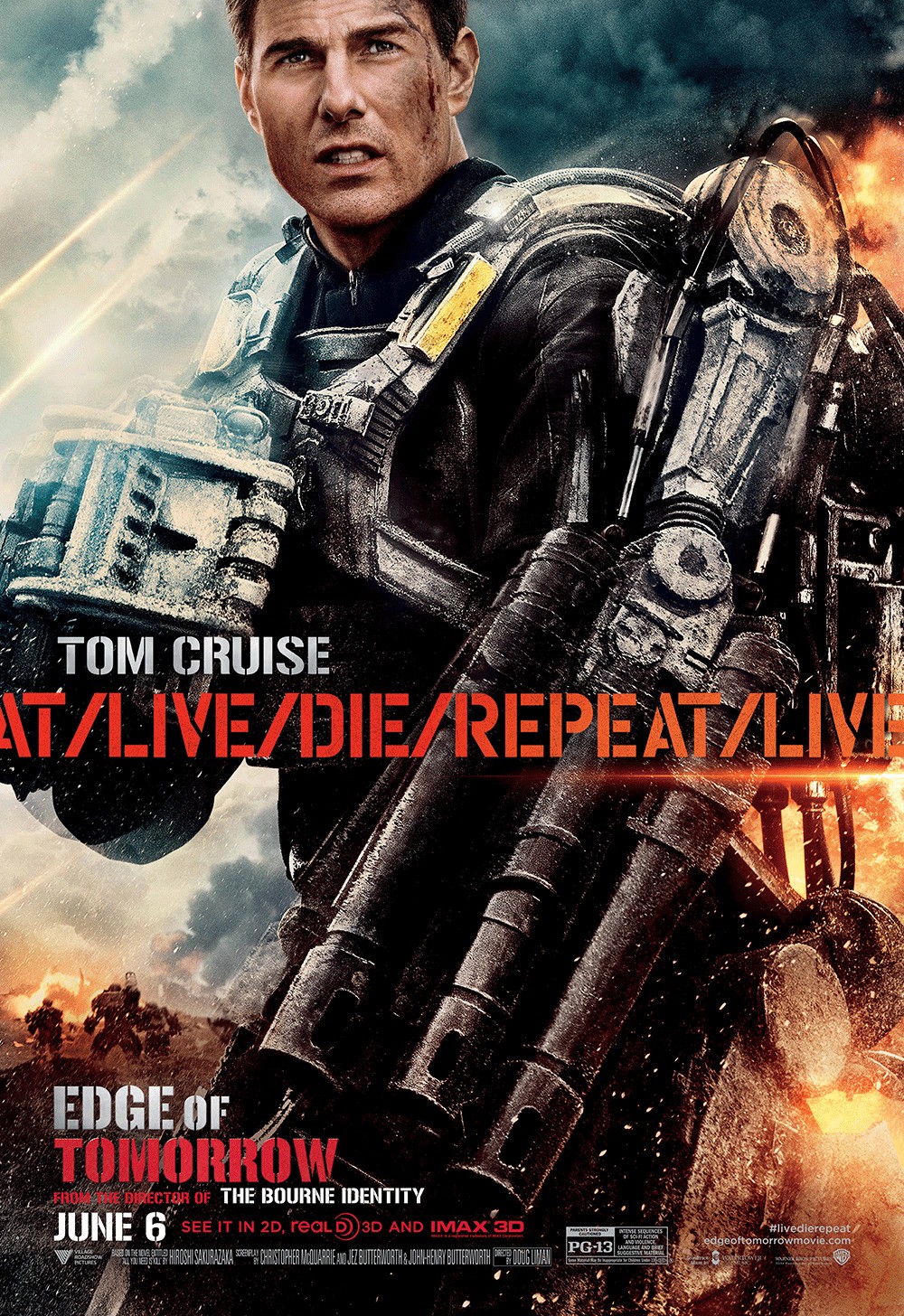
Movie Review #7: Edge of Tomorrow
Edge of Tomorrow (2014)
Director: Doug Liman
Writer(s): Christopher McQuarrie, Jez Butterworth, John-Henry Butterworth
Starring: Tom Cruise, Emily Blunt, Bill Paxton
It's Groundhog Day with aliens... and it's not very good.
OK, that's being a bit harsh. But, I'm going to be blunt. Edge of Tomorrow is a film that is clearly trying to subvert the big blockbuster special effects extravaganza model with some semi-clever plot elements, but I say it's a film that is trying and failing. Despite its admittedly fun story design, Edge of Tomorrow cannot surpass its limitations as an alien invasion sci-fi story. Paper-thin characters and monster design are just a few elements bogging down this clunky, cliché mess of a film. While not as bad as I expected it to be, Edge of Tomorrow is a bad film.
Major William Cage (Tom Cruise) is a PR officer for global defense forces, currently embroiled in a war against a bizarre race of aliens called the Mimics. Why are they called Mimics? I still have no idea; they clearly do not model themselves on their opponents, so they clearly don't live up to their name. The Mimics have taken over most of Europe, so Cage, despite his trepidations, is sent into combat to fight them. Cage, being a coward, tries to run from battle, but he gets caught up in the fighting anyways. He kills one Mimic that's much larger than the others, only to be killed seconds later. But, as soon as this happens, he wakes up to the previous day, as if nothing has ever happened. What follows is a Groundhog Day-esque series of deaths, in which Cage repeats the day over and over again in order to defeat the Mimic forces. He is helped along the way by Emily Blunt, who plays a soldier who has had the same phenomenon happen to her. Together, the two must battle against the Mimic hive mind, a powerful being that is able to turn back time in order to gain an advantage in intergalactic conflict.
Edge of Tomorrow's only strength is its gimmick. The time loop element does lead to various possibilities for storytelling not found in the generic sci-fi action flick. Furthermore, the gimmick also makes a meaningful contribution to the plot. The Mimics are successful in war due to their capacity to turn back time and learn from the mistakes of the previous day; Cage must then use the aliens' own power against them. That is a neat concept. Its execution, however, is less than perfect. The pacing of this sequence is taken, beat for beat, from Groundhog Day. The first rewound day is a simple repetition with Cage trying to make sense of it all. The second day is the spasmic freak-out. The third day is when he starts to take advantage of the situation. Then an arc of story begins with a series of days shown in rapid succession. And so forth.
One would think taking the plot and pacing from a great film like Groundhog Day would work to Edge of Tomorrow's advantage. But Edge of Tomorrow forgets the quintessential element that made Groundhog Day work: character. Groundhog Day only works insofar as Phil and the rest of the cast are interesting characters. By the end of the film, we got to know everyone in Punxsutawney pretty well. The cast was well-rounded. Edge of Tomorrow's cast is flat at best and forgettable at worst. While Tom Cruise tries his best to give a convincing performance, Cage really doesn't have a character at all. Though he presses the Emily Blunt character for information about her backstory, he never gives us one of his own. But, giving Cruise the benefit of the doubt, he actually does show genuine emotion. That's more than I can say for Emily Blunt, who plays generic "strong female role model #5." A clear effort on the part of the filmmakers to appeal to a feminist audience, Blunt's character is the brooding, tough female soldier we've seen in every sci-fi flick since Aliens. But, while she is given a backstory, the performance is so lifeless as to make us not care. All the characters die dozens of times throughout this movie, and we are supposed to care: of all the characters, I cared the least when Blunt died. The rest of the cast is a collection of cardboard cutouts disguising themselves as the genuine articles: the Red Team in Star Wars: A New Hope had more character than these clowns. The only character I actually liked was that of Bill Paxton: a master sergeant who scorns the notion of luck and faith. I wish we got some more time with him, because he was the only member of the cast that had some potential for characterization.
If Wikipedia is to be believed, Edge of Tomorrow has received much positive acclaim for its alien design. To which I say: what? The Mimics look as if one applied a splatter effect of black CGI goop to the background and had it writhe around. No CGI effect can impress me: I've seen it do pretty much anything imaginable. The Mimics have no capacity for expression, nor do they have a frightening presence. Their movements are so spastic that one cannot appreciate the design even if there was a good one to be had. Even worse is the notion of the caste-system within the alien forces: the entire system seemed custom designed for the studio to produce a terrible licensed FPS based on the game. (Just replace respawning with the time loop; it's the easiest $60 Treyarch and co. will ever make.) At any rate, I don't see the originality.
So, is Edge of Tomorrow really as bad as I make it out to be? Well, it's not insulting, at least in the way the Transformers films are insulting. There is nothing shameful or overtly sexist. Furthermore, the story isn't confused; it does manage to keep matters focused enough. The pacing, too, while stolen from Groundhog Day, still works to an extent. If one is able to let one's critical sense leave the theatre, one might be able to have a bit of fun with it. Otherwise, Edge of Tomorrow is just another explosion, CGI-heavy, sci-fi flick. Hollywood needs to recognize that the key to a good sci-fi blockbuster is not the special effects or even the story: it's the character that really counts. If we don't care about anyone, then there's no reason for us to care about the movie itself.
Recommendation: If you are looking to rot your brain and enjoy some mindless escapism, then Edge of Tomorrow might satisfy. If you just came back from your Bergman marathon and are seeking yet more intellectual stimulus, then stay as far away from Edge of Tomorrow as possible. If you are looking to watch a quality sci-fi blockbuster along the lines of The Empire Strikes Back, then I'd say Edge of Tomorrow isn't the film you are looking for. Head to your nearest library and check out something more meaningful instead.
I give Edge of Tomorrow an even 3 stars out of 10.
Director: Doug Liman
Writer(s): Christopher McQuarrie, Jez Butterworth, John-Henry Butterworth
Starring: Tom Cruise, Emily Blunt, Bill Paxton
It's Groundhog Day with aliens... and it's not very good.
OK, that's being a bit harsh. But, I'm going to be blunt. Edge of Tomorrow is a film that is clearly trying to subvert the big blockbuster special effects extravaganza model with some semi-clever plot elements, but I say it's a film that is trying and failing. Despite its admittedly fun story design, Edge of Tomorrow cannot surpass its limitations as an alien invasion sci-fi story. Paper-thin characters and monster design are just a few elements bogging down this clunky, cliché mess of a film. While not as bad as I expected it to be, Edge of Tomorrow is a bad film.
Major William Cage (Tom Cruise) is a PR officer for global defense forces, currently embroiled in a war against a bizarre race of aliens called the Mimics. Why are they called Mimics? I still have no idea; they clearly do not model themselves on their opponents, so they clearly don't live up to their name. The Mimics have taken over most of Europe, so Cage, despite his trepidations, is sent into combat to fight them. Cage, being a coward, tries to run from battle, but he gets caught up in the fighting anyways. He kills one Mimic that's much larger than the others, only to be killed seconds later. But, as soon as this happens, he wakes up to the previous day, as if nothing has ever happened. What follows is a Groundhog Day-esque series of deaths, in which Cage repeats the day over and over again in order to defeat the Mimic forces. He is helped along the way by Emily Blunt, who plays a soldier who has had the same phenomenon happen to her. Together, the two must battle against the Mimic hive mind, a powerful being that is able to turn back time in order to gain an advantage in intergalactic conflict.
Edge of Tomorrow's only strength is its gimmick. The time loop element does lead to various possibilities for storytelling not found in the generic sci-fi action flick. Furthermore, the gimmick also makes a meaningful contribution to the plot. The Mimics are successful in war due to their capacity to turn back time and learn from the mistakes of the previous day; Cage must then use the aliens' own power against them. That is a neat concept. Its execution, however, is less than perfect. The pacing of this sequence is taken, beat for beat, from Groundhog Day. The first rewound day is a simple repetition with Cage trying to make sense of it all. The second day is the spasmic freak-out. The third day is when he starts to take advantage of the situation. Then an arc of story begins with a series of days shown in rapid succession. And so forth.
One would think taking the plot and pacing from a great film like Groundhog Day would work to Edge of Tomorrow's advantage. But Edge of Tomorrow forgets the quintessential element that made Groundhog Day work: character. Groundhog Day only works insofar as Phil and the rest of the cast are interesting characters. By the end of the film, we got to know everyone in Punxsutawney pretty well. The cast was well-rounded. Edge of Tomorrow's cast is flat at best and forgettable at worst. While Tom Cruise tries his best to give a convincing performance, Cage really doesn't have a character at all. Though he presses the Emily Blunt character for information about her backstory, he never gives us one of his own. But, giving Cruise the benefit of the doubt, he actually does show genuine emotion. That's more than I can say for Emily Blunt, who plays generic "strong female role model #5." A clear effort on the part of the filmmakers to appeal to a feminist audience, Blunt's character is the brooding, tough female soldier we've seen in every sci-fi flick since Aliens. But, while she is given a backstory, the performance is so lifeless as to make us not care. All the characters die dozens of times throughout this movie, and we are supposed to care: of all the characters, I cared the least when Blunt died. The rest of the cast is a collection of cardboard cutouts disguising themselves as the genuine articles: the Red Team in Star Wars: A New Hope had more character than these clowns. The only character I actually liked was that of Bill Paxton: a master sergeant who scorns the notion of luck and faith. I wish we got some more time with him, because he was the only member of the cast that had some potential for characterization.
If Wikipedia is to be believed, Edge of Tomorrow has received much positive acclaim for its alien design. To which I say: what? The Mimics look as if one applied a splatter effect of black CGI goop to the background and had it writhe around. No CGI effect can impress me: I've seen it do pretty much anything imaginable. The Mimics have no capacity for expression, nor do they have a frightening presence. Their movements are so spastic that one cannot appreciate the design even if there was a good one to be had. Even worse is the notion of the caste-system within the alien forces: the entire system seemed custom designed for the studio to produce a terrible licensed FPS based on the game. (Just replace respawning with the time loop; it's the easiest $60 Treyarch and co. will ever make.) At any rate, I don't see the originality.
So, is Edge of Tomorrow really as bad as I make it out to be? Well, it's not insulting, at least in the way the Transformers films are insulting. There is nothing shameful or overtly sexist. Furthermore, the story isn't confused; it does manage to keep matters focused enough. The pacing, too, while stolen from Groundhog Day, still works to an extent. If one is able to let one's critical sense leave the theatre, one might be able to have a bit of fun with it. Otherwise, Edge of Tomorrow is just another explosion, CGI-heavy, sci-fi flick. Hollywood needs to recognize that the key to a good sci-fi blockbuster is not the special effects or even the story: it's the character that really counts. If we don't care about anyone, then there's no reason for us to care about the movie itself.
Recommendation: If you are looking to rot your brain and enjoy some mindless escapism, then Edge of Tomorrow might satisfy. If you just came back from your Bergman marathon and are seeking yet more intellectual stimulus, then stay as far away from Edge of Tomorrow as possible. If you are looking to watch a quality sci-fi blockbuster along the lines of The Empire Strikes Back, then I'd say Edge of Tomorrow isn't the film you are looking for. Head to your nearest library and check out something more meaningful instead.
I give Edge of Tomorrow an even 3 stars out of 10.
Monday, June 30, 2014
Movie Review #6: Lee Daniels' The Butler
Lee Daniels' The Butler
Director: Lee Daniels
Writer(s): Danny Strong
Starring: Forrest Whitaker, Oprah Winfrey, David Oyelwo
I have a very high tolerance for Oscar bait. Sure, the practice of producing period dramas with good acting and exquisite costume design for the sole purpose of winning Academy Awards is unscrupulous and manipulative, but, so long as a good movie is the result, I'm totally OK with it. Just give me a good movie, and I'm satisfied. Now, turning a movie into a commercial: that is a crime for which I will not spare the rod. Both things considered, Lee Daniels' The Butler is both Oscar bait and a commercial. It excels at one, suffers as the other. But is it worth one's time? Let's find out.
Forrest Whitaker plays Cecil Gaines, the son of a sharecropping family who leaves his home to seek a better life elsewhere. Due to the racism of the South, he makes his way north, eventually earning a living as a butler in a hotel. His skills are such that he is invited to work at the White House as a butler. While there, he has to suffer in silence as decisions are made regarding the African American people, and he cannot say a word. Back at home, his son (David Oyelwo) joins the civil rights movement, playing the W.E.B. DuBois to his father's Booker T. Washington. The two come to conflict as the younger Gaines becomes more and more radical in his pursuit of justice. All the while, the Gaines family must suffer heartbreak after heartbreak as the family begins to tear itself apart.
Some say that Forrest Whitaker gives the performance of his career with Cecil Gaines. Having not seen The Last King of Scotland, I'm going to approach that statement with some trepidation. He is certainly effective in the role, but I'm not sure if every scene comes across quite perfectly. The role does feel somewhat manipulative as we watch it, rather than a genuine part. David Oyelwo is much more compelling as the son: he proves to be highly adaptable with the many different phases through which the son goes. Most of the other actors do fine jobs, though subtlety doesn't seem to be Cuba Gooding Jr.'s strong point in his role. A whole cadre of Hollywood all-stars play the various presidents, to varying degrees of success: Robin Williams plays a very convincing Dwight D. Eisenhower, but I never saw Alan Rickman as Ronald Reagan. (Though, Jane Fonda does do a nice job as Nancy Reagan.) Most of these parts are subsidiary, as we are left to observe their actions, as is Cecil.
Structurally, the film's greatest deficiency is Oprah Winfrey as Cecil's wife. The film has no purpose for here. A subplot revolving around her infidelity is briefly introduced, but it ultimately amounts to nothing. She dies at the end of the movie, but we have no real reason to care about her. For the preceding two hours, all she does is act in a sassy manner. She's not a strong character; she's not even a character. She's just an excuse to put Oprah into the movie and add more star power to an already star-studded cast. Every second we spend with her is a second wasted on the film's real strength: the relationship between the father and the son.
I previously compared the relationship between Cecil and his son to the feud between Booker T. Washington and W.E.B. DuBois. This may or may not have been Lee Daniels's intention, but, if it was, it succeeded masterfully. The Butler brilliantly demonstrates the parallels between the moderate and the radical throughout the film, both visually and scripturally. Towards the beginning of the film's second act, we see excellently framed contrasts between the White House kitchen and the famous 1960s diner sit-ins. None of the later scenes quite match this, but the contrast between the message of Martin Luther King Jr. and that of the Black Panthers works well also. Though the film ultimately reconciles these contrasts with the subtlety of a sledgehammer, they do hold their own for at least the film's beginning. These stories aren't unknown, but they are worth telling multiple times; this film did manage to present them in an at least half-creative way.
Less creative is the heavy-handedness of the film. Every single theme is made glaringly obvious. There is no ambiguity, no room to disagree. Watching The Butler is equivalent to reading an Aesop's Fable: there is a clearly stated moral at the end. And, just like an Aesop's fable, the moral isn't anything deep or thought-provoking. The Butler manages to be interesting insofar as it is a family drama and a period piece, but as a piece meant to increase awareness of the African-American condition, it seems lacking.
And then there's the ending.
Oprah Winfrey has pulled no punches in her endorsement of President Barack Obama. It would not surprise me if her presence in this movie had nothing to do with the end result of the film. Cecil Gaines is eventually witness to the election of President Obama and is invited to the White House long after his retirement. This would just seem like a regular plot point designed to give us closure, but the film frames this moment as if this is the culmination of race relations in America. President Obama's becoming President is this great ultimate victory for African Americans in the United States. This practice seems manipulative and warped in every sense possible. First, to implicitly claim that racial problems in the US have died out since the Obama administration's beginning is to be wholly dishonest and insensitive. Second, to promote Obama solely on the basis of his race (a promotion the film implicitly, if not intentionally, makes) is to ignore both the strengths and failings of his character and administration. And, worst of all, the insertion of this scene and the manner in which it is carried makes the entire movie feel like a two hour campaign ad - after President Obama won his re-election. I wanted to watch this movie for the history, not to endorse someone I would have already voted for in the first place!
But, despite the shameless pandering of the film's conclusion, the journey remains engaging enough to warrant at least a watch. It's FAR from perfect, but it has enough elements to keep a critical viewer engaged. And, if one doesn't think too hard about it, Lee Daniels' The Butler is an enjoyable enough film. Is it a masterpiece? No. Is it a shameless commercial? Maybe. Is it Oscar-bait? Probably. Whatever the case, I am ultimately glad to have seen it. I just probably won't be watching it again.
Recommendation: Lee Daniels' The Butler moves quickly enough so that anyone of any age might enjoy it. Of the people I've spoken to, the ones who most liked the film are middle schoolers and young high schoolers. And, to be perfectly honest, that is the age demographic this kind of film for which this film is best engineered. However, if you are looking for a deeply engaging commentary on racial relations in America, I'd turn your attention to 12 Years a Slave or Do the Right Thing.
I give Lee Daniels' The Butler 5.8 stars out of 10.
Director: Lee Daniels
Writer(s): Danny Strong
Starring: Forrest Whitaker, Oprah Winfrey, David Oyelwo
I have a very high tolerance for Oscar bait. Sure, the practice of producing period dramas with good acting and exquisite costume design for the sole purpose of winning Academy Awards is unscrupulous and manipulative, but, so long as a good movie is the result, I'm totally OK with it. Just give me a good movie, and I'm satisfied. Now, turning a movie into a commercial: that is a crime for which I will not spare the rod. Both things considered, Lee Daniels' The Butler is both Oscar bait and a commercial. It excels at one, suffers as the other. But is it worth one's time? Let's find out.
Forrest Whitaker plays Cecil Gaines, the son of a sharecropping family who leaves his home to seek a better life elsewhere. Due to the racism of the South, he makes his way north, eventually earning a living as a butler in a hotel. His skills are such that he is invited to work at the White House as a butler. While there, he has to suffer in silence as decisions are made regarding the African American people, and he cannot say a word. Back at home, his son (David Oyelwo) joins the civil rights movement, playing the W.E.B. DuBois to his father's Booker T. Washington. The two come to conflict as the younger Gaines becomes more and more radical in his pursuit of justice. All the while, the Gaines family must suffer heartbreak after heartbreak as the family begins to tear itself apart.
Some say that Forrest Whitaker gives the performance of his career with Cecil Gaines. Having not seen The Last King of Scotland, I'm going to approach that statement with some trepidation. He is certainly effective in the role, but I'm not sure if every scene comes across quite perfectly. The role does feel somewhat manipulative as we watch it, rather than a genuine part. David Oyelwo is much more compelling as the son: he proves to be highly adaptable with the many different phases through which the son goes. Most of the other actors do fine jobs, though subtlety doesn't seem to be Cuba Gooding Jr.'s strong point in his role. A whole cadre of Hollywood all-stars play the various presidents, to varying degrees of success: Robin Williams plays a very convincing Dwight D. Eisenhower, but I never saw Alan Rickman as Ronald Reagan. (Though, Jane Fonda does do a nice job as Nancy Reagan.) Most of these parts are subsidiary, as we are left to observe their actions, as is Cecil.
Structurally, the film's greatest deficiency is Oprah Winfrey as Cecil's wife. The film has no purpose for here. A subplot revolving around her infidelity is briefly introduced, but it ultimately amounts to nothing. She dies at the end of the movie, but we have no real reason to care about her. For the preceding two hours, all she does is act in a sassy manner. She's not a strong character; she's not even a character. She's just an excuse to put Oprah into the movie and add more star power to an already star-studded cast. Every second we spend with her is a second wasted on the film's real strength: the relationship between the father and the son.
I previously compared the relationship between Cecil and his son to the feud between Booker T. Washington and W.E.B. DuBois. This may or may not have been Lee Daniels's intention, but, if it was, it succeeded masterfully. The Butler brilliantly demonstrates the parallels between the moderate and the radical throughout the film, both visually and scripturally. Towards the beginning of the film's second act, we see excellently framed contrasts between the White House kitchen and the famous 1960s diner sit-ins. None of the later scenes quite match this, but the contrast between the message of Martin Luther King Jr. and that of the Black Panthers works well also. Though the film ultimately reconciles these contrasts with the subtlety of a sledgehammer, they do hold their own for at least the film's beginning. These stories aren't unknown, but they are worth telling multiple times; this film did manage to present them in an at least half-creative way.
Less creative is the heavy-handedness of the film. Every single theme is made glaringly obvious. There is no ambiguity, no room to disagree. Watching The Butler is equivalent to reading an Aesop's Fable: there is a clearly stated moral at the end. And, just like an Aesop's fable, the moral isn't anything deep or thought-provoking. The Butler manages to be interesting insofar as it is a family drama and a period piece, but as a piece meant to increase awareness of the African-American condition, it seems lacking.
And then there's the ending.
Oprah Winfrey has pulled no punches in her endorsement of President Barack Obama. It would not surprise me if her presence in this movie had nothing to do with the end result of the film. Cecil Gaines is eventually witness to the election of President Obama and is invited to the White House long after his retirement. This would just seem like a regular plot point designed to give us closure, but the film frames this moment as if this is the culmination of race relations in America. President Obama's becoming President is this great ultimate victory for African Americans in the United States. This practice seems manipulative and warped in every sense possible. First, to implicitly claim that racial problems in the US have died out since the Obama administration's beginning is to be wholly dishonest and insensitive. Second, to promote Obama solely on the basis of his race (a promotion the film implicitly, if not intentionally, makes) is to ignore both the strengths and failings of his character and administration. And, worst of all, the insertion of this scene and the manner in which it is carried makes the entire movie feel like a two hour campaign ad - after President Obama won his re-election. I wanted to watch this movie for the history, not to endorse someone I would have already voted for in the first place!
But, despite the shameless pandering of the film's conclusion, the journey remains engaging enough to warrant at least a watch. It's FAR from perfect, but it has enough elements to keep a critical viewer engaged. And, if one doesn't think too hard about it, Lee Daniels' The Butler is an enjoyable enough film. Is it a masterpiece? No. Is it a shameless commercial? Maybe. Is it Oscar-bait? Probably. Whatever the case, I am ultimately glad to have seen it. I just probably won't be watching it again.
Recommendation: Lee Daniels' The Butler moves quickly enough so that anyone of any age might enjoy it. Of the people I've spoken to, the ones who most liked the film are middle schoolers and young high schoolers. And, to be perfectly honest, that is the age demographic this kind of film for which this film is best engineered. However, if you are looking for a deeply engaging commentary on racial relations in America, I'd turn your attention to 12 Years a Slave or Do the Right Thing.
I give Lee Daniels' The Butler 5.8 stars out of 10.
Monday, June 23, 2014
Movie Review #5: Der Untergang (Downfall)
Der Untergang {trans: Downfall} (2004)
Director: Oliver Hirschbiegel
Writer(s): Bernd Eichinger
Starring: Bruno Ganz, Alexandria Maria Lara, Corianna Harfouch
There will always be movies about the WWII and the Holocaust: put together, the two are the greatest tragedies ever to befall mankind. It's a true story so horrific that we cannot help but tell it over and over again. Each time, we feel a new shock. Some have called Hollywood's fascination with the Holocaust a morbid and, indeed, exploitative fixation. By making so many movies about the Holocaust, Hollywood is gradually desensitizing us to it. Sure, some films like Shoah may be appropriate, but the rest of the films just seem to capitalize on the tragedy. As for me, I hold the position that so long as there is one Holocaust denier in the world (and, trust me, there are plenty), we have an obligation to continue telling the story. And, so long as global cinema is able to tell the story of the Holocaust and the fall of Nazi Germany in new, interesting, yet historically accurate, ways, I will sit down and try to seek a greater understanding any day.
But what happens when one looks at WWII from the point of view of the homicidal maniacs? All reasonable people know that championing the Nazis as heroes is a morally despicable action (i.e. Triumph of the Will) , but what if one looked at the Nazis not as evil monsters but as human beings? It's an approach almost no one is willing to take, but Oliver Hirschbiegel took it. Der Untergang is one of the most challenging WWII films I've ever seen - grisly, gripping, horrific, and, overall, chilling.
Looking through the eyes of one of Hitler's personal secretaries, Traudl Junge, we witness the last days of Adolf Hitler and Josef Goebbels as Allied forces advance upon Berlin. Our perspective shifts from time to time, as we look through the eyes of doctor Ernst-Gunther Schenck and SS captain Wilhelm Mohnke, but our focus is on the actions within Hitler's bunker. We see every plan fail, every safeguard destroyed, every last hope shattered. We then bear witness to more suicides than can be counted, as the desperation of the battle of Berlin and the demise of Adolf Hitler takes its toll on the emotionally crippled Nazi leaders and Hitler Youth members.
Bruno Ganz masterfully plays Adolf Hitler, slowly slipping even further into madness. His outbursts, though infamously parodied on Youtube, are almost hypnotic: this is a man wholly deranged and at the end of his rope. Any sympathy we feel for him derives from his body language and physical weakness; every word he says is full of hatred and faux-compassion. Indeed, Hitler cites the Holocaust as his only victory in the war. We know he is a sick man in every sense of the word. The film shows that Hitler had some compassion for his dog and some kindness towards his secretaries, but most of this is but a disguise for the twisted lunatic hidden beneath. Bruno Ganz practically turns Adolf Hitler into Macbeth, a person with some sympathetic elements but a morally corrupt and insane person at heart.
None of the other performances are on par with Ganz's, but nearly everyone gives an adequate turn. Alexandra Maria Lara is perfectly fine as Traudl Junge, evoking the spirit of someone young and far in over her head. Christian Berkel and Andre Hennicke both do fine jobs as Schenck and Mohnke, the two Nazis to which the film shows genuine sympathy. Ulrich Matthes and Corinna Harfouch are absolutely frightening as the Goebbels; though one generally doesn't think of the Nazi minister of propaganda as one of the most evil members of the Third Reich, this film certainly hammers in the horror. My pick for the best underrated performance is that of Ulrich Noethen as Heinrich Himmler, the most despicable Nazi to ever live, and quite possibly the most evil man in human history. Of all the Nazis in the film, he is the only one to evoke a presence of pure evil. And, to be honest, a man as cruel as him deserves such a treatment.
One key element Der Untergang wholly understands is that film is a visual medium. It is the images of Der Untergang that remain rather than any particular performance or plot point. The putting down of Hitler's dog. The execution of "cowardly" Hitler Youth members in the street. A bucket of sawed off limbs in a military hospital. The barrel of a gun, hammer cocked, pointed at the temple of a man's head. A lone boy dragging a bike out of the mud, just hoping to escape. One could have silenced the film during these moments, and one would still remember every detail. We see that those killed in the blitzkrieg and the Holocaust were not the only victims of Nazi terror; the German citizenry itself proved to be another casualty of Nazi cruelty. Through Hitler's unwillingness to surrender and evacuate Berlin, he condemned his entire country.
Even more frightening is the fanaticism displayed by the Nazi leaders. I have not seen another film with more suicides; indeed, even Book V of Tacitus's Annals doesn't contain as many suicides as the third act of Der Untergang. Most point to the death of the Goebbels' children as the single most horrifying moment of the film. The scene is effective, no doubt; watching Magda Goebbels murder her children rather than have them live without National Socialism is mortifying. But I think the death of Magda and Josef is even more disturbing. The camera pans away from Josef shooting his wife and then himself, showing us instead the crew of men armed with oil cans and matches, ready to burn the bodies. It is as if we the audience should consider this suicide a procedural measure, as they did. Personally, this makes the moment all the more disturbing.
Now, I must address the elephant in the room. If anyone has spent more than a half hour's time on Youtube, one will find thousands upon thousands of Der Untergang parodies, in which the scenes of Hitler ranting are overlayed with new subtitles. Most of the time, Hitler complains about the most fickle mundane subject matter possible. I've watched more than a few of these parodies, and some of them are quite funny. But, after actually watching Der Untergang, I don't think I can ever look at one of them the same way. Certainly, their irreverence is funny, but it is irreverence nonetheless. And one cannot help but feel kind of disgusted when seeing moments of a dark, harrowing film being used to decry the latest album from Justin Bieber.
For Der Untergang is an adult movie, uncompromising in its visuals and its message. This is a story of how collective ignorance and dependence led to the rise and fall of one of the most evil men in history. This is the story of fanatics willing to kill themselves rather than let a perverse ideology die. This is a story about abandoning the ignorance of youth and taking up the responsibility that comes with anyone of any age. Der Untergang ends with a clip of the real Traudl Junge saying, "Of course, the terrible things I heard from the Nuremberg trials about the 6 million Jews and the people of other races who were killed were facts that shocked me deeply. But I wasn't able to see the connection with my own past. I was satisfied that I wasn't personally to blame and that I hadn't known about those things. I wasn't aware of the extent. It is no excuse to be young, and it would have been possible to find things out." There is a burden on all of us to seek the truth. In their frivolity, the Der Untergang parodies miss the point of the film entirely. While a Der Untergang parody may take but 10 minutes to make and has the intellectual value of a Stuart Woods "novel," the actual film is a masterpiece.
Recommendation: Der Untergang is not a film to show kids. There are plenty of other, less graphic, films that can begin to tell the story of Nazi Germany in a more sensitive way than Der Untergang. Nonetheless, everyone over 16 should watch this film. I think there is a moral value to be found in here that one will not find in many other places. It is a brilliant piece of work.
I give Der Untergang 9.3 stars out of 10.
Director: Oliver Hirschbiegel
Writer(s): Bernd Eichinger
Starring: Bruno Ganz, Alexandria Maria Lara, Corianna Harfouch
There will always be movies about the WWII and the Holocaust: put together, the two are the greatest tragedies ever to befall mankind. It's a true story so horrific that we cannot help but tell it over and over again. Each time, we feel a new shock. Some have called Hollywood's fascination with the Holocaust a morbid and, indeed, exploitative fixation. By making so many movies about the Holocaust, Hollywood is gradually desensitizing us to it. Sure, some films like Shoah may be appropriate, but the rest of the films just seem to capitalize on the tragedy. As for me, I hold the position that so long as there is one Holocaust denier in the world (and, trust me, there are plenty), we have an obligation to continue telling the story. And, so long as global cinema is able to tell the story of the Holocaust and the fall of Nazi Germany in new, interesting, yet historically accurate, ways, I will sit down and try to seek a greater understanding any day.
But what happens when one looks at WWII from the point of view of the homicidal maniacs? All reasonable people know that championing the Nazis as heroes is a morally despicable action (i.e. Triumph of the Will) , but what if one looked at the Nazis not as evil monsters but as human beings? It's an approach almost no one is willing to take, but Oliver Hirschbiegel took it. Der Untergang is one of the most challenging WWII films I've ever seen - grisly, gripping, horrific, and, overall, chilling.
Looking through the eyes of one of Hitler's personal secretaries, Traudl Junge, we witness the last days of Adolf Hitler and Josef Goebbels as Allied forces advance upon Berlin. Our perspective shifts from time to time, as we look through the eyes of doctor Ernst-Gunther Schenck and SS captain Wilhelm Mohnke, but our focus is on the actions within Hitler's bunker. We see every plan fail, every safeguard destroyed, every last hope shattered. We then bear witness to more suicides than can be counted, as the desperation of the battle of Berlin and the demise of Adolf Hitler takes its toll on the emotionally crippled Nazi leaders and Hitler Youth members.
Bruno Ganz masterfully plays Adolf Hitler, slowly slipping even further into madness. His outbursts, though infamously parodied on Youtube, are almost hypnotic: this is a man wholly deranged and at the end of his rope. Any sympathy we feel for him derives from his body language and physical weakness; every word he says is full of hatred and faux-compassion. Indeed, Hitler cites the Holocaust as his only victory in the war. We know he is a sick man in every sense of the word. The film shows that Hitler had some compassion for his dog and some kindness towards his secretaries, but most of this is but a disguise for the twisted lunatic hidden beneath. Bruno Ganz practically turns Adolf Hitler into Macbeth, a person with some sympathetic elements but a morally corrupt and insane person at heart.
None of the other performances are on par with Ganz's, but nearly everyone gives an adequate turn. Alexandra Maria Lara is perfectly fine as Traudl Junge, evoking the spirit of someone young and far in over her head. Christian Berkel and Andre Hennicke both do fine jobs as Schenck and Mohnke, the two Nazis to which the film shows genuine sympathy. Ulrich Matthes and Corinna Harfouch are absolutely frightening as the Goebbels; though one generally doesn't think of the Nazi minister of propaganda as one of the most evil members of the Third Reich, this film certainly hammers in the horror. My pick for the best underrated performance is that of Ulrich Noethen as Heinrich Himmler, the most despicable Nazi to ever live, and quite possibly the most evil man in human history. Of all the Nazis in the film, he is the only one to evoke a presence of pure evil. And, to be honest, a man as cruel as him deserves such a treatment.
One key element Der Untergang wholly understands is that film is a visual medium. It is the images of Der Untergang that remain rather than any particular performance or plot point. The putting down of Hitler's dog. The execution of "cowardly" Hitler Youth members in the street. A bucket of sawed off limbs in a military hospital. The barrel of a gun, hammer cocked, pointed at the temple of a man's head. A lone boy dragging a bike out of the mud, just hoping to escape. One could have silenced the film during these moments, and one would still remember every detail. We see that those killed in the blitzkrieg and the Holocaust were not the only victims of Nazi terror; the German citizenry itself proved to be another casualty of Nazi cruelty. Through Hitler's unwillingness to surrender and evacuate Berlin, he condemned his entire country.
Even more frightening is the fanaticism displayed by the Nazi leaders. I have not seen another film with more suicides; indeed, even Book V of Tacitus's Annals doesn't contain as many suicides as the third act of Der Untergang. Most point to the death of the Goebbels' children as the single most horrifying moment of the film. The scene is effective, no doubt; watching Magda Goebbels murder her children rather than have them live without National Socialism is mortifying. But I think the death of Magda and Josef is even more disturbing. The camera pans away from Josef shooting his wife and then himself, showing us instead the crew of men armed with oil cans and matches, ready to burn the bodies. It is as if we the audience should consider this suicide a procedural measure, as they did. Personally, this makes the moment all the more disturbing.
Now, I must address the elephant in the room. If anyone has spent more than a half hour's time on Youtube, one will find thousands upon thousands of Der Untergang parodies, in which the scenes of Hitler ranting are overlayed with new subtitles. Most of the time, Hitler complains about the most fickle mundane subject matter possible. I've watched more than a few of these parodies, and some of them are quite funny. But, after actually watching Der Untergang, I don't think I can ever look at one of them the same way. Certainly, their irreverence is funny, but it is irreverence nonetheless. And one cannot help but feel kind of disgusted when seeing moments of a dark, harrowing film being used to decry the latest album from Justin Bieber.
For Der Untergang is an adult movie, uncompromising in its visuals and its message. This is a story of how collective ignorance and dependence led to the rise and fall of one of the most evil men in history. This is the story of fanatics willing to kill themselves rather than let a perverse ideology die. This is a story about abandoning the ignorance of youth and taking up the responsibility that comes with anyone of any age. Der Untergang ends with a clip of the real Traudl Junge saying, "Of course, the terrible things I heard from the Nuremberg trials about the 6 million Jews and the people of other races who were killed were facts that shocked me deeply. But I wasn't able to see the connection with my own past. I was satisfied that I wasn't personally to blame and that I hadn't known about those things. I wasn't aware of the extent. It is no excuse to be young, and it would have been possible to find things out." There is a burden on all of us to seek the truth. In their frivolity, the Der Untergang parodies miss the point of the film entirely. While a Der Untergang parody may take but 10 minutes to make and has the intellectual value of a Stuart Woods "novel," the actual film is a masterpiece.
Recommendation: Der Untergang is not a film to show kids. There are plenty of other, less graphic, films that can begin to tell the story of Nazi Germany in a more sensitive way than Der Untergang. Nonetheless, everyone over 16 should watch this film. I think there is a moral value to be found in here that one will not find in many other places. It is a brilliant piece of work.
I give Der Untergang 9.3 stars out of 10.
Monday, June 16, 2014
Movie Review #4: The Untouchables
The Untouchables (1987)
Director: Brian de Palma
Writer(s): David Mamet
Starring: Kevin Costner, Sean Connery, Robert De Niro
I will be blunt: I love mobster movies. The Godfather, Pulp Fiction, White Heat - I love them all. (Granted, some are better than others, but I have a soft spot for the genre in general.) That being said, I also have standards, both moral and critical. A good mobster film never glamorizes the mafia or endorses the warped, twisted morals of organized crime. A good mobster film is also a good film; simply following the tropes of the genre is not conducive to an enjoyable experience. Sadly for me, The Untouchables manages to satisfy neither of these criteria. Though it depicts those who fought against the Chicago Outfit and parades them as heroes, The Untouchables is little more than a violence-glorifying, plot hole-ridden, poorly acted mess parading itself as one of the premier gangster films of its era. How could a movie based on an autobiography make me this angry? Let's find out.
Elliot Ness, played by boredom incarnate, Kevin Costner, is an agent from the Department of the Treasury sent to take down the criminal empire of Al Capone (Robert de Niro). Due to Capone's wide-reaching influence and government corruption, Ness is unable to pull off even a single sting operation. He soon turns to beat cop Jimmy Malone (Sean Connery) and a small cadre of other incorruptible, "untouchable" agents to help him take down Capone's empire. Capone, however, is one tough cookie, using his top assassin, Frank Nitti (Billy Drago) to thin the ranks of the Untouchables before they can put him behind bars. Can Ness and his men catch the most notorious gangster of all time? The answer: read your history books.
I guess I'll begin with the positives; otherwise, this review would become less of a structured critique and more of a sycophantic rant. Sean Connery won an Oscar for his portrayal of Jim Malone, and he certainly does a good job. Malone is the only character in this film that has three-dimensions. He's able to show us his experience, his fury, and his wisdom tactfully. I'm not sure if the role deserved the Oscar - I still need to watch the other nominees - but it's a good performance, nonetheless. Robert de Niro is also quite fun as Capone, playing the role with some comedic flair. This matches the real life Al Capone quite well, a man notorious for loving the spotlight. The setpieces are very nice, and one does feel transported back to the era. And, as always, Ennio Morricone gives us a great soundtrack.
If only Kevin Costner matched any of these elements. I don't know if The Untouchables is the film where he first gained his reputation as the blandest man in movies, but I wouldn't doubt it if someone told me it was. Ness is one of the most boring protagonists I've ever seen. He has no identifiable characteristics, no quirks, no weaknesses to be exploited, no strengths to be displayed. Making matters worse is the film's own recognition of Costner's weakness. Half the plot elements surrounding Ness exist only to give the audience a faint cognizance of his humanity. He has a loving family, but the family is given just enough screen time to make us "feel" for Ness rather than develop in its own right. He develops a rivalry with mob boss Frank Nitti, so to give him an identifiable mono y mono rival for the film's climax. The rivalry is forced and awkward, not helped by Drago's hammy performance. These relationships and elements are clearly shoehorned in.
There are no side characters in this movie. There are plenty of side caricatures in this movie. Andy Garcia plays the guy who can shoot, Charles Martin Smith is the nerd, and Richard Bradford plays the crooked cop. None of these characters has anything interesting to say or do. Garcia talks smack for a good five minutes of screen time, with us never getting insight as to his reasons for wanting to be a cop. It's played for laughs, but the joke isn't funny. Smith does fare somewhat better, getting one funny scene with him wielding a Tommy gun. But worst of all is Billy Drago as Frank Nitti. This Nitti is no more than a mook, relishing every murder he commits. He's not enjoyably evil, though. In fact, the performance seems to assassinate the character of the actual Frank Nitti: sure, the real life Nitti was a despicable murderer, but he wasn't as stupid and outright obvious as Drago's Nitti.
The plot and pacing aren't much better than the characters. The Untouchables is primarily based on a television series. It shows; the plot feels as if the exciting moments of various TV episodes were spliced together with no thought or care as to their arrangement. The "untouchables" hop from location to location, gathering bits of evidence that can be used against Capone, in a fashion more akin to a poorly made movie-licensed first person shooter than an actual motion picture. The action is also more reminiscent of a video game cover system than an actual movie. Bullets stop dead whenever they hit cars (a mobster and action movie cliché that has long since been debunked), gangsters pop out just long enough for a policeman to shoot them down, and the final gangster/boss takes more effort to kill than the men before him. There is one fun sequence in which Ness and one of the other cops fight men on a staircase in slow motion, but, even here, the fight seems somewhat manipulative.
Normally, I could shelve all these criticisms if the film managed to add up to something. That's not the case. As a critical thinker, I believe I ought to take something away from every movie I see. If The Untouchables had something of value to say, I'd enjoy it. Unfortunately, the true message behind The Untouchables is one of the most disgusting to which I've ever borne witness.
The Untouchables doesn't believe in American rights.
All throughout the film, our main characters constantly flout the necessities of any legal system in order to establish their perverse sense of "justice." Storming into people's private homes and businesses without a warrant to gather evidence? A-OK by The Untouchables' standards. Killing some mobsters in order to extort information from others? Two thumbs up. Cruel and unusual punishment? Fine. Cold blooded murder for sake of revenge? Go right ahead. As long as you are on the right side, you can use whatever means necessary to get what you want. WHAT. THE. HELL.
By no means is The Untouchables incompetent, but it manages to be all the more infuriating for wasting all its potential. This could have been a fun romp with a dynamic cast and a nuanced understanding of what methods are necessary to take down the world's deadliest criminals. Instead, it's a film almost hateful in its apathy and lack of effort. It's the most hollow movie-going experience I've had this month, a movie I will never willingly revisit.
Recommendation: If you are a die-hard mob movie fan who wants to see all the "classics" in the genre, I guess there's no stopping you watching this film. I say it's not worth two hours of anyone's life.
I give The Untouchables 2.1 stars out of 10.
Director: Brian de Palma
Writer(s): David Mamet
Starring: Kevin Costner, Sean Connery, Robert De Niro
I will be blunt: I love mobster movies. The Godfather, Pulp Fiction, White Heat - I love them all. (Granted, some are better than others, but I have a soft spot for the genre in general.) That being said, I also have standards, both moral and critical. A good mobster film never glamorizes the mafia or endorses the warped, twisted morals of organized crime. A good mobster film is also a good film; simply following the tropes of the genre is not conducive to an enjoyable experience. Sadly for me, The Untouchables manages to satisfy neither of these criteria. Though it depicts those who fought against the Chicago Outfit and parades them as heroes, The Untouchables is little more than a violence-glorifying, plot hole-ridden, poorly acted mess parading itself as one of the premier gangster films of its era. How could a movie based on an autobiography make me this angry? Let's find out.
Elliot Ness, played by boredom incarnate, Kevin Costner, is an agent from the Department of the Treasury sent to take down the criminal empire of Al Capone (Robert de Niro). Due to Capone's wide-reaching influence and government corruption, Ness is unable to pull off even a single sting operation. He soon turns to beat cop Jimmy Malone (Sean Connery) and a small cadre of other incorruptible, "untouchable" agents to help him take down Capone's empire. Capone, however, is one tough cookie, using his top assassin, Frank Nitti (Billy Drago) to thin the ranks of the Untouchables before they can put him behind bars. Can Ness and his men catch the most notorious gangster of all time? The answer: read your history books.
I guess I'll begin with the positives; otherwise, this review would become less of a structured critique and more of a sycophantic rant. Sean Connery won an Oscar for his portrayal of Jim Malone, and he certainly does a good job. Malone is the only character in this film that has three-dimensions. He's able to show us his experience, his fury, and his wisdom tactfully. I'm not sure if the role deserved the Oscar - I still need to watch the other nominees - but it's a good performance, nonetheless. Robert de Niro is also quite fun as Capone, playing the role with some comedic flair. This matches the real life Al Capone quite well, a man notorious for loving the spotlight. The setpieces are very nice, and one does feel transported back to the era. And, as always, Ennio Morricone gives us a great soundtrack.
If only Kevin Costner matched any of these elements. I don't know if The Untouchables is the film where he first gained his reputation as the blandest man in movies, but I wouldn't doubt it if someone told me it was. Ness is one of the most boring protagonists I've ever seen. He has no identifiable characteristics, no quirks, no weaknesses to be exploited, no strengths to be displayed. Making matters worse is the film's own recognition of Costner's weakness. Half the plot elements surrounding Ness exist only to give the audience a faint cognizance of his humanity. He has a loving family, but the family is given just enough screen time to make us "feel" for Ness rather than develop in its own right. He develops a rivalry with mob boss Frank Nitti, so to give him an identifiable mono y mono rival for the film's climax. The rivalry is forced and awkward, not helped by Drago's hammy performance. These relationships and elements are clearly shoehorned in.
There are no side characters in this movie. There are plenty of side caricatures in this movie. Andy Garcia plays the guy who can shoot, Charles Martin Smith is the nerd, and Richard Bradford plays the crooked cop. None of these characters has anything interesting to say or do. Garcia talks smack for a good five minutes of screen time, with us never getting insight as to his reasons for wanting to be a cop. It's played for laughs, but the joke isn't funny. Smith does fare somewhat better, getting one funny scene with him wielding a Tommy gun. But worst of all is Billy Drago as Frank Nitti. This Nitti is no more than a mook, relishing every murder he commits. He's not enjoyably evil, though. In fact, the performance seems to assassinate the character of the actual Frank Nitti: sure, the real life Nitti was a despicable murderer, but he wasn't as stupid and outright obvious as Drago's Nitti.
The plot and pacing aren't much better than the characters. The Untouchables is primarily based on a television series. It shows; the plot feels as if the exciting moments of various TV episodes were spliced together with no thought or care as to their arrangement. The "untouchables" hop from location to location, gathering bits of evidence that can be used against Capone, in a fashion more akin to a poorly made movie-licensed first person shooter than an actual motion picture. The action is also more reminiscent of a video game cover system than an actual movie. Bullets stop dead whenever they hit cars (a mobster and action movie cliché that has long since been debunked), gangsters pop out just long enough for a policeman to shoot them down, and the final gangster/boss takes more effort to kill than the men before him. There is one fun sequence in which Ness and one of the other cops fight men on a staircase in slow motion, but, even here, the fight seems somewhat manipulative.
Normally, I could shelve all these criticisms if the film managed to add up to something. That's not the case. As a critical thinker, I believe I ought to take something away from every movie I see. If The Untouchables had something of value to say, I'd enjoy it. Unfortunately, the true message behind The Untouchables is one of the most disgusting to which I've ever borne witness.
The Untouchables doesn't believe in American rights.
All throughout the film, our main characters constantly flout the necessities of any legal system in order to establish their perverse sense of "justice." Storming into people's private homes and businesses without a warrant to gather evidence? A-OK by The Untouchables' standards. Killing some mobsters in order to extort information from others? Two thumbs up. Cruel and unusual punishment? Fine. Cold blooded murder for sake of revenge? Go right ahead. As long as you are on the right side, you can use whatever means necessary to get what you want. WHAT. THE. HELL.
By no means is The Untouchables incompetent, but it manages to be all the more infuriating for wasting all its potential. This could have been a fun romp with a dynamic cast and a nuanced understanding of what methods are necessary to take down the world's deadliest criminals. Instead, it's a film almost hateful in its apathy and lack of effort. It's the most hollow movie-going experience I've had this month, a movie I will never willingly revisit.
Recommendation: If you are a die-hard mob movie fan who wants to see all the "classics" in the genre, I guess there's no stopping you watching this film. I say it's not worth two hours of anyone's life.
I give The Untouchables 2.1 stars out of 10.
Movie Review #3: A League of Their Own
A League of Their Own (1992)
Director: Penny Marshall
Writer(s): Lowell Ganz, Babaloo Mandel
Starring: Geena Davis, Lori Petty, Tom Hanks
I cannot stress this enough when it comes to sports films: the outcome does not matter. There are two results of a sports game: victory or defeat. Ending a sports film with either is cliché. What matters in a sports film is the odyssey; our satisfaction with an ending is wholly dependent on how much we care about the journey. With this in mind, A League of Their Own is a satisfying, if not spectacular, sports film. Is this a truly excellent sports film, like Rocky or Remember the Titans? No. Is it a terrible, patronizing mess like Facing the Giants? No. It finds a happy medium, avoiding the worst of the genre's pitfalls while somewhat succumbing to formula. All the same, I say it's worth a watch.
Dottie Hinson (Geena Davis) and her sister, Kit (Lori Petty), are two Oregon women who are avid fans and players of baseball. When most American men, including almost the entire MLB, enter combat in WWII, the owner of the Cubs decides to found a women's league in order to make money. Dottie, with a husband overseas, is hesitant to join this new league, though Kit is ecstatic. Dottie's incredible playing abilities net her access to training, while Kit just barely manages to enter training on her sister's coattails. Both make the league, encountering a star-studded cast of various quirky players and executives, including their manager, Jimmy Dugan (Tom Hanks). As the league struggles to gain national momentum, the forces of the war and jealousy begin to tear at the relationship between the two sisters, leading to a final game that will decide the fate of their sisterly love and the league at large.
Don't let the headlining pictures of Tom Hanks and Madonna fool you: this movie is about Geena Davis and Lori Petty. The movie, much like Titanic several years after, begins and ends with a quasi-inspirational flashback; both flashbacks end with a discussion of sisterhood's importance. Thankfully, this story is the greatest strength of the movie. Both Geena Davis and Lori Petty give fine performances; I only saw the characters on the screen, not the actors. Lori Petty in particular gives her career best, portraying a three-dimensional younger sibling who can equally feel excitement, rejection, disappointment, anger, and compassion. Davis, on the other hand, is the solid rock on which the film is based. She is our main character, with all the central conflicts and relationships in the movie tying into her story. As such, she plays a strong role model, willing to do what it takes to get fans in the seat but not willing to take chauvinist bull. She has her vulnerabilities, too, making her somewhat more believable.
The rest of the cast is somewhat hit-and-miss. Tom Hanks, as usual, turns in a fine performance. Everyone and his/her mother will remember the "there's no crying in baseball scene" for years to come. Megan Cavanagh does a fine turn as second baseman and slugger Marla Hooch. Madonna, a musician and actress whom I actively loathe, is actually not bad as center fielder Mae Mordabito, although her character is somewhat pointless. Less than appealing are Rosie O'Donnell, playing herself (really third baseman Doris Murphy) and Jon Lovitz as talent scout Ernie Capadino, both needlessly sleazy and utterly two-dimensional. Of all these characters, Hanks as manager Jimmy Dugan is the only one really given anything to do. It appears as if Marla is going to have an interesting arc, but she gets married off in the middle of the movie. Madonna and O'Donnell spend most of their time making jokes rather than developing. The rest of the girls are little more than bit parts.
The film's plot points fare similarly. Both the main storyline and the Jimmy Dugan subplot, in which the alcoholic Dugan must overcome his prejudices and learn to manage a team, hit all the right marks. Less than appealing is Dottie's dealing with her husband's presence overseas. At first, this story seems quite functional. Geena Davis and Tom Hanks share some surprisingly touching and subtle scenes discussing this matter. But one scene manages to botch all the build-up with a sledgehammer. Dugan receives a telegram from the War Department right before a game: the audience naturally assumes that Dottie's husband has died. This is an excellent opportunity for character development and emotional depth. Just as Dugan is about to hand off the letter to Dottie, he gives it to the player next to her, a player whom we care nothing about.
Such false twists are what I call "teases."
A good plot twist is one that surprises the audience but offers a new perspective on the scenes prior to the twist. A good plot twist is deducible. A bad plot twist is one that comes out of nowhere, a twist that, in retrospect, does absolutely nothing to further the movie and serves only to confuse. A tease is even worse. This is when a twist emerges in a movie usually for the purpose of a joke or a false start, ultimately resulting in no change to the status quo. Teases are that much worse than bad plot twists in that they have no purpose other than wasting the audience's time. If one can remove the scene without any change to the story, then the twist you've just seen is a tease. These are the banes of my film-watching existence. I have one life to live, and I don't want it wasted on false hopes.
Despite this glaring flaw in the film's pacing, the rest of the movie holds up pretty well. It follows the standard sports film formula, what with the training montages and dramatic defeat before the third act. At the same time, there are some nice other elements. I found the balance these women had to find between sexing themselves up for a male audience and playing professional baseball quite interesting: I'm not so sure Betty Friedan would have been happy with the choices made, but I think the film recognizes what compromises had to be made simply because of the time. It was either somewhat degrading clothing or no female presence in athletics altogether. It's a tough choice, no doubt, but a choice that was actually made. There's nothing else in this movie that's intellectually challenging or exceptionally strong, but it manages to satisfy. Like in any good sports film, one leaves the viewing with that "fuzzy" feeling.
Recommendation: While not a "must watch," I'd say that A League of Their Own is a great family film. This is a movie anyone can enjoy, from kids 6+ to adults. If it's on Showtime or Starz on a Friday night, I'd say it's worth one's time.
I give A League of Their Own 6.9 stars out of 10.
Director: Penny Marshall
Writer(s): Lowell Ganz, Babaloo Mandel
Starring: Geena Davis, Lori Petty, Tom Hanks
I cannot stress this enough when it comes to sports films: the outcome does not matter. There are two results of a sports game: victory or defeat. Ending a sports film with either is cliché. What matters in a sports film is the odyssey; our satisfaction with an ending is wholly dependent on how much we care about the journey. With this in mind, A League of Their Own is a satisfying, if not spectacular, sports film. Is this a truly excellent sports film, like Rocky or Remember the Titans? No. Is it a terrible, patronizing mess like Facing the Giants? No. It finds a happy medium, avoiding the worst of the genre's pitfalls while somewhat succumbing to formula. All the same, I say it's worth a watch.
Dottie Hinson (Geena Davis) and her sister, Kit (Lori Petty), are two Oregon women who are avid fans and players of baseball. When most American men, including almost the entire MLB, enter combat in WWII, the owner of the Cubs decides to found a women's league in order to make money. Dottie, with a husband overseas, is hesitant to join this new league, though Kit is ecstatic. Dottie's incredible playing abilities net her access to training, while Kit just barely manages to enter training on her sister's coattails. Both make the league, encountering a star-studded cast of various quirky players and executives, including their manager, Jimmy Dugan (Tom Hanks). As the league struggles to gain national momentum, the forces of the war and jealousy begin to tear at the relationship between the two sisters, leading to a final game that will decide the fate of their sisterly love and the league at large.
Don't let the headlining pictures of Tom Hanks and Madonna fool you: this movie is about Geena Davis and Lori Petty. The movie, much like Titanic several years after, begins and ends with a quasi-inspirational flashback; both flashbacks end with a discussion of sisterhood's importance. Thankfully, this story is the greatest strength of the movie. Both Geena Davis and Lori Petty give fine performances; I only saw the characters on the screen, not the actors. Lori Petty in particular gives her career best, portraying a three-dimensional younger sibling who can equally feel excitement, rejection, disappointment, anger, and compassion. Davis, on the other hand, is the solid rock on which the film is based. She is our main character, with all the central conflicts and relationships in the movie tying into her story. As such, she plays a strong role model, willing to do what it takes to get fans in the seat but not willing to take chauvinist bull. She has her vulnerabilities, too, making her somewhat more believable.
The rest of the cast is somewhat hit-and-miss. Tom Hanks, as usual, turns in a fine performance. Everyone and his/her mother will remember the "there's no crying in baseball scene" for years to come. Megan Cavanagh does a fine turn as second baseman and slugger Marla Hooch. Madonna, a musician and actress whom I actively loathe, is actually not bad as center fielder Mae Mordabito, although her character is somewhat pointless. Less than appealing are Rosie O'Donnell, playing herself (really third baseman Doris Murphy) and Jon Lovitz as talent scout Ernie Capadino, both needlessly sleazy and utterly two-dimensional. Of all these characters, Hanks as manager Jimmy Dugan is the only one really given anything to do. It appears as if Marla is going to have an interesting arc, but she gets married off in the middle of the movie. Madonna and O'Donnell spend most of their time making jokes rather than developing. The rest of the girls are little more than bit parts.
The film's plot points fare similarly. Both the main storyline and the Jimmy Dugan subplot, in which the alcoholic Dugan must overcome his prejudices and learn to manage a team, hit all the right marks. Less than appealing is Dottie's dealing with her husband's presence overseas. At first, this story seems quite functional. Geena Davis and Tom Hanks share some surprisingly touching and subtle scenes discussing this matter. But one scene manages to botch all the build-up with a sledgehammer. Dugan receives a telegram from the War Department right before a game: the audience naturally assumes that Dottie's husband has died. This is an excellent opportunity for character development and emotional depth. Just as Dugan is about to hand off the letter to Dottie, he gives it to the player next to her, a player whom we care nothing about.
Such false twists are what I call "teases."
A good plot twist is one that surprises the audience but offers a new perspective on the scenes prior to the twist. A good plot twist is deducible. A bad plot twist is one that comes out of nowhere, a twist that, in retrospect, does absolutely nothing to further the movie and serves only to confuse. A tease is even worse. This is when a twist emerges in a movie usually for the purpose of a joke or a false start, ultimately resulting in no change to the status quo. Teases are that much worse than bad plot twists in that they have no purpose other than wasting the audience's time. If one can remove the scene without any change to the story, then the twist you've just seen is a tease. These are the banes of my film-watching existence. I have one life to live, and I don't want it wasted on false hopes.
Despite this glaring flaw in the film's pacing, the rest of the movie holds up pretty well. It follows the standard sports film formula, what with the training montages and dramatic defeat before the third act. At the same time, there are some nice other elements. I found the balance these women had to find between sexing themselves up for a male audience and playing professional baseball quite interesting: I'm not so sure Betty Friedan would have been happy with the choices made, but I think the film recognizes what compromises had to be made simply because of the time. It was either somewhat degrading clothing or no female presence in athletics altogether. It's a tough choice, no doubt, but a choice that was actually made. There's nothing else in this movie that's intellectually challenging or exceptionally strong, but it manages to satisfy. Like in any good sports film, one leaves the viewing with that "fuzzy" feeling.
Recommendation: While not a "must watch," I'd say that A League of Their Own is a great family film. This is a movie anyone can enjoy, from kids 6+ to adults. If it's on Showtime or Starz on a Friday night, I'd say it's worth one's time.
I give A League of Their Own 6.9 stars out of 10.
Sunday, June 15, 2014
Movie Review #2: American Psycho
American Psycho (2000)
Director: Mary Harron
Writer(s): Mary Harron, Guinevere Turner
Starring: Christian Bale, Willem Dafoe, Jared Leto, Cara Seymour
There is a fine line between shock violence and cruelty, between intensity and gratuity. American Psycho toes this line so carefully that it seems to cross the line back and forth. It's either one of the most brilliant psychological horror films ever made or a malicious, accidentally misogynistic, gore fest. Whatever way one looks at it, American Psycho is certainly a well-made, well-edited film. The question is: do its strong elements actually amount to something of value?
Christian Bale plays the well-to-do businessman, Patrick Bateman. Bateman may be rich and surround himself with an elite circle of seemingly like-minded yuppies, but behind his finely maintained veneer is a psychopath. His daily meetings and excursions to 5-star restaurants seem to be but a front for his true lifestyle, that of a serial killer preying upon the poor, the suffering, and the helpless. Matters all change when Bateman kills one of his yuppie associates, Paul Allen, over his fancy business card. What ensues is a deepening of Bateman's insanity and a startling disconnect between Bateman, his upperclass world, the world below, and the world of the viewer.
Bale/Bateman is brilliant. I put the two together because I honestly could not identify the actor; Christian Bale just seems born to play this part. It is alleged that Edward Norton was also offered this role, but Bale blows any other actor out of the park here. This role defined Bale as one of Hollywood's top tier method actors. His physique fits Bateman's perfectly. (Kudos to the costume designers, too: his suits are impeccable.) He offers pure confidence, no arrogance: quite a contrast between his cocky, shallow "friends." At the same time, he slips right into a genuinely disturbing mania whenever he kills someone. He pulls us right into his paranoia, and we gradually begin to sympathize with a homicidal maniac.
Of course, all the acting in the world couldn't save American Psycho if its script and cinematography were bad. That's not the case. Most of the dialogue and inner-Bateman monologue is lifted directly from Bret Easton Ellis's book. The script offers a subtlety lacking in many other films, with the dialogue itself suggesting the malice hiding within Bateman. There is also a compelling contrast between the verbal banality of the 80s pop Bateman adores and the visceral visuals of Bateman murdering his victims. In addition, many of the angles featured in American Psycho really highlight the insanity. At one point, Bateman enters what appears to be the same building twice in a row; this is all due to well-executed camera work.
But it's the editing that gives American Psycho "a big boost." The most intense scenes of the movie are Bateman's murders of two prostitutes and his over-the-phone confession. The former lets us follow a prostitute, Christie, as she tries to flee from a chainsaw wielding Bateman. Along the way, she stumbles upon the bodies of the various women Bateman has murdered. The jump cuts here are dizzying; the viewer becomes nearly as nauseous as the victim. When Bateman finally reveals himself and kills his victim, it is truly disturbing. The confession scene is also one of the best uses of sound editing I've seen in a while. Every background sound cuts out. There is no music. We can hear every breath, every crinkle of fabric as Bateman blurts out all his crimes in a twisted attempt at catharsis. The desperation sinks in fabulously.
So, without a doubt, the film is well-made. But I do have my issues. For American Psycho is one of the most brutally violent films towards women in cinema history. Some critics, such as Roger Ebert, have considered American Psycho from a feminist perspective, and the results are quite fascinating. The vast majority of Bateman's actions, psychotic or otherwise, can be seen as little more than him extolling the virtues of his phallus. Since the film ends ambiguously, his greatest crime ends up being his sexism. This is a keen interpretation, but I think American Psycho goes a bit too far. We do not sympathize with Bateman, but some of the imagery in American Psycho is brutal beyond necessity. The murder of the prostitutes is one of the more disgusting movie scenes I've seen, even if it was appropriately scary. Even worse is the last scene, in which we see the horribly graphic drawings Bateman makes during his downtime. Some of this violence to women is extreme to the point of being offensive.
Perhaps my aversion to this violence is my being a man; when I see such brutality to women, I must therefore feel some responsibility for perpetuating a patriarchal system in which such violence is possible. My response: maybe? That certainly was not my tone when I watched the film. My simple thought at the moment was, "Wow, that's a bit over the top. Do I really need to see a woman's eye punctured through with a needle?" Certainly, I can retroactively place patriarchal guilt into my viewing of the film, but that would be inconsistent with my feelings as I watched the movie. And even if my feelings are my patriarchal tendencies rearing their ugly head, I still believe American Psycho is simply too cruel in its treatment of women. We do not necessarily need to see the violence to extract the message; indeed, sometimes the suggestion of violence against women, as in Psycho or Alien, is more compelling than actually showing the violence.
I am but one critic, and a male critic at that. Many others more experienced than I find American Psycho unimpeachable in both its intentions and its pay-off. They are entitled to that viewpoint, as am I entitled to mine. As is, American Psycho is a great, disturbing motion picture. I just think it treads a fine line, a line it occasionally crosses.
Recommendation: If you are squeamish in any way, American Psycho is not the film for you. The sheer quantities of blood alone would be worth the R-rating, putting aside the profanities and sexual content. Also, while the sexual content of American Psycho does not involve full frontal nudity, its portrayals of prostitution and <speaking for what it truly is> rape are far more disturbing. This is not a film to be watched lightly. While not entirely scary, per se, it is certainly unsettling. This is a film that must be approached with the right frame of mind. One is supposed to be challenged, one is supposed to be disturbed, and one is supposed to be disgusted. If one is prepared, though, it is worth the viewing.
I give American Psycho 7.6 stars out of 10.
Director: Mary Harron
Writer(s): Mary Harron, Guinevere Turner
Starring: Christian Bale, Willem Dafoe, Jared Leto, Cara Seymour
There is a fine line between shock violence and cruelty, between intensity and gratuity. American Psycho toes this line so carefully that it seems to cross the line back and forth. It's either one of the most brilliant psychological horror films ever made or a malicious, accidentally misogynistic, gore fest. Whatever way one looks at it, American Psycho is certainly a well-made, well-edited film. The question is: do its strong elements actually amount to something of value?
Christian Bale plays the well-to-do businessman, Patrick Bateman. Bateman may be rich and surround himself with an elite circle of seemingly like-minded yuppies, but behind his finely maintained veneer is a psychopath. His daily meetings and excursions to 5-star restaurants seem to be but a front for his true lifestyle, that of a serial killer preying upon the poor, the suffering, and the helpless. Matters all change when Bateman kills one of his yuppie associates, Paul Allen, over his fancy business card. What ensues is a deepening of Bateman's insanity and a startling disconnect between Bateman, his upperclass world, the world below, and the world of the viewer.
Bale/Bateman is brilliant. I put the two together because I honestly could not identify the actor; Christian Bale just seems born to play this part. It is alleged that Edward Norton was also offered this role, but Bale blows any other actor out of the park here. This role defined Bale as one of Hollywood's top tier method actors. His physique fits Bateman's perfectly. (Kudos to the costume designers, too: his suits are impeccable.) He offers pure confidence, no arrogance: quite a contrast between his cocky, shallow "friends." At the same time, he slips right into a genuinely disturbing mania whenever he kills someone. He pulls us right into his paranoia, and we gradually begin to sympathize with a homicidal maniac.
Of course, all the acting in the world couldn't save American Psycho if its script and cinematography were bad. That's not the case. Most of the dialogue and inner-Bateman monologue is lifted directly from Bret Easton Ellis's book. The script offers a subtlety lacking in many other films, with the dialogue itself suggesting the malice hiding within Bateman. There is also a compelling contrast between the verbal banality of the 80s pop Bateman adores and the visceral visuals of Bateman murdering his victims. In addition, many of the angles featured in American Psycho really highlight the insanity. At one point, Bateman enters what appears to be the same building twice in a row; this is all due to well-executed camera work.
But it's the editing that gives American Psycho "a big boost." The most intense scenes of the movie are Bateman's murders of two prostitutes and his over-the-phone confession. The former lets us follow a prostitute, Christie, as she tries to flee from a chainsaw wielding Bateman. Along the way, she stumbles upon the bodies of the various women Bateman has murdered. The jump cuts here are dizzying; the viewer becomes nearly as nauseous as the victim. When Bateman finally reveals himself and kills his victim, it is truly disturbing. The confession scene is also one of the best uses of sound editing I've seen in a while. Every background sound cuts out. There is no music. We can hear every breath, every crinkle of fabric as Bateman blurts out all his crimes in a twisted attempt at catharsis. The desperation sinks in fabulously.
So, without a doubt, the film is well-made. But I do have my issues. For American Psycho is one of the most brutally violent films towards women in cinema history. Some critics, such as Roger Ebert, have considered American Psycho from a feminist perspective, and the results are quite fascinating. The vast majority of Bateman's actions, psychotic or otherwise, can be seen as little more than him extolling the virtues of his phallus. Since the film ends ambiguously, his greatest crime ends up being his sexism. This is a keen interpretation, but I think American Psycho goes a bit too far. We do not sympathize with Bateman, but some of the imagery in American Psycho is brutal beyond necessity. The murder of the prostitutes is one of the more disgusting movie scenes I've seen, even if it was appropriately scary. Even worse is the last scene, in which we see the horribly graphic drawings Bateman makes during his downtime. Some of this violence to women is extreme to the point of being offensive.
Perhaps my aversion to this violence is my being a man; when I see such brutality to women, I must therefore feel some responsibility for perpetuating a patriarchal system in which such violence is possible. My response: maybe? That certainly was not my tone when I watched the film. My simple thought at the moment was, "Wow, that's a bit over the top. Do I really need to see a woman's eye punctured through with a needle?" Certainly, I can retroactively place patriarchal guilt into my viewing of the film, but that would be inconsistent with my feelings as I watched the movie. And even if my feelings are my patriarchal tendencies rearing their ugly head, I still believe American Psycho is simply too cruel in its treatment of women. We do not necessarily need to see the violence to extract the message; indeed, sometimes the suggestion of violence against women, as in Psycho or Alien, is more compelling than actually showing the violence.
I am but one critic, and a male critic at that. Many others more experienced than I find American Psycho unimpeachable in both its intentions and its pay-off. They are entitled to that viewpoint, as am I entitled to mine. As is, American Psycho is a great, disturbing motion picture. I just think it treads a fine line, a line it occasionally crosses.
Recommendation: If you are squeamish in any way, American Psycho is not the film for you. The sheer quantities of blood alone would be worth the R-rating, putting aside the profanities and sexual content. Also, while the sexual content of American Psycho does not involve full frontal nudity, its portrayals of prostitution and <speaking for what it truly is> rape are far more disturbing. This is not a film to be watched lightly. While not entirely scary, per se, it is certainly unsettling. This is a film that must be approached with the right frame of mind. One is supposed to be challenged, one is supposed to be disturbed, and one is supposed to be disgusted. If one is prepared, though, it is worth the viewing.
I give American Psycho 7.6 stars out of 10.
Sunday, May 25, 2014
Movie Review #1: The Shining
The Shining (1980)
Director: Stanley Kubrick
Writer(s): Stanley Kubrick, Diane Johnson
Starring: Jack Nicholson, Shelley Duvall, Danny Lloyd
Stanley Kubrick: everybody loves his work. (Well, at least
anyone who thinks about movies critically; I can’t speak for the Michael Bay
and Happy Madison camps.) Kubrick is known for his pioneering camera work,
extreme attention to detail, atmospheric films, dark screenplays, and, speaking
generally, being one of few directors to fully realize film as an art form.
Looking at his body of work – 2001: A
Space Odyssey, Eyes Wide Shut, A Clockwork Orange – it’s hard to deny
his influence and magnitude as a director. Indeed, many are willing to call
Kubrick the greatest director in movie history, usually ranking him right up
with Alfred Hitchcock and Ingmar Bergman. I myself have been somewhat resilient
to loving his work wholeheartedly: I’ve found pictures from Hitchcock and Francis
Ford Coppola to ask equally important questions while also stressing said
questions in subtler ways. That being said, I know a good film when I see one,
and The Shining is a very good film.
The Shining, based on the famous book by Stephen King, is often considered one of the quintessential horror films. Just last year, a scientific study found that the infamous "Here's Johnny" sequence film to be the single scariest sequence in mainstream horror films. The primary antagonist, Jack Torrance, was voted the 25th best cinematic villain in American movies. Most powerful of all is the Channel4 countdown of the scariest moments in visual history: out of 100 moments in TV and movie history, including such entries as Alien, The Exorcist, and The Silence of the Lambs, The Shining was voted the single scariest film in movie history. Needless to say, the film has quite the reputation. But have 34 years managed to decrease its effect? Let's find out.
The plot of The Shining is remarkably simple. Jack Torrance, a former alcoholic and schoolteacher, gets a new job as the caretaker of the Overlook Hotel. The Overlook Hotel, hidden in the mountains and built atop an ancient Native American burial ground, is a place seemingly haunted by spirits; indeed, the last caretaker killed his family and himself. Despite the obvious warning signs, Jack brings his wife and son, Wendy and Danny, to the hotel for the five month winter. Danny takes this especially hard, as he is either afflicted or blessed with an incredible ability called "The Shining" allowing him to access the realm of the supernatural. This ability creates tension between him and his family, as they struggle to cope with both cabin fever and the supernatural horrors of the hotel. Eventually, Jack snaps and goes on a murderous rampage, with his family near helpless to stop him.
The film's greatest strength is its ability to transcend its basic premise with great atmosphere and pacing. While many of the shots in The Shining are breathtakingly beautiful (see the opening crane shot of the mountain tops), there is an immaculate balance of openness and claustrophobia. Though the Overlook Hotel is both massive and empty, the tight hallways and symmetric arrangements make the audience feel as if there is nowhere to run. The film's heavy use of tracking shots works in spades here, as the camera seems to press all the more tightly upon our protagonists. The Hotel itself is part of the horror, as well as the spirits and the insane Jack. The excellent sound plays into this too. There is always an echo. Is that echo one's own, or is it merely the response of a ghost? The soundtrack, while highly noisy on its own, builds up the suspense masterfully. The famous "here's Johnny" scene works so well by virtue of its sound, rather than its images. In traditional Kubrick fashion, there's a great balance between light and dark, especially during the climax.
Yet, as great as all these touches are, I feel the strongest element of the film is Jack Nicholson as Jack Torrance. The film's plot is one massive crescendo to his final snap, and Nicholson captures this phrasing in his performance. With each passing scene, we are pulled more and more into Torrance's insanity. Jack is always frightening, regardless of whether he is ranting about "little pigs" or calmly discussing the nature of his work at the hotel. At the same time, the hard-working, sane Jack Torrance is still fighting against the spectral influence of the hotel, trying to break free. The final victory of his inner demons is both intimidating and tragic.
At the same time, most Stephen King purists find Nicholson's performance to be the film's largest downside. Stephen King personally despises this adaptation, as it downplays the supernatural element of the Overlook. Indeed, it is highly possible to look at The Shining as if there is no supernatural element whatsoever: it might just be an examination of cabin fever within a dysfunctional family. Yet I think such a look makes the film all the more fascinating. Every time Jack sees a ghost/spirit, a mirror or reflective surface is not far away. Taking into account Jack Nicholson's tendency to gaze into space, the spirits he sees could merely be extensions of himself. As a result, the fantastic occurrences in the hotel might just be his own insanity. The supernatural plights of Danny and Wendy could merely be reactions to the insane world they have entered, coping mechanisms in a way. Best of all, the ambiguity of the film allows the viewer to make that judgment for him/herself.
So, after all that analysis, one would expect me to wholeheartedly recommend The Shining. However, that would not be the case. For The Shining has one major failing: it is not scary.
I repeat: The Shining is not scary.
The Shining is suspenseful; it is not scary.
The Shining is creepy; it is not scary.
The Shining is an undeniably good film; it is not scary.
I never got frightened while watching The Shining. My heart never raced (trust me; I checked my pulse during the most frightening sequences in order to verify the effects of the aforementioned study), I never jumped out of my seat, and I never found the imagery too off-putting. Some of the imagery was certainly odd (the guy in the dog suit?), but it was never scary. There is some gore in The Shining, but it only ever amounts to some blood. As far as a horror title goes, The Shining works extremely hard at building up the scares, but the actual pay-off is underwhelming. Let's look at an example: <spoilers>
<skip to the 58 second mark>
This scene is probably the best scare in the movie, yet it has some major flaws. On the plus side, Jack emerges from the opposite side of the screen that the viewer is expecting him to come from. However, he announces his presence with a rather lame yell, making the axe blow all the less frightening. Plus, it takes a full second as well as two different camera angles for our hapless victim to get hit with the axe; human reaction time is much faster than a second. We need the strike to come much more suddenly if we are to be frightened. Kubrick gets closer with the subsequent jump cuts, but none of the images are particularly frightening after that. Jack's facial expressions are honestly quite goofy, so we don't see a legitimate threat. Danny's face is not scary either. If Kubrick had cut in some of the clips of the former caretaker killing his family, maybe he could have made something scarier. As is, the scene just doesn't sync up with how we process fear.
Ordinarily, I would not complain about lack of scares. But The Shining has been hyped as the scariest movie ever made. That claim is not true. I found Psycho and Whatever Happened to Baby Jane? much more scary than this film. They better understand the importance of the unexpected, satisfying their suspense with real pay-off. The timing in The Shining just does not work well enough. I'd give this film a higher rating if it were billed as a thriller rather than a horror: as is, it is one of the less effective horror films I've seen. As is, The Shining is a suspenseful, chilling, and effective film, but a somewhat underwhelming scare.
Recommendation: Obviously, The Shining is not a film to show a small child. Due to scenes of somewhat intense violence as well as a lengthy sequence involving full frontal nudity, The Shining fully deserves its R rating. By the same token, The Shining is not a gore-fest akin to the Friday the 13th or Saw franchises: as a result, it remains a strong thriller title for those looking for some "heart-pounding" sequences minus the excessive gore. But, as I mentioned in my main review, The Shining is not exceptionally scary. Thus, if you are seeking a scare, I'd probably recommend Psycho or a true horror title. Nonetheless, if you are looking for a good film with rather weighty subject material, especially if you enjoy psychological thrillers, The Shining is a must-watch.
I give The Shining 8.5 stars out of 10.
Subscribe to:
Posts (Atom)