
So, I started watching TV again this year.
That phrase might sound odd, but after the conclusion of Lost in 2012, I kind of just stopped watching television. (No, it was not because "Lost betrayed me"; I like the show in pretty much every regard.) More than anything, I just didn't have time to watch TV. I just put my audio-visual entertainment focus on movies, and that satisfied me for a good two years. But, after getting Netflix as a Christmas gift last year, I took advantage of the opportunities presented to me and started watching some of the older TV shows that I wouldn't be able to watch otherwise. Needless to say, I love older TV. It's fun. It's entertaining. It's even thought-provoking. TV is the Harper's Magazine of audio-visual media, able to impart tremendous artistic value through short bursts as opposed to a longer form of artwork like a movie or a novel. Thus, it makes sense to pay tribute to the episodes that really pay off. The following countdown ranks the top ten episodes of TV that I so happened to watch in 2014. These are not the ten best TV episodes of 2014; for that list, go read another blog.
After looking at the list, I've noticed a general trend... I seem to like TV episodes in which people die. Either death is one of the great sources of drama/thematic complexity in fiction, or I'm a very morbid person. In order to properly explain what makes these episodes classics, I thus need to give these deaths away. As one can tell, this list will be loaded with spoilers. I was aware of some of these spoilers before seeing these episodes, and their impact was in no way diminished, but I can understand why some readers would like to skip these episodes. Therefore, I'll try to keep the pictures I use to present each episode spoiler free, so readers can skim over the choices without actually reading them. I've only included one episode per show, so it's highly possible that several episodes of high ranking shows like Buffy the Vampire Slayer, Fawlty Towers, and The West Wing could have made it on here. But I want some variety on the list.
Enough mucking around, let's get going.
Honorable Mentions:

"Overcast" - Death Note
Even an evil piece of garbage like Death Note can make a good episode, and "Overcast" pretty much gets everything right. It may have the same disgusting, murder-glorifying overtone as the rest of the series, but "Overcast" puts us directly into the mind of Light Yagami as he tries to kill the one person in the show who truly manages to outsmart him (a woman, no less). He ends up succeeding (guh...), but the process by which he succeeds is very suspenseful, highly engaging, and ultimately quite heartbreaking. The imagery of Death Note is at its most potent and effective, and it's the one episode of the show that I would actually recommend.
"Red Team III" - The Newsroom
The Newsroom is a guilty pleasure of mine, if only because I enjoy Aaron Sorkin's leftist, punchy dialogue. The Newsroom is full of such banter, much like Sorkin's other shows, but it comes at the cost of generally one-note characters whose only purpose is showcasing Sorkin's own ideology about how the news should be conducted (basically MSNBC fused with The Daily Show). Plot-wise, though, "Red Team III" is a highly ambitious episode that pays off in all the right ways. Over the course of the season, ACN News learns about an "Operation Genoa" in which the US military used Sarin gas on enemy combatants, in violation of international law. After a ton of build-up, ACN airs the story, having backed it up with several witness and expert accounts. The Newsroom, however, follows actual American news fairly accurately. Since "Operation Genoa" never happened in real life, it never happened in The Newsroom either. "Red Team III" shows how each witness and expert interviewed to back up "Operation Genoa"'s existence is discredited and how ACN is discredited and crippled. The narrative style is unique, employing interviews between the cast and a lawyer sent to do damage control, while the pay-off from all the build-up is ever so satisfying. If one doesn't like The Newsroom, this might be the one episode one may enjoy.

"Succession" - 30 Rock
30 Rock is an odd TV show. To be honest, it's not laugh-out-loud funny. Nor is it emotionally endearing. But it has enough of both to be rather entertaining overall. My personal favorite episode, "Succession," is probably the silliest episode of the entire show, even considering the lunacy of "Tracy Does Conan." On the one hand, it's a satisfying conclusion to one of the season's main arcs, with a resolution that is at once ridiculous and perfectly placed. On the other, it's a loving parody of Amadeus, with Tracy Jordan's pornographic video game replacing Mozart's music. It's the most on point parody that 30 Rock ever made, and it's the only episode that made me laugh out loud. Well done.

"Murder By the Book" - Columbo
"Murder By the Book" makes this list more for what it represents than what it actually is. Pretty much any episode of Columbo is the same: a reverse whodunit with the audience seeing the murder first and then seeing how the killer is caught. This pilot completely revolutionized the TV detective genre, and several shows follow this formula to a T. Columbo, though, manages to stand out due to its excellent sense of atmosphere and Columbo himself. Certainly, the villain is kind of stereotypical, but Columbo is a TV detective like no other. Unlike a Sherlock Holmes, an Adrian Monk, or a Dale Cooper, he doesn't succeed by sheer genius or overly bizarre methods. He just makes a few observations and dogs the suspects with increasingly annoying questions. It's his persistence combined with an intuition about each case that makes him such a memorable character. He's probably the best TV detective ever, and I enjoy his presence in every episode.

"Jus in Bello" - Supernatural
I find it hard to "feel" anything while watching Supernatural. Perhaps it's because I'm not particularly drawn to either of the Winchester brothers, as neither their characters nor their relationship are particularly new. Nonetheless, I can still enjoy a good episode when I see one, and "Jus in Bello" is a good episode. A demonic siege story (wrap your head around that one), "Jus in Bello" sees Supernatural incorporate strong suspense, rich atmosphere, and subtle character development to create a truly tense experience. Of all the honorable mentions, it's the closest to making the list, but it just falls short enough.
Number 10

"And the Bag's in the River" - Breaking Bad
So, apparently Breaking Bad is an amazing show, the best show since The Sopranos, the second coming of Shakespeare, a work of genius that will never be surpassed, and all that jazz. I've not watched it all the way through, so I can't make any claims to the contrary. In fact, after watching the first season, I think the show's definitely entertaining and powerful. I can't wait to see how much further Walter White is willing to go, and I've good reason to suspect great things are on the horizons. For 2014, though, the best episode I saw would have to be "And the Bag's in the River," the most tension-filled episode of the first season.
In "And the Bag's in the River," everyone's favorite chemistry teacher turned meth cooker Walter White is just getting his start. In earlier episodes, his operation was threatened by two other drug dealers named Emilio and Krazy-8. Forced to defend himself, White kills Emilio and knocks out Krazy-8 with lethal gas from the meth production process. Walter and his partner, Jesse, then tie up Krazy-8 and keep him in the basement. Thus, they are left with the dilemma of whether or not to kill Krazy-8. The conclusion: Krazy-8 must die. Since Jesse gets the task of decomposing Emilio's body, Walter has to kill Krazy-8. Unlike before, this killing isn't self-defense; it's murder. Thus, throughout most of the episode, Walter White has to work up the nerve to kill a criminal who is willing to kill him in order to escape.
This episode is chiefly a triumph in sound editing. While most shows use music to create tension and peril, "And the Bag's in the River" does just the opposite. The listener hears every minute sound in the room, for there's no music to get in the way. From Walter's footsteps to the shattering of a plate to Krazy-8 eating the last sandwich of his life, there's a real attention to detail. It's almost a sense-by-sense retelling of Krazy-8's death from his perspective, even though we look at it through the eyes of the killer. It's also the episode in which Walter White starts to come to terms with his terminal lung cancer, as he discusses his problems with Krazy-8 in order to numb the inevitable. The ending of this episode is extremely potent, so I'll try not to spoil it. Let's just say that all the suspense has a fantastic pay-off. Throw in a great Bryan Cranston performance, and you've got a solid hour of television.
This episode is chiefly a triumph in sound editing. While most shows use music to create tension and peril, "And the Bag's in the River" does just the opposite. The listener hears every minute sound in the room, for there's no music to get in the way. From Walter's footsteps to the shattering of a plate to Krazy-8 eating the last sandwich of his life, there's a real attention to detail. It's almost a sense-by-sense retelling of Krazy-8's death from his perspective, even though we look at it through the eyes of the killer. It's also the episode in which Walter White starts to come to terms with his terminal lung cancer, as he discusses his problems with Krazy-8 in order to numb the inevitable. The ending of this episode is extremely potent, so I'll try not to spoil it. Let's just say that all the suspense has a fantastic pay-off. Throw in a great Bryan Cranston performance, and you've got a solid hour of television.
Number 9

"Not Fade Away" - Angel
I will not be doing a ranking of the seasons of Angel like I did for Buffy the Vampire Slayer, seeing as there are only five of them and they're not nearly as good as those of Buffy the Vampire Slayer (for the über-Wedonites out there... 5-2-3-4-1, in descending order of quality). Angel benefits from having David Boreanaz stretch his muscles as an actor, having had to play it pretty safe with his role as Buffy's boyfriend on the parent show. At the same time, it is definitely a harder show to get into than Buffy, as the first season's lack of direction makes the viewing experience kind of a drag. Fortunately, Seasons 2-4 have a better sense of plot as well as a more rounded sense of character. By Season 5, by far Angel's season, we had a cast that we truly cared about as well as a perfect set-up for some truly excellent episodes. I was kind of stuck between three choices for this spot. First: "Smile Time," Angel's response to "Once More, with Feeling" and other comedy-within-drama episodes. I'm not spoiling anything, but let's just say it's one hell of a laugh. Second: "A Hole in the World," perhaps the most emotionally traumatizing... thing Joss Whedon has ever created. (Yes, this is even worse than Buffy the Vampire Slayer's "The Body.") Ultimately, I sided with Angel's practically perfect finale, "Not Fade Away." Buddy Holly references aside, this episode doesn't let up.
Most of Angel is framed around a miniature war between Angel's allies and the evil law firm, Wolfram and Hart. In the fifth season, Wolfram and Hart actually hires Angel and co., hoping to corrupt them. Angel and his allies decide to take the offer, using Wolfram and Hart's vast resources to help people instead of hurting them. By the end of the season, it appears as if Wolfram and Hart has succeeded in corrupting Angel, only or him to reveal that he is putting up a front in order to eliminate Wolfram and Hart's most powerful members: the Circle of the Black Thorn.
"Not Fade Away" is pretty much a montage of our characters' last day before facing the members of the Circle. They think, correctly in some cases, that it will be the last day of their lives. Thus, we see what each one of them does. Angel goes and spends time with his estranged son. Gunn, the muscle of the group, donates his time to a homeless shelter in his old neighborhood. Lorne, the empath, sings karaoke, his passion. Lindsey, a villain turned hero within the course of one episode, sleeps with his girlfriend. Spike, the punk vampire who makes a dramatic return after the events of Buffy the Vampire Slayer, spends his time drinking and reciting slam poetry from the 1800s. And Wesley, the brains of the group... we'll talk about later.
Unlike most Whedon episodes, there's very little of his traditional "verbal nouniness" to be had. Nearly all the emotions shown in this episode are simple and genuine; they are communicated as such. No longer is there time for games. This is the end. The writing sets up each miniature story excellently, and the segues from the last day to the battles are just perfect. The battles themselves are very satisfying, with special mention to Gunn killing a corrupt senator with a hilariously timed axe to the face. Maybe it's just the current political stalemate, but there's something so ludicrous about that scene as to make me crack up. Not a single moment of the episode is wasted.
And then there's Wesley... oh God, Wesley.
For those who didn't read my Buffy countdown or watch the show, Wesley Wyndam-Pryce is a minor character in the Buffy universe, initially played for comic relief, who transitions over to Angel. Over the course of the show, he develops into quite possibly the best character in the entire Whedonverse. The only person who could possibly challenge him is Buffy Summers herself, and she'd only win the battle on grounds of pop culture relevance. I'd be hard pressed to find TV characters with better characterization and growth than Wesley Wyndam-Pryce. Over the course of five seasons, he transforms from a timid, arrogant, and lovable doofus into a confident, caring, and lovable badass. He is by far my favorite character in the show, and he dies in this episode.
Out of all the characters, Wesley doesn't have anything to live for on the last day before the battle. For, earlier in the season, the love of his life, Fred Burkle, dies. Scratch that: her soul is annihilated. She is in neither heaven nor hell. She is gone. All Wesley is left with is a demon inhabiting Fred's body named Illyria. Instead of having fun or treasuring loved ones, Wesley is left with Illyria, who offers to pretend to be Fred for him. Wesley rejects this offer, as doing so would be lying to himself and Fred's memory. He is left inconsolable. In his fight with the Circle member, Wesley gives his life, as he has truly nothing to lose. At the last moment, Illyria comes to save him, only for him to be fatally wounded. In his last moments, Wesley asks to be lied to, getting to see a memory of Fred right before he passes away.
Wesley's death is probably what secures "Not Fade Away" a spot on this list. Illyria-Fred's last words to Wesley are that "they'll be together." Yet the audience and Illyria both know that this is a lie. Fred is gone, literally wiped out of existence. Unlike every other person in the universe, Wesley can never find perfect happiness in heaven, as Fred is not there to greet him. While this theological paradox might be of some concern to Judeo-Christians, it just reveals a greater truth about the Whedonverse as a whole: there really are no perfectly happy endings. Wesley may have lived a complete life devoted to helping others, but he isn't necessarily going to be rewarded for it, even in death. While Wesley's death isn't the most "tragic" event on this list (join me at number seven for that one), it's definitely the saddest. The emotion combined with the metaphysical revelation just hits in all the right spots.
"Not Fade Away" is an end to a good show, a great season, and an amazing character. What more could a viewer ask for?
Well, whatever is in the top eight episodes, I guess.
Most of Angel is framed around a miniature war between Angel's allies and the evil law firm, Wolfram and Hart. In the fifth season, Wolfram and Hart actually hires Angel and co., hoping to corrupt them. Angel and his allies decide to take the offer, using Wolfram and Hart's vast resources to help people instead of hurting them. By the end of the season, it appears as if Wolfram and Hart has succeeded in corrupting Angel, only or him to reveal that he is putting up a front in order to eliminate Wolfram and Hart's most powerful members: the Circle of the Black Thorn.
"Not Fade Away" is pretty much a montage of our characters' last day before facing the members of the Circle. They think, correctly in some cases, that it will be the last day of their lives. Thus, we see what each one of them does. Angel goes and spends time with his estranged son. Gunn, the muscle of the group, donates his time to a homeless shelter in his old neighborhood. Lorne, the empath, sings karaoke, his passion. Lindsey, a villain turned hero within the course of one episode, sleeps with his girlfriend. Spike, the punk vampire who makes a dramatic return after the events of Buffy the Vampire Slayer, spends his time drinking and reciting slam poetry from the 1800s. And Wesley, the brains of the group... we'll talk about later.
Unlike most Whedon episodes, there's very little of his traditional "verbal nouniness" to be had. Nearly all the emotions shown in this episode are simple and genuine; they are communicated as such. No longer is there time for games. This is the end. The writing sets up each miniature story excellently, and the segues from the last day to the battles are just perfect. The battles themselves are very satisfying, with special mention to Gunn killing a corrupt senator with a hilariously timed axe to the face. Maybe it's just the current political stalemate, but there's something so ludicrous about that scene as to make me crack up. Not a single moment of the episode is wasted.
And then there's Wesley... oh God, Wesley.
Out of all the characters, Wesley doesn't have anything to live for on the last day before the battle. For, earlier in the season, the love of his life, Fred Burkle, dies. Scratch that: her soul is annihilated. She is in neither heaven nor hell. She is gone. All Wesley is left with is a demon inhabiting Fred's body named Illyria. Instead of having fun or treasuring loved ones, Wesley is left with Illyria, who offers to pretend to be Fred for him. Wesley rejects this offer, as doing so would be lying to himself and Fred's memory. He is left inconsolable. In his fight with the Circle member, Wesley gives his life, as he has truly nothing to lose. At the last moment, Illyria comes to save him, only for him to be fatally wounded. In his last moments, Wesley asks to be lied to, getting to see a memory of Fred right before he passes away.
Wesley's death is probably what secures "Not Fade Away" a spot on this list. Illyria-Fred's last words to Wesley are that "they'll be together." Yet the audience and Illyria both know that this is a lie. Fred is gone, literally wiped out of existence. Unlike every other person in the universe, Wesley can never find perfect happiness in heaven, as Fred is not there to greet him. While this theological paradox might be of some concern to Judeo-Christians, it just reveals a greater truth about the Whedonverse as a whole: there really are no perfectly happy endings. Wesley may have lived a complete life devoted to helping others, but he isn't necessarily going to be rewarded for it, even in death. While Wesley's death isn't the most "tragic" event on this list (join me at number seven for that one), it's definitely the saddest. The emotion combined with the metaphysical revelation just hits in all the right spots.
"Not Fade Away" is an end to a good show, a great season, and an amazing character. What more could a viewer ask for?
Well, whatever is in the top eight episodes, I guess.
Number 8

"Chapter 1" - House of Cards
Just as picking an episode of Angel was difficult, the same held for House of Cards, now one of my ten favorite TV shows ever. Yet, unlike a show like Lost, House of Cards is definitely a show that excels as the sum of its parts rather than any of the parts themselves. I don't think there is a bad episode of House of Cards, but it's kind of hard for them to stand-out when so many incredible moments happen within them. So, I decided to cash in my chips while I was ahead and pick the excellent pilot episode.
Frank Underwood is the majority-whip of Congress, an ambitious man who has been promised the position of Secretary of State by the President-elect, whom Underwood helped get into office. Unfortunately for Frank, the President decides to pass him over, as he needs Underwood's experience in Congress to pass other bills. Infuriated, Frank Underwood launches a complex scheme to humiliate the President for his choice. Along the way, he capitalizes on a sex scandal perpetrated by a less experienced Congressman, Peter Russo, rescuing him in exchange for political loyalty. Underwood also feeds information to an up-and-coming reporter, Zoe Barnes, in order to gain allies in the press. As all the conspiracy comes to a head in the next episode, the audience is left on pins and needles as we see just how vicious the political process can be.
"Chapter 1"'s brilliance can be summed up in two words: Kevin Spacey. Little else need be said. Underwood is absolutely perfect as a South Carolina senator (insert your own Civil War joke here) intent upon eliminating every political foe in his way. By now, his infamous fourth-wall breaking has permeated the Internet on every level. And rightfully so: the speeches are excellently written and marvelously entertaining. It's just incredible to see how many famous autocrats and autocratic philosophers Underwood manages to channel: Appius Claudius, Machiavelli, Thomas Hobbes. He just doesn't let up. But Underwood adds a viciousness to the political philosophy that makes it all the more threatening. There's a predatory nature to his speeches, as if he's a hungry animal looking for a kill. Indeed, his very first speech to the audience occurs while he is euthanizing a dog. That's a truly fantastic set-up.
Unlike Light Yagami, Frank Underwood is a likeable villain and an antagonist we can respect. The show is fully aware that Underwood is doing terrible things, and the lighting and music indicates this. There seems to be the slightest grey filter over the entire show, as the natural light of the sun seems to be dimmed through Congress's windows. There's a tremendous feeling that something sick is at work in Washington, a sickness that gets worse and worse as the series continues. Since we are not made to side with the villain, we are more able to enjoy him as an antagonist. Instead of being forced to love the antagonist, we naturally "love to hate" him. Thus, Frank Underwood is fifteen times more compelling than Light Yagami could ever be.
If one isn't a fan of politics, one isn't likely to enjoy House of Cards. But, if one is, there is no reason one should pass this show up. I would wholly endorse buying Netflix just for House of Cards, and "Chapter 1" is a great distillation of what makes the show so great.
Number 7

"Night of the Chimera's Cry" - Fullmetal Alchemist
When identifying the Seven Social Sins, Mahatma Gandhi included "science without humanity." If there's any episode of television that examines this social ill, it's Fullmetal Alchemist's "Night of the Chimera's Cry." Quite possibly the most disturbing entry on the entire list, it's a chilling exploration of just what happens when mankind defies what is morally acceptable in the name of science. Should one choose to extend the metaphor or not, one thing can be agreed: this episode is fraught with horror.
Fullmetal Alchemist follows the two Elric brothers, Edward and Alphonse, as they try to uncover the secrets of the Philosopher's Stone. The two want to use the stone to restore their bodies, destroyed in a massive alchemical catastrophe. How did this catastrophe transpire? Well, Edward and Alphonse performed the ultimate alchemical sin and tried to bring their mother back from the dead. In order to get their bodies back, they need the resources of the state, which has a monopoly on alchemy research.
In the preceding episode, "The Alchemy Exam," Edward and Alphonse end up lodging with Shou Tucker, a highly respected state alchemist known for his work with chimeras. These chimeras are animals alchemically bound together to create a totally new creature. Basically, Tucker is PETA's worst nightmare. Remember: chimeras are not considered unethical in the FMA universe, so Tucker comes across as a rather ordinary person. He's an essentially kind man who does whatever he can to protect Edward and Alphonse but even more to protect the well-being of his daughter, Nina. Nina is perhaps one of the best written children in animated history, as she genuinely feels like a little girl. "The Alchemy Exam" firmly establishes the relationship between the Elrics and the Tuckers, with the two brothers growing to respect Shou and adore Nina. In many ways, "The Alchemy Exam" is the most heartwarming episode of the entire series, what with Edward and Alphonse triumphantly passing their exam and Nina and Shou being ready to congratulate them.
"Night of the Chimera's Cry" is a gigantic U-turn. The episode begins with Shou looking remarkably grim. He is up for evaluation, and if he does not present a truly astounding chimera to the alchemy board, he will lose his state certification and his livelihood. Shou knows what it is like to live on the streets, impoverished, and he is not willing to let his daughter or himself live like that. With his wife having left him two years prior because of his poverty, he does not want to repeat the same mistake. Edward and Alphonse, however, are certain that Shou can make the deadline. After all, two years ago, Tucker managed to produce a chimera with the ability to understand human speech. A person of his talents should certainly be able to replicate his results.
But Edward begins noticing Shou's increasingly erratic behavior. He tracks down information on Shou's first chimera, learning that it only spoke one phrase: "I want to die." Edward also learns that a serial killer has been murdering women, particularly mothers, throughout the city. Suspicious, Edward and Alphonse track Shou to his secret laboratory, with the audience suspecting that he is the mystery killer. The horrifying conclusion makes the audience wish this were the case. Edward and Alphonse discover that Shou has created a new chimera that can talk. Nina and her dog are both missing.
Shou Tucker has fused his own daughter into a chimera.
The scariest thing about the episode is Tucker's rationale behind his decision. For Shou does not murder his daughter in order to save her or himself from poverty. He does not do so out of fear for his life. He murders his daughter because he wanted to see what kind of chimera he could create. In essence, he murders his daughter because he can. For science. Edward and Alphonse almost beat Tucker to death, only for them to recoil when he claims that what they tried to do to their mother is no different. The sheer shock of the moment leaves the audience stunned, as we cannot believe that anyone could do something so horrible.
Tucker is apprehended and one thinks the episode would end on a bleak note. But "Night of the Chimera's Cry" manages to get even more depressing. The Nina-dog chimera escapes government custody and heads into a back alley. She encounters a scarred man whom we have seen earlier in the episode. He senses what has happened to Nina and euthanizes her. Even worse, he does it by alchemically decomposing her, reducing her to the basic essences of matter. By the time Edward and Alphonse arrive, all that is left is a pile of chemical dust and ash.
"Night of the Chimera's Cry" is an episode so disturbing and terrifying that it is bound to leave an impact. Only an antisocial psychopath couldn't feel at least something after watching this truly traumatizing episode. The art is graphic without being gory, with the contorted bodies of failed chimeras and the blood stains on city streets telling the story without us actually having to see anything particularly gruesome. But the suggestion of the violence ends up being far scarier than anything that could actually have been shown to us. Indeed, this is a huge reason why "Night of the Chimera's Cry" is a resounding success while a show like Death Note is a morbid piece of crap.
Perhaps the episode's greatest triumph is its use of misdirection and parallels. For most of the episode, Shou is animated with the same timid facial designs seen in "The Alchemy Exam," so we don't have reason to suspect his cruelty. Furthermore, the insertion of the serial killer plot line makes us think Shou is guilty of a different deplorable crime, but a deplorable crime that we can at least understand. At the same time, the deplorable act of Edward and Alphonse returns to haunt them, as Nina's death so closely parallels their trying to bring their mother back to life. There are plenty of clever lighting cues, complemented by some masterfully drawn backgrounds, to further complement the episode's strong points.
Come Fullmetal Alchemist's end, "Night of the Chimera's Cry" has very little to do with the overall plot. Nonetheless, it remains the show's best episode because of the truly insightful questions it asks. The episode doesn't go so far as to say all practices that compromise lives for sake of science or mercy - such as stem cell research or euthanasia - are unethical, but there is a clear suggestion that some ethical line exists in our world as well as the animated one. The show offers no clear answers, just as our world does not. It's a grim portrayal of our reality as fantasy, a world of the morally deplorable within the morally grey. It's considered one of the greatest anime episodes ever for good reason.

Number 5
Fullmetal Alchemist follows the two Elric brothers, Edward and Alphonse, as they try to uncover the secrets of the Philosopher's Stone. The two want to use the stone to restore their bodies, destroyed in a massive alchemical catastrophe. How did this catastrophe transpire? Well, Edward and Alphonse performed the ultimate alchemical sin and tried to bring their mother back from the dead. In order to get their bodies back, they need the resources of the state, which has a monopoly on alchemy research.
In the preceding episode, "The Alchemy Exam," Edward and Alphonse end up lodging with Shou Tucker, a highly respected state alchemist known for his work with chimeras. These chimeras are animals alchemically bound together to create a totally new creature. Basically, Tucker is PETA's worst nightmare. Remember: chimeras are not considered unethical in the FMA universe, so Tucker comes across as a rather ordinary person. He's an essentially kind man who does whatever he can to protect Edward and Alphonse but even more to protect the well-being of his daughter, Nina. Nina is perhaps one of the best written children in animated history, as she genuinely feels like a little girl. "The Alchemy Exam" firmly establishes the relationship between the Elrics and the Tuckers, with the two brothers growing to respect Shou and adore Nina. In many ways, "The Alchemy Exam" is the most heartwarming episode of the entire series, what with Edward and Alphonse triumphantly passing their exam and Nina and Shou being ready to congratulate them.
"Night of the Chimera's Cry" is a gigantic U-turn. The episode begins with Shou looking remarkably grim. He is up for evaluation, and if he does not present a truly astounding chimera to the alchemy board, he will lose his state certification and his livelihood. Shou knows what it is like to live on the streets, impoverished, and he is not willing to let his daughter or himself live like that. With his wife having left him two years prior because of his poverty, he does not want to repeat the same mistake. Edward and Alphonse, however, are certain that Shou can make the deadline. After all, two years ago, Tucker managed to produce a chimera with the ability to understand human speech. A person of his talents should certainly be able to replicate his results.
But Edward begins noticing Shou's increasingly erratic behavior. He tracks down information on Shou's first chimera, learning that it only spoke one phrase: "I want to die." Edward also learns that a serial killer has been murdering women, particularly mothers, throughout the city. Suspicious, Edward and Alphonse track Shou to his secret laboratory, with the audience suspecting that he is the mystery killer. The horrifying conclusion makes the audience wish this were the case. Edward and Alphonse discover that Shou has created a new chimera that can talk. Nina and her dog are both missing.
Shou Tucker has fused his own daughter into a chimera.
The scariest thing about the episode is Tucker's rationale behind his decision. For Shou does not murder his daughter in order to save her or himself from poverty. He does not do so out of fear for his life. He murders his daughter because he wanted to see what kind of chimera he could create. In essence, he murders his daughter because he can. For science. Edward and Alphonse almost beat Tucker to death, only for them to recoil when he claims that what they tried to do to their mother is no different. The sheer shock of the moment leaves the audience stunned, as we cannot believe that anyone could do something so horrible.
Tucker is apprehended and one thinks the episode would end on a bleak note. But "Night of the Chimera's Cry" manages to get even more depressing. The Nina-dog chimera escapes government custody and heads into a back alley. She encounters a scarred man whom we have seen earlier in the episode. He senses what has happened to Nina and euthanizes her. Even worse, he does it by alchemically decomposing her, reducing her to the basic essences of matter. By the time Edward and Alphonse arrive, all that is left is a pile of chemical dust and ash.
"Night of the Chimera's Cry" is an episode so disturbing and terrifying that it is bound to leave an impact. Only an antisocial psychopath couldn't feel at least something after watching this truly traumatizing episode. The art is graphic without being gory, with the contorted bodies of failed chimeras and the blood stains on city streets telling the story without us actually having to see anything particularly gruesome. But the suggestion of the violence ends up being far scarier than anything that could actually have been shown to us. Indeed, this is a huge reason why "Night of the Chimera's Cry" is a resounding success while a show like Death Note is a morbid piece of crap.
Perhaps the episode's greatest triumph is its use of misdirection and parallels. For most of the episode, Shou is animated with the same timid facial designs seen in "The Alchemy Exam," so we don't have reason to suspect his cruelty. Furthermore, the insertion of the serial killer plot line makes us think Shou is guilty of a different deplorable crime, but a deplorable crime that we can at least understand. At the same time, the deplorable act of Edward and Alphonse returns to haunt them, as Nina's death so closely parallels their trying to bring their mother back to life. There are plenty of clever lighting cues, complemented by some masterfully drawn backgrounds, to further complement the episode's strong points.
Come Fullmetal Alchemist's end, "Night of the Chimera's Cry" has very little to do with the overall plot. Nonetheless, it remains the show's best episode because of the truly insightful questions it asks. The episode doesn't go so far as to say all practices that compromise lives for sake of science or mercy - such as stem cell research or euthanasia - are unethical, but there is a clear suggestion that some ethical line exists in our world as well as the animated one. The show offers no clear answers, just as our world does not. It's a grim portrayal of our reality as fantasy, a world of the morally deplorable within the morally grey. It's considered one of the greatest anime episodes ever for good reason.
Number 6

"Two Cathedrals" - The West Wing
If The Newsroom is too disgustingly leftist and sexist for your tastes, then turning to Aaron Sorkin's masterful The West Wing is probably a good fix. While it's certainly leftist, its characters are better developed, the writing is snappier, and the themes aren't as insulting. Hell, it's even more fair and balanced than The Newsroom. It's one of those shows that the politically minded cannot possibly pass up. But, being honest, I can find its flaws. At its core, The West Wing is a dramatized version of The Daily Show with more jargon and fewer jokes. It's not to say that it's a bad show, but how could this show possibly make me feel something?
Leave it to "Two Cathedrals" to tear every fan of the show to pieces.
The West Wing is a show about the Josiah Bartlett administration, struggling to surmount the various difficulties that come with running the executive branch of the US government. Our characters must take on a vast variety of problems - intractable opponents in the Senate, greedy lobbyists, obstinate foreign ministers, paralyzing TV gaffes - every day. Not helping this is the fact that President Josiah Bartlett has multiple sclerosis and has hidden this fact throughout his initial campaign for President. In the middle of Season 2, the truth comes forward and the Bartlett administration is cast in doubt. Making matters worse, Mrs. Landingham, President Bartlett's personal secretary, dies in a car accident.
"Two Cathedrals," the finale of Season 2, is the episode in which all these matters are brought into focus. In the wake of Mrs. Landingham's death, Bartlett has a crisis of faith, becoming unsure of whether or not he can win re-election due to the press's misconstruing of his condition and the incredibly volatile political atmosphere that has been building throughout the season. After Mrs. Landingham's funeral, he bursts out into a tirade against God, an especially dramatic moment considering that Bartlett is a devout Catholic who would never do this. But President Bartlett goes beyond that: he curses and spites God, with his speech bursting out into Latin. For those viewers who don't understand Latin or need to see it visually in order to translate it (I'm the latter of these), Martin Sheen manages to convey the power of the words in spite of the translation gap. In fact, the use of Latin manages to make the speech even more powerful, as he is denouncing God in the Catholic Church's preferred tongue. At the end of the speech, he grinds a cigarette into the floor and renounces his intention to run for re-election.
This scene manages to ask one of the biggest questions as to the existence of the Judeo-Christian-Islamic God: why do bad things happen to good people? The Bible has its own answer to this, the Book of Job, but that answer is deeply unsatisfying. God's (abbreviated) answer? "Look, were you around when I made the world? Just take your lot and accept it." Nowadays, this idea has been distilled down to the phrase, "The Lord works in mysterious ways," but such a Hallmark-patented sentence fails to satisfy philosophers and, even more important, those good people who are affected by tragedy. Given today's secularist culture, the main response people seem to take with regards to this question is that the Judeo-Christian-Islamic God must not exist; that's the conclusion this episode seems to take. But, likely due to my faith as a Catholic and as a fan of The West Wing, I think the show manages to say something deeper.
To me, "Two Cathedrals" is really a question about faith and conviction. Throughout the episode, we learn how President Bartlett and Mrs. Landingham met: she was once the secretary of Bartlett's father at Bartlett's Catholic school. Mrs. Landingham discovers that women are being paid less in the school than men, and she asks Bartlett to confront his father, since he won't take her word for it. Though Bartlett feigns aloofness, he decides to do what is right and challenge his father, in spite of the fact that his father could and does hit him. In spite of the hardships we face, the convictions driving us prove more compelling. At the episode's conclusion, Mrs. Landingham's spirit appears before President Bartlett and confronts him about his decision not to run again. As she did once before, she challenges him to do what he thinks is right as opposed to what is easy. President Bartlett responds by using the same physical mannerisms he used back in the past to announce that he will run again, in spite of his multiple sclerosis and his crisis of faith. It's a subtle answer to the question of faith. Certainly, the trials are absolutely heartbreaking, but they come as a test to our character.
"Two Cathedrals," the finale of Season 2, is the episode in which all these matters are brought into focus. In the wake of Mrs. Landingham's death, Bartlett has a crisis of faith, becoming unsure of whether or not he can win re-election due to the press's misconstruing of his condition and the incredibly volatile political atmosphere that has been building throughout the season. After Mrs. Landingham's funeral, he bursts out into a tirade against God, an especially dramatic moment considering that Bartlett is a devout Catholic who would never do this. But President Bartlett goes beyond that: he curses and spites God, with his speech bursting out into Latin. For those viewers who don't understand Latin or need to see it visually in order to translate it (I'm the latter of these), Martin Sheen manages to convey the power of the words in spite of the translation gap. In fact, the use of Latin manages to make the speech even more powerful, as he is denouncing God in the Catholic Church's preferred tongue. At the end of the speech, he grinds a cigarette into the floor and renounces his intention to run for re-election.
This scene manages to ask one of the biggest questions as to the existence of the Judeo-Christian-Islamic God: why do bad things happen to good people? The Bible has its own answer to this, the Book of Job, but that answer is deeply unsatisfying. God's (abbreviated) answer? "Look, were you around when I made the world? Just take your lot and accept it." Nowadays, this idea has been distilled down to the phrase, "The Lord works in mysterious ways," but such a Hallmark-patented sentence fails to satisfy philosophers and, even more important, those good people who are affected by tragedy. Given today's secularist culture, the main response people seem to take with regards to this question is that the Judeo-Christian-Islamic God must not exist; that's the conclusion this episode seems to take. But, likely due to my faith as a Catholic and as a fan of The West Wing, I think the show manages to say something deeper.
To me, "Two Cathedrals" is really a question about faith and conviction. Throughout the episode, we learn how President Bartlett and Mrs. Landingham met: she was once the secretary of Bartlett's father at Bartlett's Catholic school. Mrs. Landingham discovers that women are being paid less in the school than men, and she asks Bartlett to confront his father, since he won't take her word for it. Though Bartlett feigns aloofness, he decides to do what is right and challenge his father, in spite of the fact that his father could and does hit him. In spite of the hardships we face, the convictions driving us prove more compelling. At the episode's conclusion, Mrs. Landingham's spirit appears before President Bartlett and confronts him about his decision not to run again. As she did once before, she challenges him to do what he thinks is right as opposed to what is easy. President Bartlett responds by using the same physical mannerisms he used back in the past to announce that he will run again, in spite of his multiple sclerosis and his crisis of faith. It's a subtle answer to the question of faith. Certainly, the trials are absolutely heartbreaking, but they come as a test to our character.
"Two Cathedrals" often gets hailed for its cinematic scope and quality, yet its real triumph is its remarkably subtle characterization and theming. The masterful performance of Martin Sheen is 100% appreciated in this episode, as he gives a performance that deserves commemoration in a television Hall of Fame. The rest of the ensemble cast, as usual, is excellent. Add in a brilliant ending set to the Dire Straits' "Brothers in Arms," and you've got one of the most legendary season finales in television history. Indeed, if there's any one flaw to the episode, it's the finality of it. Rather than acting as a masterful episode in and of itself, "Two Cathedrals" just feels like the satisfactory completion of several story arcs. There's certainly nothing wrong with this, but, as far as the conditions of the list are concerned, I think the top five manage to edge it out just a little bit.
Number 5

.jpg)
"Blink" - Doctor Who
Before Steve Moffat started ruining Doctor Who with convoluted plot lines that serve only to confuse the audience, he was pushing the science fiction series to the most creative it had been in decades. "Blink" is undoubtedly his magnum opus and the best episode of the latest generation of Doctor Who, in spite of it barely having the Doctor in it. Though "Blink" is neither particularly complex nor subtle, it is an episode so undeniably entertaining as to make this list instantly. The excellent pacing complemented by the sharp writing and even sharper presentation make for one thrill ride of an episode. Indeed, it's an episode so good that it doesn't even need to be a Doctor Who episode. "Blink" could just be an episode in a sci-fi anthology series, and it would still work.
Sally Sparrow is an avatar, I mean, run-of-the-mill Brit taking photographs of some statues in an abandoned house when she starts to receive mysterious messages from the Doctor, the show's hero. She brings along a friend to investigate, only for the friend to mysteriously disappear. Moments later, a letter arrives revealing that Sally's friend was warped back in time and lived out her natural life. Frightened by the experience, Sally's worries only increase as the Doctor continues to send her cryptic information. As it turns out, he and his companion have been trapped back in time as well, and they need their Time And Relative Dimension in Space (TARDIS) to get back. The ones responsible for all this time warping madness: the statues Sally was photographing earlier, the Weeping Angels.
The Weeping Angels are some of the best science fiction monsters ever created, second only to Doctor Who's very own Daleks in terms of brilliance. The Weeping Angels feed on potential energy, so they send organisms back in time in order to feed on the lives they would have had in the future. At the same time, the Angels are "quantum locked": they have concrete form while they are being observed. While this is, undoubtedly, a perversion of the Heisenberg Uncertainty Principle, it's a variation so clever in its design that it creates some truly suspenseful moments. The slightest look away from a Weeping Angel leaves one susceptible to its attacks. Blinking but once can kill.
It is up to Sparrow to send the TARDIS back to the Doctor, and the thrill-ride that ensues makes for some truly fantastic television. The episode has an excellent sense of escalation, knowing right where to push up the adrenaline. While I don't find this episode "scary" in the same ways most people online seem to think (go up to the top pick to see something truly terrifying), it certainly does get the heart racing. It's the basic Hitchcock principle of suspense: if one puts an armed bomb into the room, the suspense comes not from the bomb's impact, but when the bomb's impact arrives. "Blink" capitalizes on this theory completely, knowing right when to apply and relax tension. While Sally Sparrow is essentially a blank slate, she is the quintessential concept of the audience avatar done right. Moffat and the other writers understood that this premise was the main selling point of the episode, and the key way for it to work was to put the audience into the shoes of the protagonist. Thus, a tabula rasa is the perfect form of execution.
But what really sets "Blink" apart from other great Doctor Who episodes are all the bells and whistles. The close-ups on the Weeping Angels' faces does provide for some truly unsettling images. Even better are the close-ups on those people who, in the end, capitulate to the desire to blink: the camera perfectly captures the sense of resignation the Angels' victims have. Much of the lighting in this episode toys with the Heisenberg principle on which the Angels operate, taking cues from early stop-motion to throw the viewer off-kilter. The set design further complements this, as windows provide just the right amount of lighting to keep the viewer slightly out of the loop as to what could be lying in wait. Even the Weeping Angels' design is great, with the statues looking like God's despondent servants in one second to truly demonic monsters in the next. I'm not sure if they were statues, plastic models, or even people in costume, but whoever set them up deserves an award.
"Blink" is a great romp from start to finish. It might not be as subtle or dark as the preceding two entries, but it will undoubtedly leave the viewer more engaged. It's not possible to tear one's eyes from the screen while watching this episode. One won't even want to blink.
Number 4

"The Germans" - Fawlty Towers
They couldn't all be dramas, could they? Of course not. Fawlty Towers is one of the best comedy shows ever made, packing more humor into each episode than can be found in entire seasons of The Simpsons or Saturday Night Live. The only other show that has this much satire in it is All in the Family, a show I consider to be the greatest ever made. Indeed, I'd go so far as to call Fawlty Towers the British equivalent to All in the Family, in that it is a sitcom that pushed the boundaries of just how far sitcom comedy could go. I can't remember the last time I laughed as hard at an episode of television as I did at "The Germans," and it's one of those half-hours of my life that I consider well spent.
The arrogant, middle-class Basil Fawlty and his preening wife Sybil run Fawlty Towers, a subpar hotel with a staff that either doesn't understand English or doesn't bother to take time to help the customers. Making matters worse, Basil is constantly trying to increase the reputation of his hotel by instituting "upper-class" policies and alienating his staff and guests. His plans invariably fail, but the audience gets in a good laugh along the way. "The Germans," however, is an episode in which the formula is actually changed. Sybil has to go to the hospital in order to settle an in-grown toe nail, leaving Basil to run the hotel by himself. This time, though, he manages to fail due to matters of miscommunication and verbal humor rather than his usual hijinks. In the midst of this fray, he manages to get a severe concussion, forcing him to go to the hospital. Determined to do his job, Basil returns from the hospital while a group of Germans are staying at the hotel. Still suffering from his concussion, Basil serves the Germans while trying not to discuss WWII. The above image is a perfect distillation of how well that plan goes.
The excellence of "The Germans" is in the humor. One cannot find a snappier collection of jokes in any current American sitcom. The jokes are so varied, rapid, and overall excellent that one is guaranteed to be in stitches. Sure, there's the classic verbal humor of the British comedic legacy, but there's plenty of vaudeville-esque slapstick in here too. If one subscribes to the "comedy as suffering" theory, there's plenty of suffering to be had, on all sides of the show. There are impressions, puns, one-liners, funny accents: everything works.
The satire is especially on-point. Even in 1975, Britons were still criticizing the German people for the bombings of WWII, singling them out as a nation as opposed to rightly blaming the Nazis. This same warped sense of nationalism is what led to the first world war in the first place! Thus, John Cleese's traipsing around the room spouting prejudiced comments is the perfect criticism of those Britons who just didn't get over the national barriers. The very best satire manages to use dumbest possible comedy in order to communicate the smartest possible critique of a problem; Basil Fawlty's goose stepping around the room is this paradigm to a T.
"The Germans" is the funniest episode of television I've seen all year. That's got to count for omething. Also, this is the only episode on this list in which no one dies... gosh, this list is even more grim than I thought.

The plot of "Time Enough at Last" is pretty well known, including its infamous twist. Henry Bemis is a bank teller who just wants to read, but his bosses and wife just won't afford him the chance. Distraught, he ends up going into the vault of his bank in order to read. While in there, he ends up as the sole survivor of a nuclear attack. After learning that everyone else is dead, he falls into despair and tries to kill himself. That is, before he realizes that most of the books survived the attack and that he has enough food to last a lifetime. He decides to set up a little library for himself and spend the rest of his life reading, only for him to break his glasses and forever lose the ability to read. Life's cruel that way.
This episode has been analyzed to death, but I don't think the Internet has really taken enough time to really analyze the most important theme: the cost of anti-intellectualism to our society. Henry Bemis is written off as "a reader," but he's not just reading to read. He's trying to read the great works of the West - Dickens, Shaw, Shakespeare - and truly enjoy them. Every other person in the story lives his/her life by the clock, not taking time to read. Ultimately, Bemis proves triumphant over the naysayers by literally outliving them. Yet he too falls to the hand of the clock, as his glasses break and all he has left is time. For it's also apparent that Bemis himself is not much of an intellectual. While reading David Copperfield, he's only able to draw attention to the names of the characters and their sound rather than the significance of these characters to either the narrative at work or the broader contextual themes. He reads, but he doesn't take the time to process what he is reading. In short, if Henry Bemis is the best intellectual we have, then we are already lost. Him losing his glasses is just the final punishment for humanity for abandoning literature and the arts.
...making it slightly hypocritical that this story be best known as a television episode rather than a book... perhaps we already are doomed.
Number 2
The arrogant, middle-class Basil Fawlty and his preening wife Sybil run Fawlty Towers, a subpar hotel with a staff that either doesn't understand English or doesn't bother to take time to help the customers. Making matters worse, Basil is constantly trying to increase the reputation of his hotel by instituting "upper-class" policies and alienating his staff and guests. His plans invariably fail, but the audience gets in a good laugh along the way. "The Germans," however, is an episode in which the formula is actually changed. Sybil has to go to the hospital in order to settle an in-grown toe nail, leaving Basil to run the hotel by himself. This time, though, he manages to fail due to matters of miscommunication and verbal humor rather than his usual hijinks. In the midst of this fray, he manages to get a severe concussion, forcing him to go to the hospital. Determined to do his job, Basil returns from the hospital while a group of Germans are staying at the hotel. Still suffering from his concussion, Basil serves the Germans while trying not to discuss WWII. The above image is a perfect distillation of how well that plan goes.
The excellence of "The Germans" is in the humor. One cannot find a snappier collection of jokes in any current American sitcom. The jokes are so varied, rapid, and overall excellent that one is guaranteed to be in stitches. Sure, there's the classic verbal humor of the British comedic legacy, but there's plenty of vaudeville-esque slapstick in here too. If one subscribes to the "comedy as suffering" theory, there's plenty of suffering to be had, on all sides of the show. There are impressions, puns, one-liners, funny accents: everything works.
The satire is especially on-point. Even in 1975, Britons were still criticizing the German people for the bombings of WWII, singling them out as a nation as opposed to rightly blaming the Nazis. This same warped sense of nationalism is what led to the first world war in the first place! Thus, John Cleese's traipsing around the room spouting prejudiced comments is the perfect criticism of those Britons who just didn't get over the national barriers. The very best satire manages to use dumbest possible comedy in order to communicate the smartest possible critique of a problem; Basil Fawlty's goose stepping around the room is this paradigm to a T.
"The Germans" is the funniest episode of television I've seen all year. That's got to count for omething. Also, this is the only episode on this list in which no one dies... gosh, this list is even more grim than I thought.
Number 3
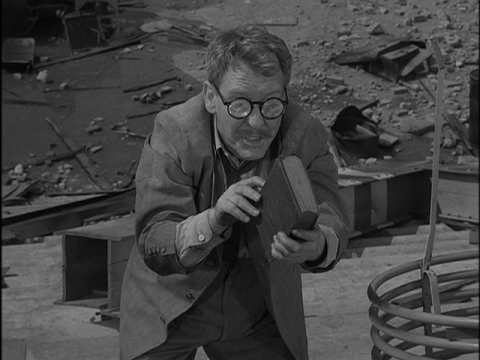
"Time Enough at Last" - The Twilight Zone
This is a big one. I'd listened to the audiodrama of "Time Enough at Last" prior to 2014, but I'd never actually gotten the chance to sit down and watch the episode all the way through. Thanks to Netflix, I could. And, boy, it's earned its reputation as one of the best episodes of television ever made for good reason.The plot of "Time Enough at Last" is pretty well known, including its infamous twist. Henry Bemis is a bank teller who just wants to read, but his bosses and wife just won't afford him the chance. Distraught, he ends up going into the vault of his bank in order to read. While in there, he ends up as the sole survivor of a nuclear attack. After learning that everyone else is dead, he falls into despair and tries to kill himself. That is, before he realizes that most of the books survived the attack and that he has enough food to last a lifetime. He decides to set up a little library for himself and spend the rest of his life reading, only for him to break his glasses and forever lose the ability to read. Life's cruel that way.
This episode has been analyzed to death, but I don't think the Internet has really taken enough time to really analyze the most important theme: the cost of anti-intellectualism to our society. Henry Bemis is written off as "a reader," but he's not just reading to read. He's trying to read the great works of the West - Dickens, Shaw, Shakespeare - and truly enjoy them. Every other person in the story lives his/her life by the clock, not taking time to read. Ultimately, Bemis proves triumphant over the naysayers by literally outliving them. Yet he too falls to the hand of the clock, as his glasses break and all he has left is time. For it's also apparent that Bemis himself is not much of an intellectual. While reading David Copperfield, he's only able to draw attention to the names of the characters and their sound rather than the significance of these characters to either the narrative at work or the broader contextual themes. He reads, but he doesn't take the time to process what he is reading. In short, if Henry Bemis is the best intellectual we have, then we are already lost. Him losing his glasses is just the final punishment for humanity for abandoning literature and the arts.
...making it slightly hypocritical that this story be best known as a television episode rather than a book... perhaps we already are doomed.
Number 2

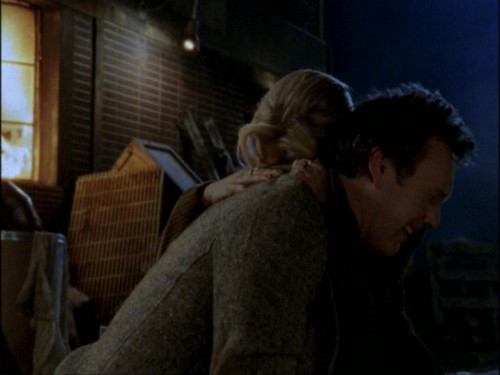
"Passion" - Buffy the Vampire Slayer
I talked about "Passion" briefly in my countdown of the best seasons of Buffy the Vampire Slayer, but this masterpiece of television deserves a more thorough review. While "Once More, with Feeling," "The Body," and "Hush" might have more critical acclaim and while "Becoming," "Graduation Day," and "The Gift" are all spectacular season finales, "Passion" is as good an episode of television as one is going to find in pretty much any show. It's Buffy the Vampire Slayer at its darkest, subtlest, most poignant, and most horrific.Prior to this episode, Buffy Summers has accidentally exorcised the soul of her vampire boyfriend, Angel, turning him back into the murderous demon, Angelus. Reluctant to kill him, she lets him live to fight another day. "Passion" is the episode in which this decision comes back to bite Buffy and her friends. Angelus begins stalking Buffy and her friends, drawing pictures of them in their sleep and killing their goldfish (no jokes here). Buffy and her friends manage to cast a spell that prevents Angelus from entering their homes, but he reveals just how Buffy exorcised his soul: having sex with Angel. This comes as quite a shock to Buffy's mother, who has a pleasantly non-condescending discussion with her daughter about the matter that's actually quite compelling. All this would be enough to make "Passion" a fairly good episode of the show.
Then things get cruel.
Jenny Calendar, a long-time friend of Buffy and romantic partner to Buffy's mentor, Giles, discovers a way to re-ensoul Angelus. She stores the information on a floppy disc (ah, the 90s), but Angelus breaks into her room and destroys most every copy of the information available. What follows is a thrilling chase scene throughout the high school, as Angelus tracks Jenny down and breaks her neck. The vampire then places Jenny in Giles's bed, all the while suggesting that she is still alive. While Buffy and her friends begin to grieve, they realize that Giles has decided to take matters into his own hands and kill Angelus himself. What ensues is the most brutal emotional and physical battle in Buffy the Vampire Slayer history.
With the existence such famous episodes under its belt as "The Body" and "Once More, with Feeling," why is "Passion" the best episode of Buffy the Vampire Slayer? The simplest reason is the precedent: no episode of Buffy the Vampire Slayer had effectively dealt with death prior to this. Even more important, no other episode of Buffy the Vampire Slayer dealt with grief before, and no other episode managed to deal with it better. While other major characters died over the course of the show, said deaths were always inevitable. In the case of "Passion," the tragedy could have wholly been prevented, and these internal issues of causality must be resolved. There's a sense of failed responsibility. It's easily the most mature exploration of violence and death in any Joss Whedon show.
What makes the violence and death of "Passion" more compelling than the violence of "Night of the Chimera's Cry" and the death of "Two Cathedrals" is the sexual/romantic edge to it. Jenny's death and the reveal of her corpse have a disturbing elegance to them that is truly unsettling. When Angelus snaps Jenny's neck, it's practically a climax for him. Likewise, Giles discovers Jenny's body after Angelus leaves a trail of rose petals leading to the corpse on the bed, alluding to the sex Jenny and Giles were planning to have earlier in the episode. While the science-based death of "Night of the Chimera's Cry" is certainly shocking, I think the death in "Passion" is a bit more harrowing. Passion and love are supposed to be good things, while science is, by nature, a straightforward process whose morality is dependent on the user. Thus, while "Night of the Chimera's Cry" merely presents a morbid narrative, "Passion" inverts a romantic narrative and transforms it into a morbid narrative. It's doing more and asks deeper questions.
Both the direction and writing of "Passion" are spectacular. Michael Gershman pushes both the camera and shadows of Buffy the Vampire Slayer to their greatest extremes, with special mentions to both the death of Jenny and Giles's attack on Angelus's compound. There's a sense of claustrophobia throughout the episode, as if there is nowhere to run from both the physical and emotional threat. The Whedon-isms are as snappy as ever. The conversations are remarkably frank and genuine. Perhaps the greatest written achievement is the monologue about the nature of passion that is laced throughout the episode. Most of the time, we believe it to be a threatening monologue from Angelus to Buffy and her friends, as if he is commenting on the passions that have dominated their lives. Yet, at the very end of the episode, there's a tone of melancholy that pierces into David Boreanaz's narration, as if Angel has returned and is now commenting on the story in retrospect. The ambiguity of the monologue makes it the most effective piece of writing on the show.
"Passion" is just about as good as an episode of television could possibly be. It's got excellent writing, superb direction, powerful acting, tight camera, brilliant atmosphere: it's the whole package. As I said before, "Passion" = perfect.
NUMBER 1

"Episode 207"/"Lonely Souls" - Twin Peaks
Let's be clear. To beat an episode like "Passion," an episode has to be either a game-changer for TV to come ("Lucy Does a TV Commercial," "Chuckles Bites the Dust," "The Contest") or a masterpiece episode with art film caliber direction. "Lonely Souls" from David Lynch's Twin Peaks manages to be both.
Hoo boy. This episode. This episode.
Twin Peaks is a show about the murder of high school prom queen Laura Palmer. When Detective Dale Cooper is called in to investigate the death, he uncovers that nearly everyone in the town is, in some way, tied into the death. No one is lacking a skeleton in the closet. Yet Twin Peaks is not just a cop drama; it's a supernatural thriller. It becomes clear that Twin Peaks is haunted by a demon of pure evil known as "Killer BOB"; BOB is a serial murderer and rapist that has haunted the Twin Peaks region for years, possessing people and making them perform acts they themselves would be horrified to do. The great question is: who has BOB possessed? "Lonely Souls" is the episode in which we find this out.
As with most episodes of Twin Peaks, "Lonely Souls" mostly focuses on Detective Cooper and his discoveries. In "Lonely Souls," he finds the one clue that has eluded him throughout the entire investigation: Laura Palmer's secret diary. The diary ends up implicating the most powerful businessman in Twin Peaks - Ben Horne - confirming Cooper's suspicion that the businessman is BOB's human host. They arrest Ben, and we believe the case to be solved. Everyone returns to the Twin Peaks' bar, One-Eyed Jacks, and watches Julee Cruise perform a song, only for a giant to appear, a figure commonly associated with death throughout the show, and claim that "it is happening again." We then discover who BOB's real host is. And the revelation breaks our hearts. I will not dare spoil this secret, but it is the very person we least want to be BOB's host.
"Lonely Souls" is ranked number one because of the final five minutes of the episode alone. This seems like a shallow reason, but these five minutes are quite possibly the most realistic and terrifying depiction of domestic violence, sexual assault, and murder in TV history. BOB's host tracks down his most recent victim and begins chasing her around the room, pursuing her in a circle. He grabs her and spins her around, kissing her as if he was a perverted animal. Time speeds up and slows down throughout the sequence, with both the murderer and victim becoming more and more inhuman throughout. Simultaneously, the camera flashes between showing BOB and the host committing the act, blurring our perception of reality and surreality. Finally, BOB kills his victim not by stabbing her and letting out inhuman amounts of blood or snapping her neck in an overly dramatized death scene. No, the victim's death is simultaneously banal and terrifying: BOB smashes her head into a picture frame, causing her to hemorrhage to death. As the victim dies, we close on the bar, with Cooper realizing that he has let another person die on his watch.
The last five minutes of "Lonely Souls" are simultaneously the most frightening and artistically accomplished minutes of television I have ever seen. As BOB wheels his victim around the room, we are reminded of the often cyclical nature of domestic violence, as some victims, out of either fear or love, let their abusers continue to abuse them. At the same time, it could be a suggestion that repeat offenses are far more frequent and terrifying in the case of sexual crimes, as they are so often ignored by the public and the police force. As time speeds up and slows down, we are reminded of the horror both from an outside and inside perspective, as the sexual violence seems to last forever for the victim, but all too short for the perpetrator. The lighting is haunting and disturbing, almost blinding in its brightness. We are looking upon the act as if we were angels, haunted by the horrors of mankind. Of course, all these ideas take on a double meaning given the knowledge of who is committing the act, as e see the relevance of all these ideas to the plot, and, more importantly, exactly what happened to Laura.
As with every episode of Twin Peaks, the writing and ambience are fantastic. The viewer constantly feels unsettled by the environment, constantly looking on in fear. The acting is superb, never over the top and never too understated. The characters are vibrant and engaging. The camera work is some of the most experimental and spectacular in television history. "Lonely Souls" is the rare episode of television that is both a masterpiece in and of itself and a game changer for other TV shows to follow. Twin Peaks and "Lonely Souls" managed to influence practically every police drama and supernatural series to follow it, and we still feel its influence today. "Lonely Souls" is the best television episode I saw this year.
It is with great joy and fear that I can say "it is happening again."
Twin Peaks is a show about the murder of high school prom queen Laura Palmer. When Detective Dale Cooper is called in to investigate the death, he uncovers that nearly everyone in the town is, in some way, tied into the death. No one is lacking a skeleton in the closet. Yet Twin Peaks is not just a cop drama; it's a supernatural thriller. It becomes clear that Twin Peaks is haunted by a demon of pure evil known as "Killer BOB"; BOB is a serial murderer and rapist that has haunted the Twin Peaks region for years, possessing people and making them perform acts they themselves would be horrified to do. The great question is: who has BOB possessed? "Lonely Souls" is the episode in which we find this out.
As with most episodes of Twin Peaks, "Lonely Souls" mostly focuses on Detective Cooper and his discoveries. In "Lonely Souls," he finds the one clue that has eluded him throughout the entire investigation: Laura Palmer's secret diary. The diary ends up implicating the most powerful businessman in Twin Peaks - Ben Horne - confirming Cooper's suspicion that the businessman is BOB's human host. They arrest Ben, and we believe the case to be solved. Everyone returns to the Twin Peaks' bar, One-Eyed Jacks, and watches Julee Cruise perform a song, only for a giant to appear, a figure commonly associated with death throughout the show, and claim that "it is happening again." We then discover who BOB's real host is. And the revelation breaks our hearts. I will not dare spoil this secret, but it is the very person we least want to be BOB's host.
"Lonely Souls" is ranked number one because of the final five minutes of the episode alone. This seems like a shallow reason, but these five minutes are quite possibly the most realistic and terrifying depiction of domestic violence, sexual assault, and murder in TV history. BOB's host tracks down his most recent victim and begins chasing her around the room, pursuing her in a circle. He grabs her and spins her around, kissing her as if he was a perverted animal. Time speeds up and slows down throughout the sequence, with both the murderer and victim becoming more and more inhuman throughout. Simultaneously, the camera flashes between showing BOB and the host committing the act, blurring our perception of reality and surreality. Finally, BOB kills his victim not by stabbing her and letting out inhuman amounts of blood or snapping her neck in an overly dramatized death scene. No, the victim's death is simultaneously banal and terrifying: BOB smashes her head into a picture frame, causing her to hemorrhage to death. As the victim dies, we close on the bar, with Cooper realizing that he has let another person die on his watch.
The last five minutes of "Lonely Souls" are simultaneously the most frightening and artistically accomplished minutes of television I have ever seen. As BOB wheels his victim around the room, we are reminded of the often cyclical nature of domestic violence, as some victims, out of either fear or love, let their abusers continue to abuse them. At the same time, it could be a suggestion that repeat offenses are far more frequent and terrifying in the case of sexual crimes, as they are so often ignored by the public and the police force. As time speeds up and slows down, we are reminded of the horror both from an outside and inside perspective, as the sexual violence seems to last forever for the victim, but all too short for the perpetrator. The lighting is haunting and disturbing, almost blinding in its brightness. We are looking upon the act as if we were angels, haunted by the horrors of mankind. Of course, all these ideas take on a double meaning given the knowledge of who is committing the act, as e see the relevance of all these ideas to the plot, and, more importantly, exactly what happened to Laura.
As with every episode of Twin Peaks, the writing and ambience are fantastic. The viewer constantly feels unsettled by the environment, constantly looking on in fear. The acting is superb, never over the top and never too understated. The characters are vibrant and engaging. The camera work is some of the most experimental and spectacular in television history. "Lonely Souls" is the rare episode of television that is both a masterpiece in and of itself and a game changer for other TV shows to follow. Twin Peaks and "Lonely Souls" managed to influence practically every police drama and supernatural series to follow it, and we still feel its influence today. "Lonely Souls" is the best television episode I saw this year.
It is with great joy and fear that I can say "it is happening again."

.jpg)
